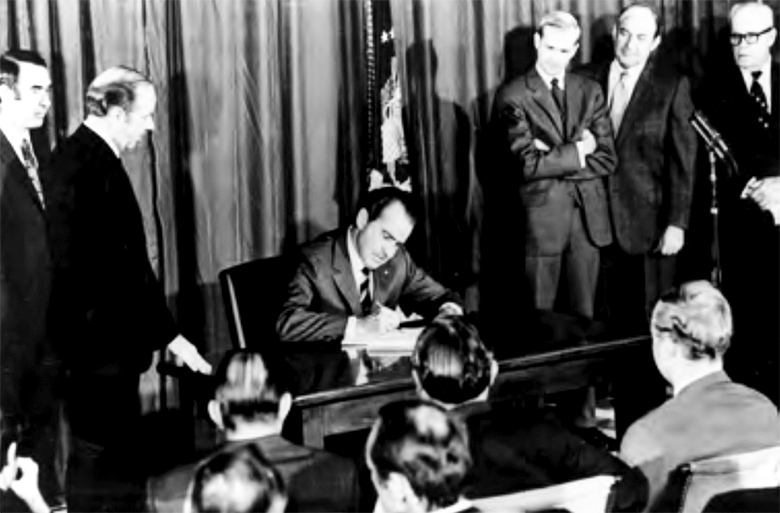
The signing photograph makes the Occupational Safety and Health Act look like one decisive act by one president. Richard Nixon sits at a desk on December 29, 1970, pen poised, while legislators, labor leaders, business representatives, and federal officials close the space behind him. Everyone fits inside the frame. The conflict does not.
Read the statute instead of the ceremony and a different achievement comes into view. Congress did not merely create the Occupational Safety and Health Administration, hand it a rulebook, and declare workplaces safe. It built a chain with distinct jobs: someone had to produce knowledge about hazards; someone had to turn that knowledge into standards and inspect workplaces; and someone outside the enforcement agency had to hear contested cases. The chain was deliberately federal without being wholly centralized, because states could run approved programs of their own.[1][3]
That divided design is the OSH Act's most durable public-health idea. A dangerous workplace was no longer only the site of an accident, a private compensation claim, or a state inspector's local concern. It became a place where exposure could be investigated, risk translated into a public standard, an employer ordered to correct a hazard, and the government's case tested in an independent forum. The law did not guarantee that every link would move quickly. It made each link visible.
The harmony in the photograph came last
The Department of Labor's history describes a three-year legislative fight, not a sudden consensus. President Lyndon Johnson proposed a comprehensive federal program in January 1968, arguing that fragmented laws, weak enforcement, lagging research, and shortages of trained personnel could not keep pace with industrial hazards. His bill never reached a vote. Later that year, the Farmington mine explosion in West Virginia trapped 78 miners underground; the disaster helped produce a separate coal-mine law in 1969 and added force to the demand for broader protection.[2][4]
The argument was not simply safety versus indifference. The parties disputed where power should sit. Proposals divided over whether standards and enforcement belonged under the Secretary of Labor or an independent board, how much authority federal inspectors should have, how states would participate, and whether the body issuing citations should also judge disputes. The final Williams-Steiger Act placed standard-setting and enforcement in the Labor Department but created a separate review commission. Nixon signed it on December 29, 1970; the new system began operating in 1971.[2][4]
The photograph therefore captures the end of bargaining, not the disappearance of disagreement. Its crowded composition is almost a preview of the statute: labor, management, Congress, the executive branch, researchers, inspectors, states, and adjudicators would all remain in the system after the pens were put away.[2][6]
Section 2 is a blueprint, not a slogan
The Act's famous purpose appears in Section 2: to assure, “so far as possible,” safe and healthful working conditions for every working man and woman and to preserve human resources. The qualifying phrase matters. It makes the goal expansive without pretending that a signing ceremony abolishes risk.[1]
Congress then explains how the goal is supposed to become administrative reality. Section 2 does not name a single instrument. It calls for employer and employee efforts, enforceable standards, an effective inspection program, research into occupational safety and health, medical examinations, training, occupational-health personnel, reporting and recordkeeping, statistical programs, state plans, and attention to injuries and illnesses that may develop slowly. The list reads less like the charter of one agency than the specification for an evidence system.[1]
That breadth also corrects a common visual shorthand. OSHA became the recognizable name on posters, citations, and hard hats, but the statute's object was not an agency called OSHA. Its object was a condition—work that did not exact preventable injury or disease—and its chosen method was to distribute the work of reaching that condition.
Section 5 creates a floor and a rulebook
Section 5 gives employers two connected duties. The first is general: provide employment and a workplace free from recognized hazards causing or likely to cause death or serious physical harm. The second is specific: comply with occupational safety and health standards issued under the Act.[1]
Those clauses solve different problems. A specific standard can prescribe what must be controlled and make compliance more predictable. But a rulebook is always written after knowledge has accumulated, while dangerous work changes with materials, processes, and machines. The general duty clause supplies a floor where no specific standard fits. Its words are narrower than a promise of perfect safety: the hazard must be recognized, and the threatened harm must be serious. A citation still requires a case, not merely the observation that all work contains risk.[1][3]
The pair also turns prevention upstream. Earlier systems often encountered workplace harm after an injury, through compensation or litigation. Section 5 makes the condition of work itself the object of a continuing duty. The question is no longer only who pays after a worker is hurt. It is whether a recognized serious hazard should have remained in the workplace at all.
Evidence cannot enforce itself
The law's institutional split is clearest when its research provisions are read beside its enforcement provisions.
Under Sections 6, 8, 9, and 10, the Secretary of Labor can promulgate standards, inspect workplaces, investigate conditions, require records, issue citations, and begin the enforcement process that follows an alleged violation. Section 20 assigns a different kind of authority to the health side of government: research, experiments, demonstrations, criteria for standards, toxicological work, training, and on-site evaluations of possible hazards. That research mandate became the National Institute for Occupational Safety and Health, or NIOSH.[1][3]
The difference is functional, not cosmetic. OSHA can compel and cite; NIOSH studies and recommends. Research can identify a dose-response relationship, develop a sampling method, or describe how a process exposes workers. It does not, by itself, create an enforceable limit. Conversely, an inspector cannot make an emerging hazard scientifically legible by issuing a citation. Evidence has to travel from observation to criteria, from criteria to a standard or a general-duty case, and from the legal requirement to actual control in a workplace.
This separation can slow action, but combining the jobs would not make the underlying questions vanish. How much exposure causes harm? Is a control technically feasible? Does a specific workplace violate a legal duty? Those are different questions with different kinds of proof. The Act's architecture admits as much.[1][3]
Enforcement cannot judge itself
Congress created another separation in Section 12: the Occupational Safety and Health Review Commission. It is independent of OSHA and the Department of Labor. When an employer contests a citation or penalty—or when an employee or representative contests the time allowed for abatement—the dispute enters a process before an administrative law judge, with possible review by the three-member commission.[1][5]
This is not a decorative appeals desk. Inspection and adjudication require different postures. OSHA enters a workplace, gathers evidence, selects the standard or duty it believes applies, and alleges a violation. The Review Commission asks whether that allegation survives an adversarial record. Its independence gives employers and affected workers a forum outside the agency that brought the case.[5]
The separation also clarifies what a citation is: an enforcement claim, not a final historical fact. A functioning prevention system needs inspectors able to act, but durable authority also needs a place where the government's proof, classification, penalty, and correction deadline can be challenged.
Federal did not mean uniform
The Act responded to a patchwork of state laws, yet it did not simply erase the states. Section 18 permits a state to assume responsibility for occupational-safety and health standards under a federally approved plan. The legal threshold is comparative: the state program must be “at least as effective” as the federal program. Federalism remains, but a national floor constrains it.[1][3]
Nor did the phrase “every working man and woman” describe literal universal coverage. The statute excludes working conditions regulated by certain other federal agencies; its definition of employer does not simply pull every self-employed person or every state and local public employee into federal OSHA. Approved state plans can extend coverage to public workers, and sector-specific regimes govern areas such as mining. The aspiration is broad; the jurisdiction is bounded.[1][2][3]
This boundary is essential to a close reading because anniversary language can make the Act sound like a single shield over all work. It is better understood as a framework that assigns responsibility—and therefore also reveals gaps. When a worker, hazard, or employer falls outside one route, the question becomes which institution, if any, holds the next link.
Progress is not proof of one cause
NIOSH's historical account estimates that about 14,000 workers died on the job in 1970. By 2018, the figure was about 5,000, even though the working population had grown to roughly 155 million, almost twice its 1970 size.[4] The comparison gives scale to the change, but it is not a clean experiment on the Act. Industry mix, technology, emergency medicine, reporting, state law, union pressure, employer practice, sector-specific regulation, and the long decline of some dangerous jobs all changed too. Occupational diseases with long latency are also much harder to count than traumatic deaths.
The defensible claim is narrower and more important. After 1970, a comprehensive federal statute made recognized serious hazards an employer duty, authorized national standards and inspections, established a permanent research function, required records, admitted state programs under a federal effectiveness test, and created an independent venue for disputed enforcement. Those are mechanisms through which prevention can happen; the fatality trend alone cannot tell us how much each mechanism contributed.[1][3][4]
That distinction follows the statute's own logic. The OSH Act does not say that good intentions cause safety. It builds institutions that can turn observation into evidence, evidence into duties, duties into inspections and corrections, and contested government action into a reviewable record.
The chain is the legacy
Look again at the signing photograph and the desk seems too small for what was signed there. The Act had to hold scientific uncertainty, federal power, state variation, employer obligations, worker participation, inspections, penalties, and due process in one system. It did so by refusing to make one office perform every role.
That design is also a diagnostic tool. When workplace protection fails, ask where the chain broke. Was a hazard not studied? Was the evidence never converted into a standard? Was a recognized danger left uncorrected? Did an inspection never occur? Did a citation fail for lack of proof? Did jurisdiction stop at the wrong boundary? The questions are more useful than treating “OSHA” as either a magic word or a single bureaucratic obstacle.
The ceremonial image records a law's birth. The text records its harder insight: prevention is not one command. It is a sequence of public responsibilities, and every handoff matters.
Sources
- Office of the Law Revision Counsel, U.S. House of Representatives, United States Code, Title 29, Chapter 15: Occupational Safety and Health, 2024 edition — current official codification of the Act's purpose, coverage, duties, standards, inspections, citations, enforcement, review, state plans, and research authority.
- Judson MacLaury, “The Job Safety Law of 1970: Its Passage Was Perilous,” U.S. Department of Labor, originally published in Monthly Labor Review, March 1981 — official institutional history of the 1968–1970 proposals, conflicts, compromise, and signing.
- Jimmy Balser, The Occupational Safety and Health Act of 1970 (OSH Act): A Legal Overview, Congressional Research Service R48292, December 6, 2024 — current legal synthesis of coverage, duties, standard-setting, enforcement, adjudication, and state plans.
- Cheryl Lynn Hamilton, “The OSH Act—A Response to Workplace Tragedies,” CDC/NIOSH, November 23, 2021 — Farmington chronology, pre-Act fatality context, later workforce and fatality comparison, and the creation of OSHA and NIOSH.
- Occupational Safety and Health Review Commission, “How OSHRC Works” — official explanation of the commission's independence, parties, contest process, hearing level, and commission review.
- Wikimedia Commons, “President Nixon signing the Occupational Safety and Health Act of 1970,” U.S. Department of Labor photograph, December 29, 1970 — archival image record and provenance.