Victorian surgery is often remembered through a single heroic breakthrough. Depending on the retelling, that breakthrough is ether, because it removed agony from the operating table, or Lister, because it made infection less likely after the knife had done its work. The stronger history keeps both moments apart long enough to see what each actually changed. Ether and antisepsis did not solve the same problem. They removed different bottlenecks on different clocks. In 1846, ether anesthesia made it possible for surgeons to operate without pain setting the pace of every move. In the later 1860s, Listerian antisepsis attacked the other killer that still waited in the ward after a technically successful operation: putrefaction, erysipelas, pyaemia, and the wider hospital ecology of wound infection.[1][2][4][5][6]
That distinction matters because it corrects a common flattening. If ether is treated as the whole revolution, Victorian surgery looks suddenly modern as soon as patients stop screaming. If antisepsis is treated as the whole revolution, the earlier anesthesia breakthrough can look like mere comfort. The source record supports a harsher and more useful view. Surgery only became more governable when both thresholds were crossed: first pain control, then infection control.[1][3][4][5]
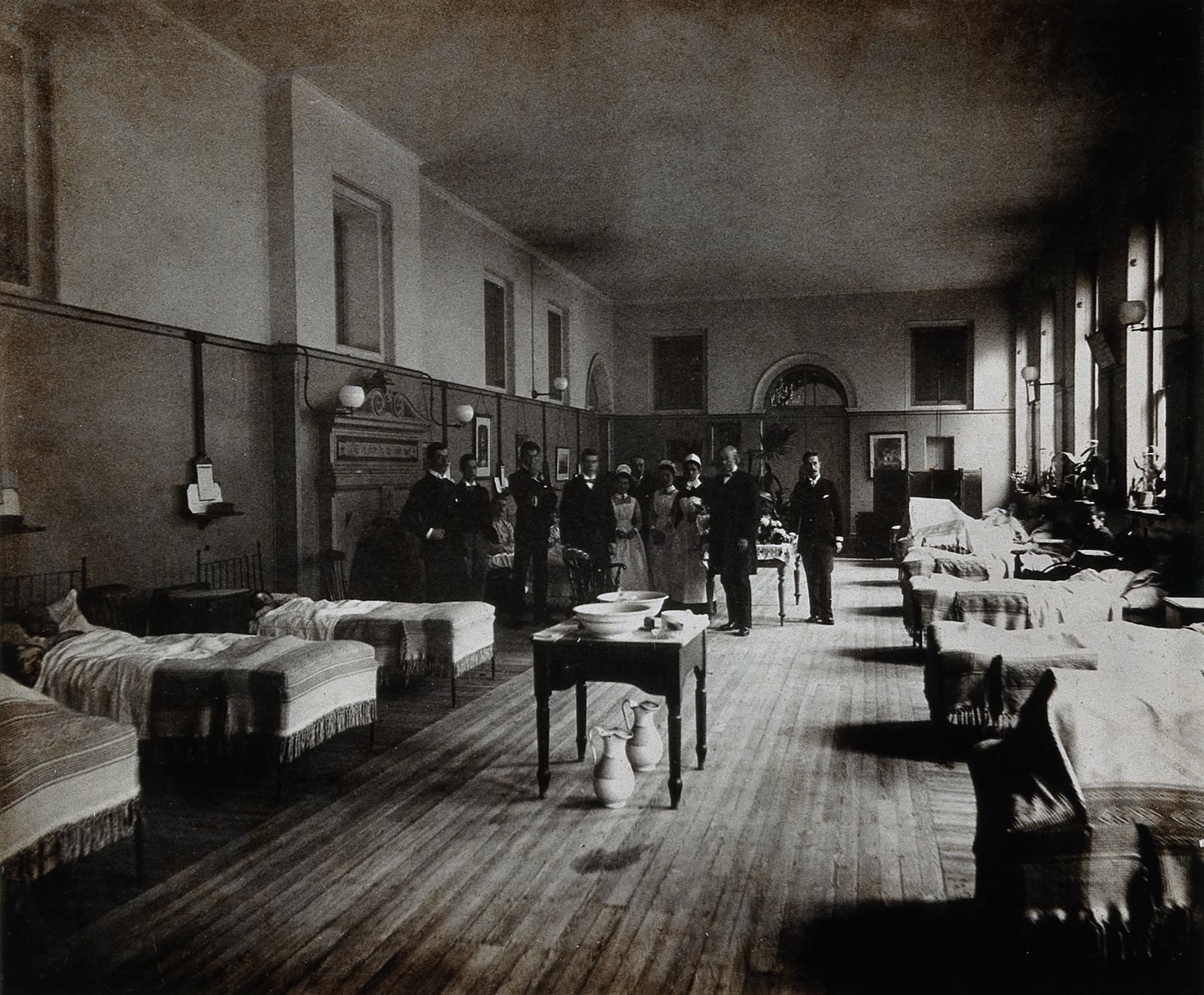
Image context: the cover uses a real 1890 hospital photograph of Joseph Lister with assistants in the Victoria ward at King's College Hospital.[7] It belongs here because this article is less interested in one famous incision than in the hospital setting that had to absorb its consequences. The comparison only becomes clear when the operating act and the ward afterlife are kept in the same frame.
Timeline anchors before interpretation
- October 16, 1846: William T.G. Morton demonstrated ether anesthesia in Massachusetts General Hospital's surgical amphitheater, later known as the Ether Dome.[1]
- Late 1846: Boston's public ether demonstration moved quickly into publication, imitation, and wider surgical adoption, turning anesthesia from a local event into a professional signal.[2]
- August 12, 1865: Lister treated the compound-fracture case of James Greenlees in Glasgow, a key early antiseptic case later folded into his broader method.[6]
- March to July 1867: Lister's six Lancet papers made the antiseptic principle public as a repeatable surgical method rather than a private ward habit.[4][6]
- 1870: Lister's "salubrity of a surgical hospital" paper shifted the claim from selected cases to hospital-level mortality and ward climate.[5]
1. Ether changed the minute of the operation
The first threshold was immediate and bodily. Before anesthesia, surgery had to race pain. The operating theatre was not yet a calm sterile room; it was a place where speed, physical restraint, and tolerable duration shaped what could be attempted.[1][3] The Mass General museum page makes the 1846 hinge explicit: Morton's demonstration on October 16, 1846 was the first public surgery using ether in the amphitheater now called the Ether Dome.[1] That date matters not only because it is ceremonial. It marks the moment when a patient could be kept insensible long enough for the surgeon's technical choices to be governed less by screaming time and more by anatomy and intention.
The Wellcome essay on operating theatres helps recover how dramatic that shift was.[3] Public surgery before modern anesthesia belonged partly to spectacle and partly to ordeal. Audiences gathered in tiered spaces because the operation itself was a visible test of nerve, speed, and stamina. When pain ceases to dictate every second, the operation changes character even if nothing else has yet improved. Surgeons can slow down. Assistants can coordinate differently. More intricate procedures become thinkable. The patient stops being a clock made of suffering.[1][3]
This is why ether deserves its own threshold rather than a brief prelude in a longer infection story. It changed what surgery could look like while it was happening. That is already a revolution, and the speed of dissemination confirms it. The Mass General history guide frames the Boston demonstration as a moment that quickly entered the professional literature and the broader medical imagination, making anesthesia a portable practice rather than a local curiosity.[2]
2. Ether did not solve the hospital that waited afterward
Yet pain relief did not secure postoperative survival by itself. A patient could undergo a calmer operation and still die days later from wound infection in a crowded ward. This is the point modern memory often underestimates because the dramatic scene belongs to the operating table, while sepsis belongs to the slower, less theatrical aftermath.
Lister's own 1867 and 1870 writings, read beside later historical analysis, show why the second threshold had to be treated separately.[4][5][6] The practical enemy was not pain but putrefaction. Compound fractures, abscesses, and surgical wounds remained vulnerable once tissue was opened to the environment. A surgeon could cut accurately and still lose the patient to processes that seemed to ignite only after the operation had succeeded mechanically.[4][6]
The Royal College of Surgeons summary compresses the old ward reality bluntly: roughly one in four patients on surgical wards died from infection before the antiseptic turn took hold.[6] That figure explains why anesthesia alone could not be allowed to stand for surgical modernity. It removed a governing constraint on the procedure itself, but it did not yet remove the microbial tax charged afterward.
3. Lister changed the denominator from the case to the ward
Lister's antiseptic principle mattered because it widened the surgeon's zone of responsibility. In the 1867 paper, he argued that the wound had to be protected from the external causes of putrefaction.[4] That sentence can be read too narrowly as a chemical recommendation about carbolic acid. The larger move was operational. Dressings, drainage, contact, exposure, and the handling of tissue all became part of the surgical act. The procedure no longer ended when the final cut was closed. It extended into the management of contamination risk.[4][6]
Claire Jones's study is especially useful here because it restores the developmental sequence.[6] Lister did not publish one lucky case and declare victory. He treated James Greenlees in 1865, kept working, refined the method, and then published a run of papers in 1867 once he believed the practice had repeated enough times to support general argument.[6] That is a different kind of threshold from ether. Morton's public demonstration was dramatic and punctual. Lister's advance was slower, built from accumulation, adjustment, and ward discipline.
The 1870 salubrity paper pushed the claim outward from a few memorable wounds to the whole surgical environment.[5] Lister argued that antiseptic practice altered the health character of the ward itself. The Royal College summary preserves the most striking numbers attached to that shift: before antiseptic treatment, from 1864 to 1866, about 46% of Lister's surgical patients died; from 1867 to 1870, after antiseptic practice was introduced, the figure fell to about 15%.[5][6] Historians read nineteenth-century denominators cautiously, but the directional force is unmistakable. Ether changed the operation's tempo. Antisepsis changed the operation's afterlife.
4. The comparison is really about two different definitions of surgical success
Placed side by side, the two breakthroughs illuminate one another. Ether answered the question: can the body be opened without pain governing the knife? Antisepsis answered the later question: once the body has been opened, can the wound survive the ward?[1][4][5][6] These are related questions, but they are not interchangeable.
That is why the chronology matters so much. A calmer operation in 1846 did not mean a safer hospital in 1846. Likewise, when Lister's method began to work in the later 1860s, it did not erase what anesthesia had already done for operative possibility. The two changes belong to different parts of the surgical chain. One widened what could be attempted; the other widened what could be survived.
Seen this way, Victorian surgery did not modernize in one leap. It crossed one threshold when pain ceased to be the operation's ruling timer. It crossed another when infection came to be treated as an operative variable rather than a ward fate. That double threshold is harder to memorize than one miracle date, but it is much closer to how medical change usually happens.
The strongest two interpretations
Interpretation A: ether was the true revolution, because without anesthesia modern surgery is unimaginable
This reading gets one major fact right. Ether transformed the experience and feasibility of surgery in a way that was immediate, public, and impossible to ignore.[1][2][3] Once pain no longer dictated every second, a new range of procedures became conceivable.
What it misses is the ward problem. A technically better operation could still feed into the same lethal infection ecology. Pain control widened possibility; it did not yet secure survival.[3][5][6]
Interpretation B: antisepsis was the decisive revolution, because painless surgery without infection control was still too dangerous
This reading gets the postoperative reality right. Lister's method attacked the slower killer that made successful cutting collapse into septic decline, and his ward-level mortality argument shows why infection control changed surgical credibility so deeply.[4][5][6]
What it misses is that antisepsis built on a world already altered by anesthesia. Surgeons could only exploit the finer technical possibilities of later nineteenth-century practice because pain had first ceased to be the operation's governing pace.[1][2]
What the comparison still teaches
The most useful conclusion is that ether and antisepsis belong to one history but not to one function. Ether made surgery more bearable in the moment. Antisepsis made it more survivable across the days that followed.[1][4][5][6] When those achievements are collapsed into a single triumphal story, the mechanism of change disappears. When they are separated, Victorian surgery becomes easier to understand and modern medicine becomes easier to recognize. Technical progress rarely arrives as one total solution. It arrives by removing one bottleneck, then discovering the next one waiting behind it.
That is why the nineteenth-century operating room still reads clearly in 2026. The hardest improvements often do not replace earlier breakthroughs; they reveal the problem those breakthroughs had left behind. Ether exposed the hospital after pain. Lister exposed the wound after applause. Modern surgery needed both.
Sources
- Massachusetts General Hospital Russell Museum, "The Ether Dome at Mass General" - museum overview of the October 16, 1846 demonstration and the amphitheater's later history.
- Massachusetts General Hospital Library, "Ether - History of Massachusetts General Hospital" - historical guide on the 1846 demonstration, early publication, and dissemination context.
- Wellcome Collection, "The original drama of operating theatres" - background on premodern and early modern operating-theatre culture, public surgery, and the bodily ordeal that anesthesia interrupted.
- Joseph Lister, "On the Antiseptic Principle in the Practice of Surgery" (British Medical Journal, 1867) - Lister's own public statement of the antiseptic principle, via PMC.
- Joseph Lister, "Effects of the antiseptic system of treatment upon the salubrity of a surgical hospital" (Lancet, 1870) - Lister's ward-level mortality argument, via the James Lind Library.
- Claire L. Jones, "Joseph Lister and the performance of antiseptic surgery" (Notes and Records of the Royal Society, 2013) - chronology from James Greenlees through the 1867 publication sequence and the wider staging of antiseptic practice, via PMC.
- Wikimedia Commons / Wellcome Collection, "File:Lister and his assistants in the Victoria ward, King's Colle Wellcome V0027908.jpg" - source page for the 1890 hospital photograph used as the article image.