Trans fat is often remembered as though it were caught in one clean moment: science exposed a harmful ingredient, regulators stepped in, and packaged food quietly moved on.[1][3][4] The real history is slower and more revealing. Industrial trans fat first spread because it solved practical problems that food manufacturers cared about deeply. Partial hydrogenation helped turn liquid oils into semisolid fats, extended shelf life, stabilized deep-frying, and gave bakeries and processed-food companies a reliable texture they could reproduce at scale.[3][4] Only later did the same ingredient stop looking like a clever industrial upgrade and start looking like a population-wide cardiovascular exposure.
That sequence matters because the downfall of trans fat was not driven by consumer virtue alone. It took several different systems moving in order: laboratory work showing how these fats changed lipoproteins, cohort studies linking intake to coronary disease, front-of-pack labeling that made reformulation visible, and finally a regulatory decision aimed at the ingredient class that carried most artificial trans fat into the food supply.[1][2][3][4] The result was less a moral conversion than a long dismantling of a default.
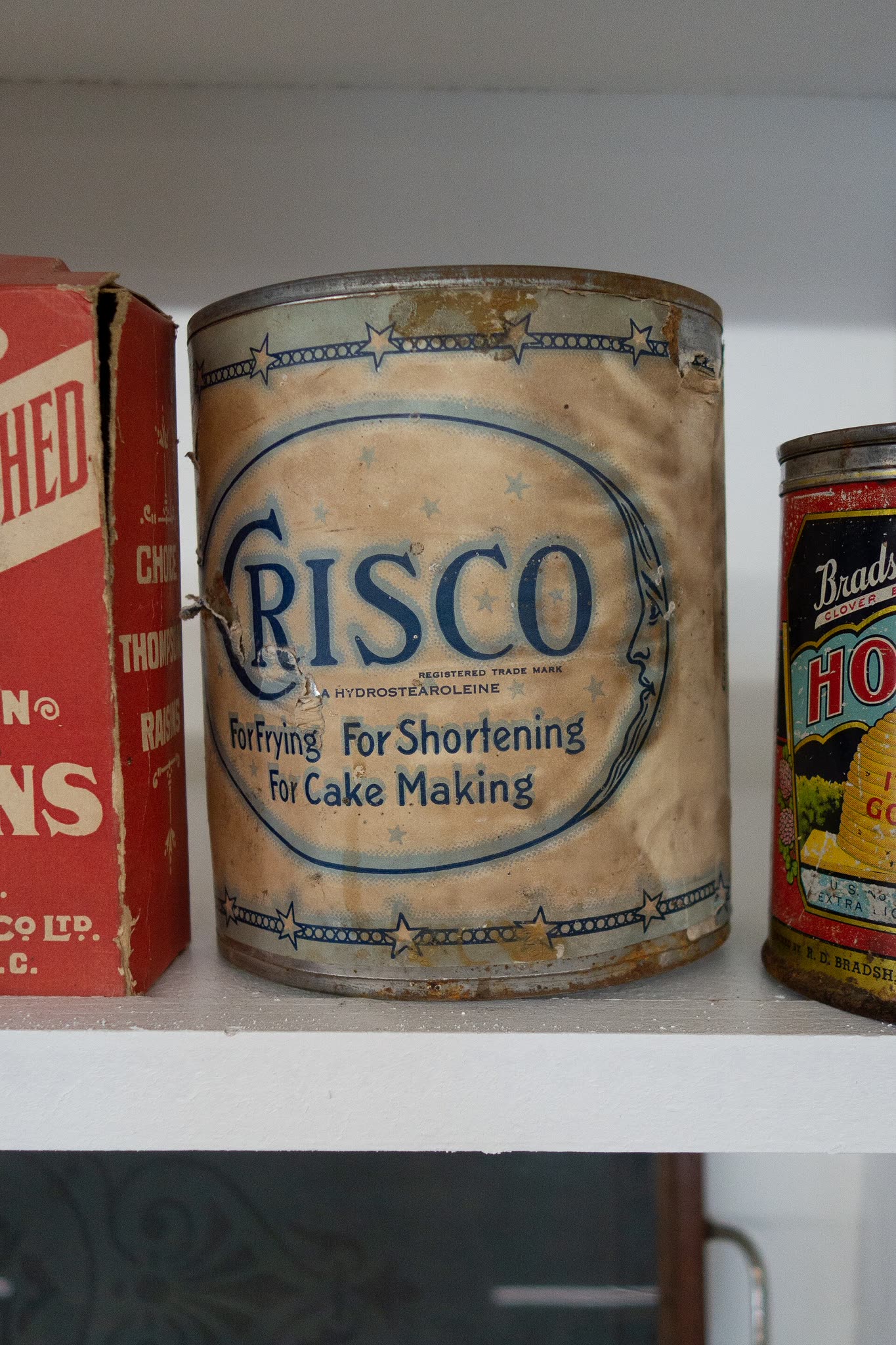
Image context: the lead image shows an antique Crisco tin photographed in 2018 and preserved on Wikimedia Commons. It fits this article because Crisco was one of the most recognizable early consumer faces of partially hydrogenated shortening: a kitchen artifact that made industrial chemistry look ordinary, useful, and modern before the health costs were widely understood.[6]
Timeline anchors before the argument
- 1901: chemist Wilhelm Normann developed the industrial hydrogenation process that could turn liquid oil into solid fat.[3][4]
- 1911: Crisco reached U.S. stores as the first shortening made entirely from partially hydrogenated oil.[4][6]
- 1950s: controlled studies began showing that trans fat raised serum cholesterol in worrying ways.[4]
- 1990: controlled feeding evidence and the broader policy literature made it harder to treat trans fat as metabolically interchangeable with other fats.[3][4]
- January 2006: FDA required trans fat disclosure on the Nutrition Facts label in the United States.[1][3]
- June 16, 2015: FDA issued its final determination that partially hydrogenated oils were no longer generally recognized as safe.[1]
- June 18, 2018: the main U.S. compliance date arrived for removing most uses of PHOs, with limited petitioned uses extended to June 18, 2019 and distribution of those foods to January 1, 2021.[1]
- End of 2023: WHO reported that 53 countries had best-practice industrial trans fat policies covering 3.7 billion people, or about 46% of the world population.[5]
1. Why hydrogenation first looked like progress
The rise of industrial trans fat makes little sense if it is told only as a nutrition mistake. Its first success was logistical. Partial hydrogenation gave manufacturers a fat that behaved more like butter, lard, and tropical oils while still drawing on cheaper vegetable-oil inputs.[3][4] In practical terms, that meant solidity at room temperature, greater resistance to rancidity, and stronger performance in repeated commercial frying.[3] Those were not cosmetic gains. They changed storage, shipping, texture, and labor predictability across bakeries, snack production, restaurant fryers, and packaged goods.
The chemistry itself helps explain the appeal. In the hydrogenation process, some unsaturated fatty acids become saturated, while others are pushed into a trans configuration; one major review notes that partial hydrogenation can alter roughly 30% to 50% of the unsaturated fats in the oil.[3] The food industry was therefore not handling a tiny contaminant. It was building a new fat profile on purpose because the resulting ingredient performed so well in mass production.
That is why the early consumer story matters. Crisco was not introduced as a suspicious additive hidden in the shadows of food technology. It was introduced as a clean, modern, convenient shortening.[4][6] The shelf-stable miracle came wrapped in domestic usefulness. Once that happened, industrial trans fat stopped being merely a manufacturing intermediate and became a normal part of everyday eating.
2. The evidence did not topple trans fat all at once
The long middle of this story is where public memory tends to flatten things. The problem with industrial trans fat was not that one dramatic paper suddenly proved it toxic. The problem was that multiple evidence layers kept pointing in the same direction.[3][4]
The first doubts arrived through lipid studies in the 1950s, when controlled experiments showed that trans-containing fats affected serum cholesterol in ways that did not look benign.[4] Later clinical and epidemiologic work deepened the case. Reviews gathered evidence that trans fat raises LDL cholesterol, lowers HDL cholesterol, and exerts additional adverse effects that extend beyond a simple one-number story about total cholesterol.[3] That made industrial trans fat especially damaging from a policy perspective. It was not merely an excess-calorie problem or a case of people eating too much fried food in general. It was an ingredient that worsened the biological risk profile of the foods carrying it.
By the early 1990s, the historical review in The Milbank Quarterly describes the evidence base as strong enough that public-health advocates could start translating it into concrete reform demands.[4] This shift mattered because it turned a scientific concern into an administrative question. Once harm could be linked to a discrete, manufactured input, regulators no longer had to treat the problem as vague dietary behavior beyond the reach of ingredient policy.
The scale of exposure also kept the stakes high. The same historical review notes that artificial trans fat in the U.S. food supply was estimated in 2006 to contribute to as many as 250,000 heart attacks and 50,000 deaths each year.[4] Whether one uses the high end or the more conservative readings, the structure of the problem was plain by then: a deliberately engineered ingredient had acquired population-level consequences.
3. Labeling changed the politics because it changed the unit of attention
The Nutrition Facts label did not remove industrial trans fat by itself, but it changed the fight. Before front-of-pack disclosure, artificial trans fat could remain buried inside ingredient systems and invisible to most shoppers.[2][4] Once FDA required declared trans fat content on labels in January 2006, reformulation pressure no longer came only from journals, hearings, or public-health groups. It also came from the mundane embarrassment of a number that competitors could shrink or eliminate.[1][3]
That shift is easy to underrate because labels look passive. In practice, they changed the unit of attention from food chemistry to shelf comparison. Food companies did not have to be persuaded all at once that trans fat was a moral problem. They had to deal with the new fact that trans fat could now appear as a visible liability attached to a branded product line.[2][4]
The label rule had limits. Foods under 0.5 g of trans fat per serving could still be listed as zero, which meant small serving sizes could soften the appearance of exposure.[3] Yet even with that loophole, disclosure mattered because it accelerated reformulation and made the ingredient harder to defend publicly.[2][3][4] The historical review shows the size of that effect in ordinary products: items that once carried several grams per serving later fell to zero or near zero after labeling and reformulation pressure accumulated.[4]
4. The decisive turn came when FDA targeted PHOs as an ingredient class
The deepest policy move was not a bigger warning label. It was FDA's decision in 2015 to determine that partially hydrogenated oils were no longer generally recognized as safe.[1] That phrasing sounds technical, but its importance is straightforward. The agency was no longer asking consumers to manage exposure one purchase at a time. It was telling manufacturers that the primary dietary source of artificial trans fat had lost its ordinary place in food production.[1]
This also explains why the rule was more precise than the shorthand phrase "trans fat ban" suggests. FDA's action was aimed at partially hydrogenated oils, which it identified as the primary dietary source of artificial trans fat in processed foods.[1] It did not erase naturally occurring trans fat in meat and dairy, and it did not claim that every molecule labeled trans had the same policy status.[1][2] The target was the industrial formulation pathway that had put artificial trans fat at scale into packaged and restaurant foods.
The compliance dates show how structural the fix had to be. For most uses, manufacturers had until June 18, 2018 to stop adding PHOs, while certain petitioned uses received a limited extension to June 18, 2019, and already-manufactured foods could continue through distribution until January 1, 2021.[1] This was supply-chain surgery, not a symbolic declaration. The government had to give time for reformulation, inventory turnover, and orderly exit from an ingredient architecture that had been normal for decades.
5. The afterlife of the story is global, not nostalgic
It would be comforting to treat trans fat as a completed American health-policy story. WHO's more recent work shows why that reading is too local.[5] In its 2024 milestone report covering progress through the end of 2023, WHO said that 53 countries had best-practice industrial trans fat policies protecting 3.7 billion people, or 46% of the world population.[5] That is major progress, but it also means trans fat elimination remains an unfinished global public-health project.
This is the final lesson of the chronology. Industrial trans fat did not disappear merely because science was right. It retreated where governments and manufacturers rewired the default ingredient environment.[1][4][5] The successful intervention was not a lecture about personal discipline. It was a redesign of what ordinary food production was allowed to contain.
That is why trans fat still matters as a model. The rise of PHOs shows how quickly a useful industrial convenience can become embedded in daily life before long-term health effects are fully reckoned with.[3][4] The fall of PHOs shows the reverse: when a harmful exposure is tightly tied to an ingredient class, public-health progress can move fastest when policy acts upstream, where recipes, procurement, and manufacturing norms are set. Industrial trans fat stopped looking invincible the moment it was no longer treated as an inevitable feature of cheap modern food.
Sources
- U.S. Food and Drug Administration, "Final Determination Regarding Partially Hydrogenated Oils (Removing Trans Fat)" - FDA summary of the 2015 determination, the 2006 labeling requirement, and the 2018/2019/2021 compliance timeline.
- U.S. Food and Drug Administration, "Changes to the Nutrition Facts Label" - FDA explanation of the modern label, including why trans fat remains listed and how the 2015 PHO determination relates to labeling.
- Mozaffarian D, Aro A, Willett WC, "Trans Fatty Acids: Effects on Cardiometabolic Health and Implications for Policy" (Prostaglandins, Leukotrienes and Essential Fatty Acids, 2009; PMCID available) - review of the chemistry, lipid effects, and labeling-policy context of industrial trans fat.
- Amico A, Harris JL, Mozaffarian D, et al., "The Demise of Artificial Trans Fat: A History of a Public Health Achievement" (The Milbank Quarterly, 2021; PMCID available) - historical account of hydrogenation, Crisco, evidence accumulation, labeling, advocacy, and the PHO phaseout.
- World Health Organization, "WHO 5-year milestone report on global trans fat elimination illustrates latest progress up to 2023" (June 24, 2024) - WHO progress update on best-practice policies and global population coverage.
- Wikimedia Commons, "File:Antique Crisco shortening tin (30307979107).jpg" - source page for the photographed antique Crisco tin used as the lead image.