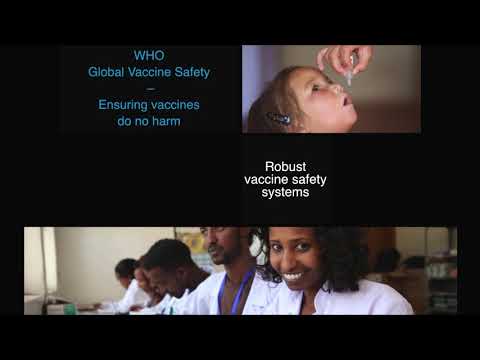
WHO's 2019 short "WHO works to ensure vaccinations are safe" lasts only two and a half minutes, but it makes one unusually disciplined move.[1] It does not try to defend vaccination with a generic slogan about trust. Instead it frames trust as a systems problem. A parent brings a child for a shot expecting three things at once: a safe product, correct administration, and a health system able to notice quickly when something goes wrong after vaccination.[1]
That distinction matters because vaccine safety is often discussed as if it were mainly a communications problem. The WHO clip points somewhere harder and more useful. Safety depends on classification, reporting, investigation, and feedback.[1][2][3] If a child develops fever, faints, or lands in hospital after immunization, the first technical question is not "Do we have confidence?" It is "What kind of event is this, and what evidence chain should follow from it?"[2][3]
WHO's longer manuals and CDC's monitoring pages make the architecture behind the short video much more legible. WHO's AEFI surveillance guidance treats safety as a cycle: detect an event, document it, investigate what happened, assess causality, communicate clearly, and feed the result back into program decisions.[2][3] CDC's system pages show the U.S. version of that same layered logic: passive reporting for early warnings, active follow-up with electronic health record data, and multiple complementary systems rather than one all-knowing dashboard.[4][5][6]
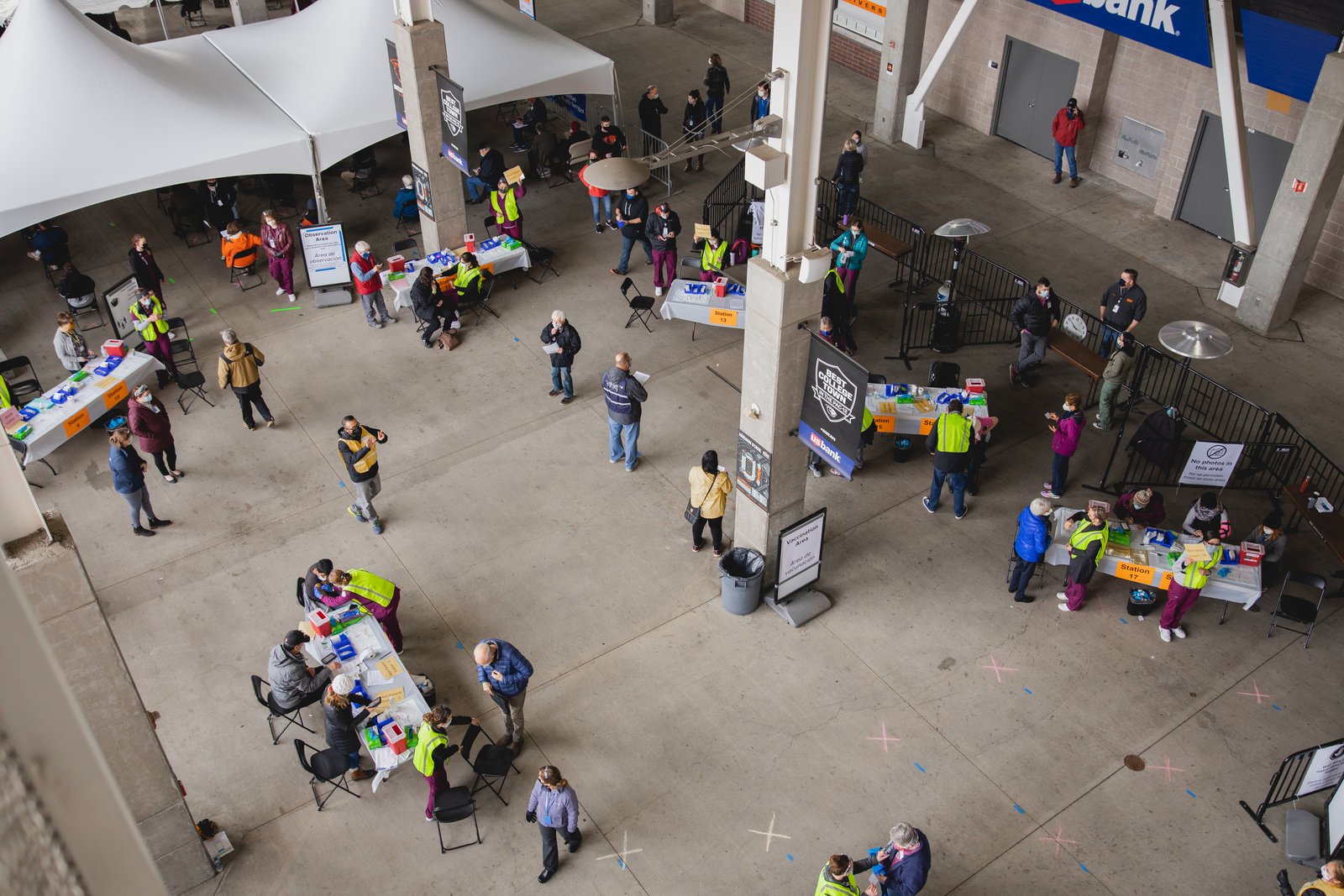
Image context: the cover uses a real photograph of a mass-vaccination clinic at Oregon State University's Reser Stadium. That is the right visual for this piece because the article is about the hidden system behind an ordinary vaccination encounter: safe administration in public view, then reporting and review capacity in the background if an adverse event follows.[7]
Around 0:00 to 1:05, the video starts with disease burden so safety is not read in a vacuum
The speaker opens as a pediatrician recalling children with neonatal tetanus, measles encephalitis, and severe tuberculosis.[1] That is not rhetorical ornament. It sets the comparison class for everything that follows. Vaccine-safety systems are built because vaccines are used at population scale, but they are used at population scale only because the diseases they prevent are serious enough to justify organized protection in the first place.[1][2]
This opening matters because debates about vaccine injury often collapse timing into causation. The emotional sequence is understandable: a child receives a dose, then something frightening happens, and the event becomes fused in memory. The technical sequence has to slow down. Surveillance asks what happened, when it happened, whether the event fits a known background rate, whether the vaccine was administered correctly, whether there is a biologically plausible mechanism, and whether similar reports are appearing elsewhere.[2][3][4][5]
The short video's opening therefore does more than remind viewers that vaccines save lives. It quietly defines the standard of safety work. The goal is not to protect a product's reputation. The goal is to protect vaccination as a disease-prevention tool by being disciplined enough to notice genuine harms without misclassifying every post-shot illness as proof of causation.[1][2]
Around 1:06 to 1:23, the key move is classification, not reassurance
The video's most important sentence arrives when the speaker says that if someone gets sick after vaccination, it is usually coincidence, an error in administering the vaccine, or more rarely a problem with the vaccine itself.[1] That line sounds simple. Underneath it sits a much richer WHO framework. The WHO causality manual separates adverse events following immunization into vaccine product-related reactions, vaccine quality-defect-related reactions, immunization-error-related reactions, immunization-anxiety-related reactions, and coincidental events.[3]
That taxonomy is the heart of the article. Vaccine safety begins with sorting, not with blanket certainty. A fever or seizure after immunization can be temporally real without being caused by the vaccine. A clinic can generate harm through storage failure, dilution mistakes, contamination, or incorrect technique even when the product itself is sound. A cluster can reflect anxiety reactions or background illness rates. And sometimes there really is a product-related safety issue worth escalated scrutiny.[2][3]
The WHO short compresses this because it has only seconds to work with. The important thing is what it chooses to compress. It does not say, "If something happens afterward, trust us." It says, in effect, "Different bad outcomes belong to different investigative lanes."[1][3] That is a stronger and more technically honest basis for public trust.
Around 1:23 to 1:47, "robust systems" means layered surveillance, not one inbox
When the video turns to "robust vaccine safety systems," the natural temptation is to imagine one central reporting portal that solves the problem.[1] CDC's documentation shows why that picture is too thin. The agency describes multiple complementary systems because different parts of the job require different instruments.[4][5][6]
VAERS, managed by CDC and FDA, is the early-warning layer. It collects reports from clinicians, manufacturers, patients, and families. CDC is explicit that VAERS can detect patterns that need attention, but a report to VAERS does not by itself establish that a vaccine caused the event.[4] That limitation is not a flaw to hide. It is the price of a broad, sensitive intake system. You want a system willing to hear weak signals early, then hand them off for better analysis.
The Vaccine Safety Datalink does a different job. CDC says VSD uses electronic health record data from participating health systems to assess vaccine safety and detect adverse events in near real time.[5] That means the follow-up question becomes more structured: are rates of a specific adverse event higher in vaccinated groups than in appropriate comparison groups, and do those patterns persist after more careful analysis?[5] The broader CDC overview page makes the logic explicit: vaccine safety monitoring works as a suite, not as a single metric.[6]
That is why the WHO clip works better as a systems video than a reassurance video. It implies that trust is produced by escalation pathways. Reports enter. Patterns are checked. Weak signals are either explained, monitored further, or taken seriously enough to change guidance. The credibility comes from the loop.
Around 1:47 to 2:13, the global claim is about monitoring capacity, not abstract confidence
In the final third, the speaker says WHO works with countries so vaccines can do their job while new vaccines for malaria, meningitis, and encephalitis are monitored with WHO support.[1] Read against WHO's longer AEFI materials, that line points to a practical global-health issue. Introducing or scaling vaccines is not just a procurement task. Countries also need reporting forms, case definitions, review committees, investigation capacity, and a way to communicate findings without either panic or denial.[2][3]
This is especially important when programs expand in lower-resource settings, where baseline diagnostic capacity, record linkage, and follow-up infrastructure can vary sharply. WHO's surveillance manual is full of ordinary-seeming but decisive work: how to define a serious event, what to collect in an investigation, when to notify rapidly, how to review clusters, and how to feed conclusions back into immunization programs.[2] None of that looks dramatic on camera. All of it determines whether a health ministry can distinguish rumor from pattern.
The larger lesson is that vaccine confidence is downstream of institutional competence. People do not trust vaccination because a system asserts perfection. They trust it when a system can tell the difference between a coincidence, an immunization error, a plausible adverse reaction, and a false alarm that looked ominous for a day.[1][2][3][4][5]
What the short gets right
The WHO video is effective because it keeps the argument narrow. It does not promise a world without adverse events. It does not pretend that every report after vaccination is noise. It says something more durable: vaccine safety depends on watching closely enough to classify events correctly and respond fast enough when the pattern is real.[1][2][3][4][5][6]
That is the point worth carrying out of the clip in 2026. The public face of immunization is the brief encounter at the clinic table. The real durability of the system sits behind it in forms, databases, review protocols, and the willingness to investigate uncomfortable signals without surrendering to every temporal coincidence. The shot is quick. The feedback loop is the real safety infrastructure.
Sources
- World Health Organization (WHO), "WHO works to ensure vaccinations are safe," official YouTube video, published November 28, 2019.
- World Health Organization, Global manual on surveillance of adverse events following immunization - WHO guidance on detection, reporting, investigation, analysis, and response for AEFI programs.
- World Health Organization, Causality assessment of an adverse event following immunization (AEFI): user manual for the revised WHO classification, 2nd ed., 2019 update - WHO framework for distinguishing product-related, quality-defect, immunization-error, anxiety-related, and coincidental events.
- Centers for Disease Control and Prevention, "About VAERS" - CDC overview of the Vaccine Adverse Event Reporting System as an early-warning system that does not by itself prove causation.
- Centers for Disease Control and Prevention, "About the Vaccine Safety Datalink (VSD)" - CDC overview of near-real-time vaccine-safety monitoring using electronic health record data.
- Centers for Disease Control and Prevention, "Vaccine Safety Systems" - CDC overview of the complementary systems used to detect and evaluate vaccine-safety concerns in the United States.
- Wikimedia Commons, "COVID-19 mass vaccination clinic at Oregon State University's Reser Stadium (51046751776).jpg" - source page for the documentary clinic photograph used as the article image.