Sister Elizabeth Kenny is easy to flatten into a folklore shape: rough Australian outsider, stubborn woman, hot packs, Hollywood fame, then vindication. That version keeps the drama and loses the mechanism. Kenny mattered because she changed the unit of treatment inside the polio ward. Where orthodox care treated the threatened limb as something to immobilize with splints, braces, and prolonged rest, Kenny treated the limb as a painful but still recoverable field of muscle spasm and movement. Her larger historical achievement was not that every theory she held about poliomyelitis turned out to be right. It was that she made immobilization look clinically and morally intolerable at the bedside.[1][2][3][4]
That distinction is worth holding onto because Kenny's career sits in an awkward but fertile part of medical history. She was not a laboratory discoverer, and she never owned the winning virology. Britannica's account is explicit that many physicians dismissed her partly because she located the physical manifestation of polio in muscle and peripheral tissues rather than in the nervous system, which later science supported.[1] Yet the same history shows why dismissal was too easy. Her method of damp heat plus bending, flexing, and later muscle re-education altered what patients experienced in acute care and what rehabilitation medicine thought a damaged limb was for.[1][2][3]
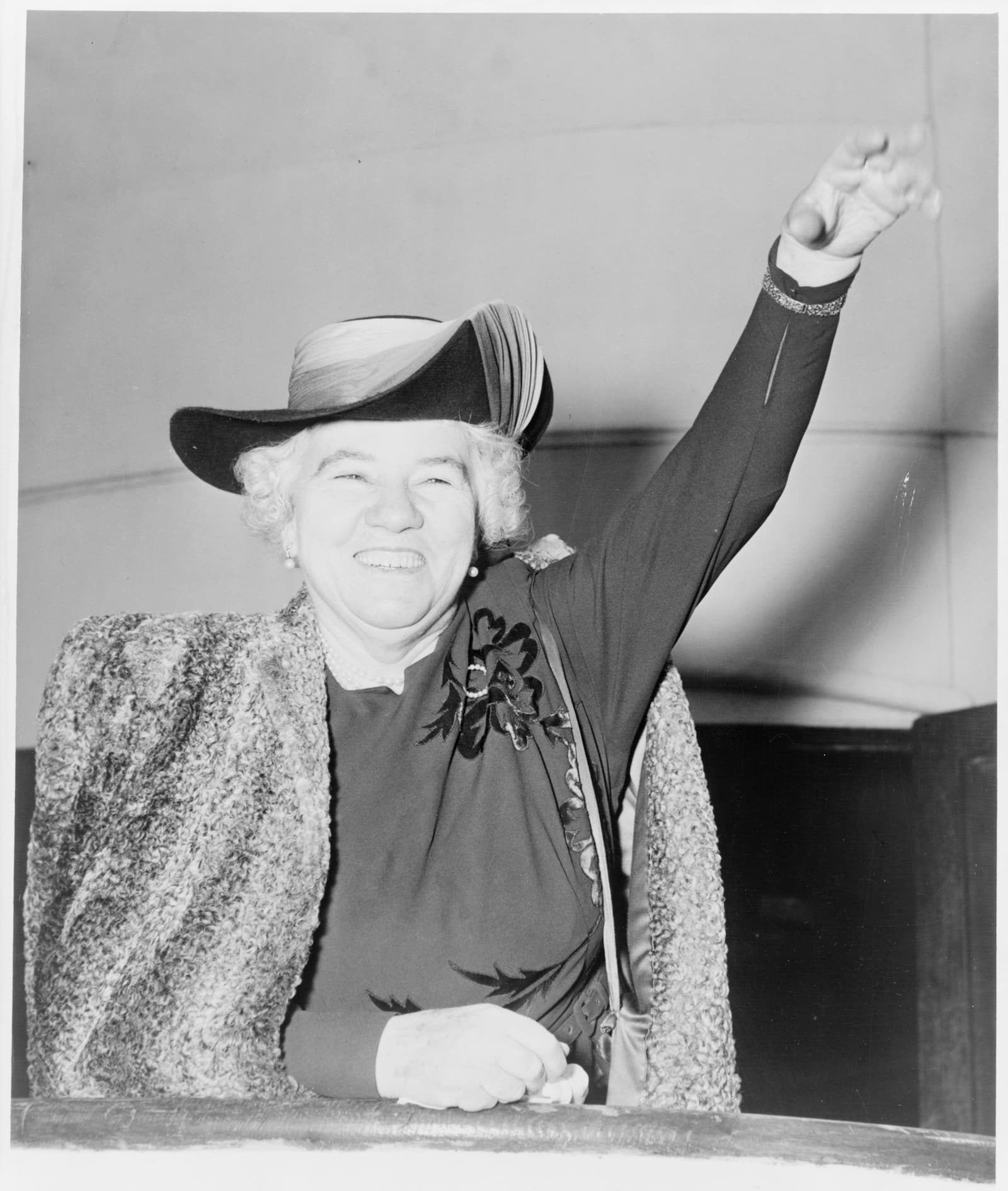
Image context: the lead image uses a real 1950 portrait photograph of Kenny from the Library of Congress collection via Wikimedia Commons. That public-facing image belongs here because this article is about authority at the bedside becoming authority in public view, even while the medical profession remained divided over her theory and status.[5]
Timeline anchors before interpretation
- 1880: Elizabeth Kenny was born on September 20 in Warialda, New South Wales.[1]
- About 1910: she was running an independent nursing practice in rural Queensland after informal training and local hospital work.[1]
- 1911: MNopedia places her first encounter with polio in Australia in this year, when she concluded that the afflicted limbs were painfully stiff and should be treated with heat and gentle motion rather than rigid support.[2]
- 1913: Britannica records that she opened a small hospital in Clifton, where her method was reportedly used with success.[1]
- 1932-1933: Kenny's Townsville clinic and a Queensland government demonstration widened both support and professional opposition around her anti-immobilization approach.[1]
- 1940: after chilly receptions elsewhere, she reached the United States and eventually obtained space at Minneapolis General Hospital.[1][2]
- December 17, 1942: the Elizabeth Kenny Clinic opened in Minneapolis; soon after, the institution became the Sister Kenny Institute.[2]
- 1952: Kenny died on November 30 in Toowoomba, Australia.[1][2]
- 1955: with the polio vaccine in use, the institute's mission widened from polio treatment into rehabilitation medicine more broadly.[2]
Those dates matter because they show the real arc of the story. Kenny did not simply appear in America with one clever trick. She spent decades trying to convert a bedside observation into a treatment system, then into an institution capable of training others.
Kenny's first break with orthodoxy happened at the level of pain
Before Kenny, standard polio management leaned heavily on immobilization. MNopedia describes the prevailing pattern bluntly: braces and splints were used to keep affected limbs rigid, sometimes alongside surgery, while iron lungs managed severe respiratory failure.[2] The logic had a certain coherence. If doctors feared deformity and assumed damaged muscles should be protected from further injury, then stillness felt prudent.
Kenny's early move cut across that logic. Britannica says that when she encountered children with infantile paralysis, she experimented with heat as a pain-relieving measure and landed on hot moist cloths over affected areas, later combining that practice with bending and flexing for rehabilitation.[1] The crucial point is not only that she used warmth. It is that she treated acute suffering and later function as connected problems. Golden and Rogers summarize the American nursing encounter with the Kenny method in similarly concrete terms: hot packs and muscle-strengthening exercises replaced the standard regime of prolonged immobilization.[4]
That replacement changed the emotional texture of treatment. MPR's historical profile is not a technical paper, but its oral-history reporting is useful because it preserves how the old regime felt to patients and families in Minnesota: months in splints and braces, a sense of being strapped into helplessness, and genuine panic around a disease that could deform children for life.[6] Kenny's method reached so widely in part because it was experienced not only as a new doctrine but as a release from a visibly brutal one.
Her deepest practical insight was narrower than her theory
This is the place where historical judgment usually wobbles. One reading says Kenny was right because patients improved. Another says she was wrong because her explanation of polio's pathology did not align with later neuroscience. The stronger interpretation keeps both facts in view without forcing them into one verdict.
Britannica states the boundary clearly: Kenny maintained that polio's physical manifestation came from viral infection of muscle and other peripheral tissues rather than infection of the nervous system, and that claim helped many doctors dismiss her work.[1] Becker's 2018 rehabilitation-history review, even in its title, frames the ambiguity directly by asking whether she should be remembered as doyenne or demagogue in rehabilitation medicine.[3] That is the right tension. Kenny's theory of the disease could overreach. Her treatment system could still outperform the orthodoxy in important clinical settings.
The practical insight was therefore narrower and more durable than the full Kenny concept. She recognized that painful spasm, fear, and disuse were part of the patient's lived disability inside the ward, and that treatment had to begin by relieving pain and then reintroducing purposeful movement.[1][2][4] In modern language, she was more clinically right about rehabilitation sequence than about viral mechanism. That is why her afterlife sits so naturally inside rehab even though later virology did not ratify all of her causal claims.
Minneapolis turned a disputed method into an institution
Kenny's story would be smaller if it ended as one charismatic clinician treating a few memorable children. It became historically durable because Minnesota converted her practice into organizational form. MNopedia's account is especially useful here. After resistance in New York and Chicago, Kenny found a hearing in Minnesota, demonstrated her treatment at the Mayo Clinic and the University of Minnesota, and then began caring for acute polio patients at Minneapolis General Hospital.[2] Demand quickly outran what one person could do. She trained technicians, needed more space, and on December 17, 1942 the Elizabeth Kenny Clinic opened in Minneapolis.[2]
That is the institutional hinge in the whole biography. Once the clinic existed, the Kenny method no longer depended on Kenny's hands alone. The institute offered courses for nurses and physical therapists, served children and young adults from far beyond Minnesota, and helped make rehabilitation into something more than a loose afterthought to acute medical care.[2] Becker's rehabilitation-history framing supports that wider reading: Kenny's role in America belongs inside the making of rehabilitation medicine, not merely inside polio celebrity.[3]
There is a larger pattern here that biography can easily miss. Many medical challenges are remembered through vaccines, drugs, or decisive lab findings. Kenny's contribution lived in procedures, training, and repeated handling. It moved by demonstration, repetition, and conversion of skeptics on hospital floors. That is a different kind of medical power, and it is usually harder to narrate because it looks less like discovery than like stubborn craft.
Why doctors resisted, and why some eventually yielded
Resistance to Kenny was not only sexism, though gender and status plainly mattered. MNopedia notes that her ideas challenged conventional wisdom and that she lacked the formal medical credentials many gatekeepers expected.[2] Britannica adds that trained professionals criticized her because her practices ran directly against standard immobilization techniques.[1] Those were real reasons for skepticism, especially in an era when polio deformity was feared and mechanism remained contested.
But the resistance also had a practical limit. If a treatment approach reduced pain, improved mobility, and won parents' loyalty, orthodox contempt became harder to maintain. MPR's archive captures that shift in lived terms: Minneapolis physicians who first took a chance on Kenny encountered striking recoveries and started keeping records, while families saw her care as more effective and less painful than the old brace-and-splint regime.[6] That does not prove every Kenny claim. It does show why the argument could not remain abstract.
Golden and Rogers add another layer by following nurses who came to study the Kenny method in 1942-1943.[4] Their abstract makes clear that the method was not merely a slogan attached to one famous woman. It became a transmissible set of practices taught to American nurses during wartime polio care. That teaching function is one reason Kenny's influence survived even after the worst epidemics passed.
The strongest two interpretations
Interpretation A: Kenny was a heroic rebel whose method was vindicated wholesale
This interpretation survives because it fits the public narrative. Kenny challenged the medical establishment, relieved patients' suffering, built a famous institute, and became one of the best-known women in wartime and postwar America.[1][2] It captures the scale of her charisma and the emotional truth that many patients and families experienced her method as rescue from needless rigidity.
Interpretation B: Kenny mattered because she forced polio care toward pain relief, guided movement, and organized rehabilitation, even though parts of her disease theory were wrong
This interpretation fits the record better. Britannica explicitly preserves the mismatch between her pathophysiological claims and later scientific consensus.[1] MNopedia and the nursing and rehabilitation literature preserve the stronger point: hot packs, careful exercise, and muscle re-education changed care practice and helped define rehabilitation medicine as a field.[2][3][4]
Interpretation A keeps the legend. Interpretation B explains the legacy.
Why this microhistory still matters
Kenny remains contemporary because medicine still struggles with the same kind of problem. Sometimes the decisive intervention is not a new molecule. It is a new treatment sequence that rearranges what clinicians do first, what they count as harm, and what patients are allowed to attempt. Kenny looked at a ward full of frightened, painful, immobilized children and refused to treat stillness as neutral. That refusal traveled far.
Her story also warns against a lazy choice between "theory right" and "practice wrong," or the reverse. Clinical history is full of episodes in which partial theory and effective handling coexist for a time. Kenny's place in that history is secure. She did not solve poliovirus. She changed what happened to bodies once the virus had done its damage. In the long history of health care, that is more than a footnote. It is one of the clearest cases of bedside practice becoming a new medical discipline.[1][2][3][4]
Sources
- Kara Rogers, "Elizabeth Kenny." Encyclopaedia Britannica - biography, chronology, the Kenny method, the Minneapolis turn, and the boundary between Kenny's theory and later scientific consensus.
- Minnesota Historical Society, "Sister Kenny Institute" (MNopedia) - 1911 origin story, 1942 clinic opening, 1943 foundation transition, and the institute's role in the rise of rehabilitation medicine.
- Bruce E. Becker, "Sister Elizabeth Kenny and Polio in America: Doyenne or Demagogue in Her Role in Rehabilitation Medicine?" PM&R (2018), PubMed record.
- Janet Golden and Naomi Rogers, "Nurse Irene Shea studies the 'Kenny method' of treatment of infantile paralysis, 1942-1943." Nursing History Review (2010), PubMed record.
- Wikimedia Commons, direct file-delivery link for "Elizabeth Kenny NYWTS.jpg" - 1950 portrait photograph from the Library of Congress collection used as the article image.
- Minnesota Public Radio Archive, "Profile of Elizabeth Kenny" - oral-history reportage on Minnesota polio care, the old splint-and-brace regime, and Kenny's local afterlife.