The Apgar score is now so familiar that it can feel older and broader than it really is. In hospital memory and in popular explanation, it often appears as a universal newborn verdict: a neat number from 0 to 10 that says how well a baby is doing, or even hints at what sort of future lies ahead. Read Virginia Apgar's 1953 paper closely, though, and the original object is narrower, sharper, and more practical.[1][2]
What Apgar wanted was not a metaphysical judgment on the newborn infant. She wanted a fast, repeatable delivery-room classification that would let clinicians compare obstetric practice, maternal pain relief, and immediate resuscitation results without collapsing into vague language like "mild" or "severe" depression.[1] The score's later prestige partly hides that origin. It began as an anesthesiologist's instrument for the first minute after birth, not as a prophecy machine for the whole child.[1][2][3]
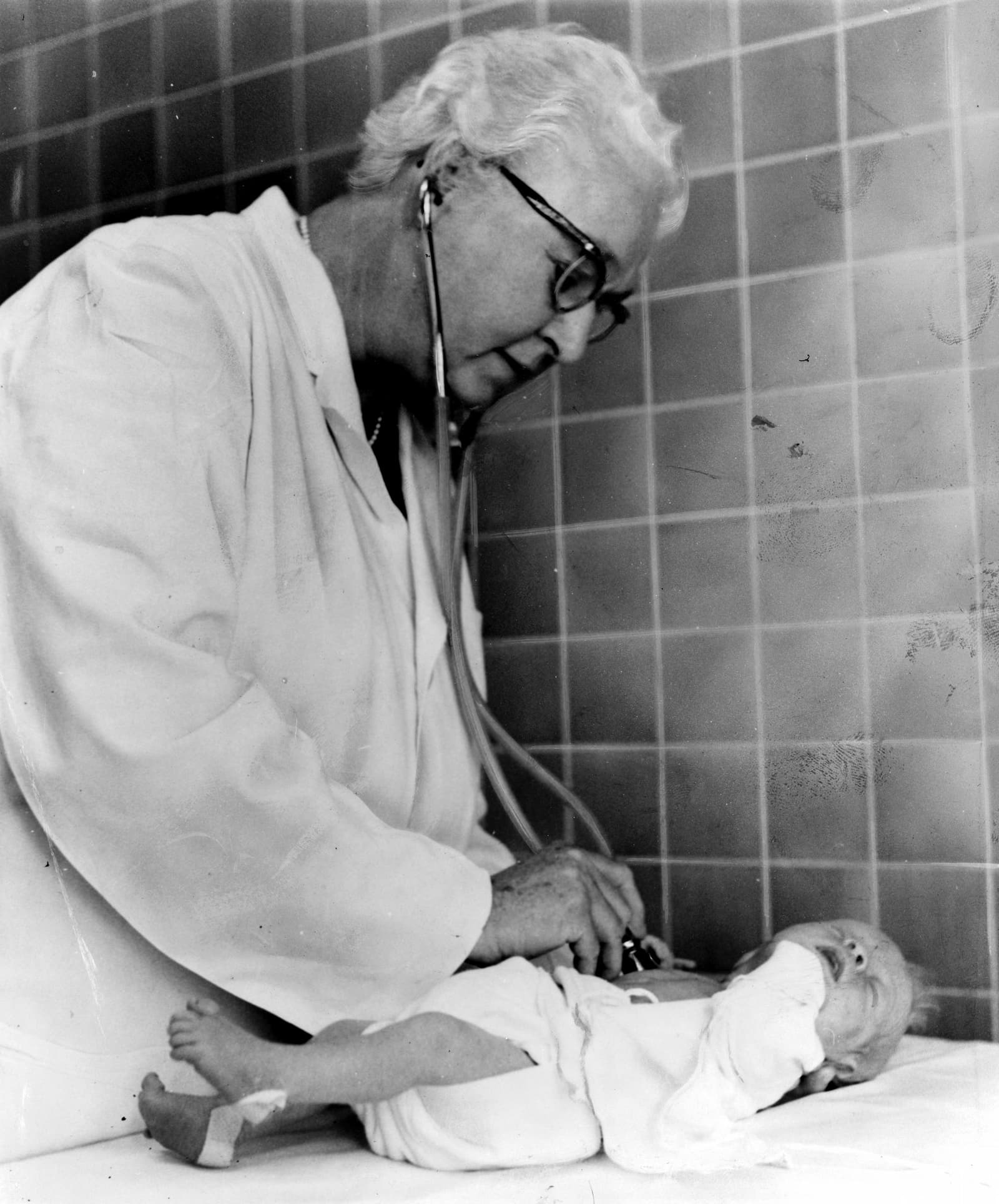
Image context: the lead image uses a real 1966 Library of Congress photograph of Virginia Apgar examining a newborn. That matters here because the essay is about the score as an embodied clinical act of bedside observation under time pressure, not as a floating acronym detached from the room where it was made.[4]
Timeline anchors before the close reading
- 1949: Virginia Apgar became the first woman at Columbia University College of Physicians and Surgeons to be named a full professor, a marker of the obstetric-anesthesia setting from which the score emerged.[3]
- September 1952: Apgar presented the method at a joint anesthetists' meeting before formal publication, already framing it as a practical grading system for newborn condition.[1][3]
- 1953: "A Proposal for a New Method of Evaluation of the Newborn Infant" appeared in Current Researches in Anesthesia and Analgesia and fixed the evaluation point at 60 seconds after complete birth.[1]
- 1958: a second report on a larger number of patients helped consolidate the score's wider use and the move toward later repeat measurements.[2][3]
- 2015: ACOG and the American Academy of Pediatrics restated the modern boundary: report the score at 1 minute and 5 minutes for all infants, continue every 5 minutes to 20 minutes if the score remains below 7, and do not use the score to predict an individual infant's neurologic outcome.[2]
Those dates matter because they show how quickly the score traveled from one delivery-room problem into a global medical habit. The 1953 paper belongs to a local operational setting. The later afterlife turned it into something much larger, and sometimes much less precise.
1. The paper opens as a complaint about bad evidence
The first paragraph of the 1953 article is unusually sharp.[1] Apgar writes that infant resuscitation had generated "imaginative ideas," strong enthusiasms and dislikes, and too many "unscientific observations." The target of her criticism was not neonatal care itself. It was a language problem. The literature, in her view, lacked clean and comparable data.[1]
That complaint determines the whole paper. Apgar does not say she is inventing a measure of newborn destiny. She says the purpose is the "reestablishment of simple, clear classification or grading" that can serve as a basis for discussion and comparison of obstetric practices, types of maternal pain relief, and the effects of resuscitation.[1] This sentence is the key to the whole document. The score is a standardization device.
That point is easy to miss because the score later became famous as a universal pediatric number. In the paper itself, the clinical and institutional target is more specific. Apgar is writing from anesthesiology and obstetrics, inside a setting where different drugs, different delivery routes, and different resuscitation choices were producing babies in visibly different early condition.[1][3] She wanted a way to compare those outcomes without relying on impressionistic description.
2. The real center of gravity is the 60-second mark
The second close-reading clue is the paper's obsession with timing.[1] Apgar says the observation point was varied until the "most practicable and useful time" was found, and that time was sixty seconds after the complete birth of the baby.[1] That is a much narrower claim than the score's later cultural afterlife. The method was tuned to the first minute because that minute was operationally decisive: long enough for basic observation, short enough to guide immediate care.
Her argument against earlier methods makes the same point. "Breathing time" and "crying time" looked objective, but Apgar explains why they failed in practice: some infants breathed once and then became apneic, while others never produced a "satisfactory cry" even when later surviving the delivery room.[1] Likewise, broad labels like mild, moderate, and severe depression left too much room for individual interpretation.[1] The score was designed to compress that ambiguity.
The five chosen signs were meant to be easy to determine without interfering with care.[1] Heart rate, respiratory effort, reflex irritability, muscle tone, and color each received 0, 1, or 2 points, yielding a maximum of 10.[1] Apgar makes clear that these were not equal in value. She explicitly calls heart rate the "most important diagnostic and prognostic" sign.[1] That alone should warn readers against treating the final sum as a flat, all-purpose truth about the infant. The paper itself does not.
What it does instead is something more modest and more useful. It turns the first minute into a structured observational surface. The score is a way to organize attention under pressure.
3. Read the weakest component closely and the method becomes clearer
The most revealing section in the paper may be the one on color.[1] Apgar calls it "by far the most unsatisfactory sign" and notes that it caused the most discussion among observers. Many infants who scored well on the other dimensions still looked cyanotic at one minute, and color often improved later.[1] In her summary tables, she eventually concludes that color is relatively unimportant when observed at that early point.[1]
This matters because it shows what kind of instrument the score really was. A mythical reading would treat the total as if every component expressed one deep underlying quantity called newborn wellness. Apgar's own text resists that idea. The five items are a practical bundle, not a perfect theory. Some signs are stronger, some weaker; some are more stable, some more time-sensitive. The score works not because it captures an essence, but because it gives clinicians a usable common surface for quick comparison.[1]
That helps explain why the score survived its own imperfections. In medicine, a tool does not need to be philosophically complete to be durable. It needs to be fast, teachable, reproducible, and good enough to improve communication. The paper shows Apgar thinking in exactly those terms. She is building a bedside classification that can travel across staff members, deliveries, and anesthetic approaches.[1][3]
4. The original paper is also an anesthesia paper
Another detail the afterlife often blurs is how thoroughly the 1953 article belongs to maternal anesthesia and delivery management.[1][3] Large parts of the paper compare average infant scores across vaginal delivery, cesarean section, breech delivery, forceps delivery, and different anesthetic methods.[1] Regional anesthesia repeatedly looks better than general anesthesia in her tables, while the score functions as the comparative language that makes those differences discussable.[1]
That context sharpens the article's real ambition. Apgar was not primarily inventing a timeless pediatric identity number. She was supplying obstetrics and anesthesiology with a common endpoint that could audit their own choices.[1][3] The score's historical force came from that portability. Once delivery rooms had a fast shared language for infant condition at one minute, different teams could compare technique and argue about cause with more discipline than before.
This is also why the score moved so easily beyond the original paper. A simple bedside method that organizes the first minute of life is exactly the kind of thing institutions know how to teach and standardize. The score turned a messy clinical impression into an ordinary reported fact.
5. The later history widened the use and narrowed the boundary
The modern boundary comes into focus when the later official guidance is read alongside the 1953 paper.[2] ACOG says the score should be reported at 1 minute and 5 minutes for all infants, with continued 5-minute measurements through 20 minutes if the score remains below 7.[2] That later structure preserves the original first-minute logic while adding a second question: how the infant responds over the next short interval, including after resuscitation.[2][3]
At the same time, ACOG is blunt about misuse. The score is an accepted method for reporting newborn status immediately after birth and for describing response to resuscitation, but it has been used inappropriately to predict individual adverse neurologic outcome.[2] That warning is not a contradiction of Apgar's paper. It is a return to the paper's proper scale.
The original method was built for rapid clinical classification in a specific time window.[1] Later clinicians understandably asked more of it. The five-minute score became more predictive of short-term survival and neurologic risk at the population level, and repeat scores became useful for tracking response.[2][3] But that is not the same as saying a number at birth can narrate one infant's entire future. The score is best read as a structured first look, then a short-interval response measure, not a life sentence.
Why this close reading still matters
The Apgar score lasts because it solved a real workflow problem with unusual elegance. It made the first minute reportable. It gave clinicians a compact language for comparing deliveries, anesthetics, and immediate neonatal condition. What it did not do, even in origin, was abolish judgment or foretell a whole neurologic life.[1][2]
That is the value of going back to the 1953 paper. The score appears less magical there, but more intelligent. It is a tool for disciplined observation under pressure, built by a physician who wanted less mythology and more comparability in the room. Modern medicine still needs that instinct.
Sources
- Virginia Apgar, "A Proposal for a New Method of Evaluation of the Newborn Infant" (Current Researches in Anesthesia and Analgesia, 1953) - the original paper defining the 60-second score, the five signs, and the paper's stated purpose of comparing obstetric practice, maternal pain relief, and resuscitation results.
- American College of Obstetricians and Gynecologists, "The Apgar Score" (Committee Opinion No. 644, 2015) - current official boundary on one-minute and five-minute reporting, repeat scoring below 7, and the warning against using the score to predict an individual infant's neurologic outcome.
- U.S. National Library of Medicine, "Biography - Dr. Virginia Apgar" - official historical overview covering Apgar's 1949 Columbia professorship, 1952 score design, 1953 publication, and the later standardization of one-minute and five-minute scoring.
- Library of Congress, "Dr. Virginia Apgar welcoming world's newest guest" - archival 1966 photograph source page for the article image.