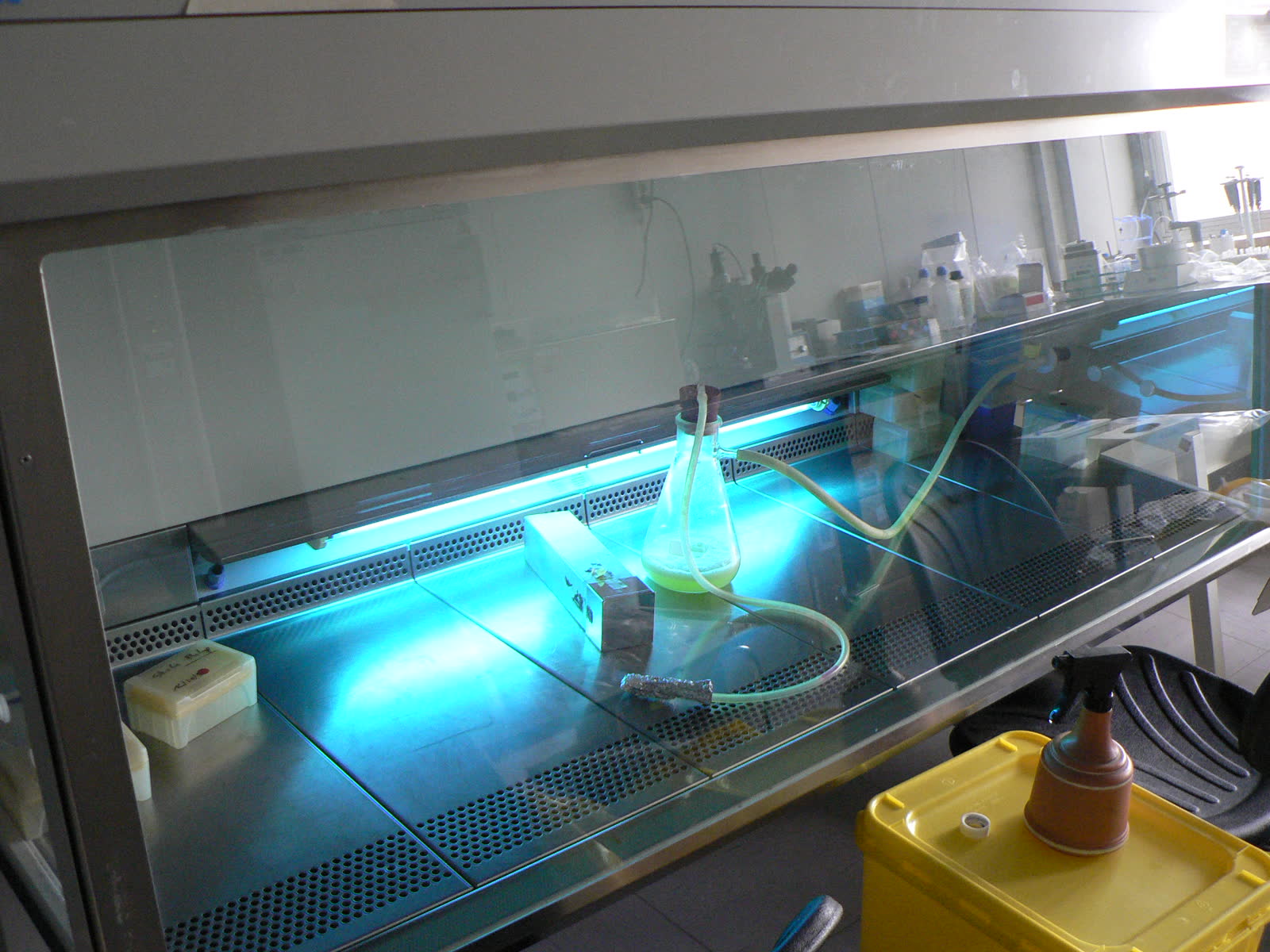
Upper-room germicidal ultraviolet light is easy to misread because it looks like a device story. A fixture appears near the ceiling, a faint blue glow suggests cleanliness, and the sales language often makes the room sound self-disinfecting. That is the wrong mental model. The public-health mechanism is not "UV light in a room." It is a controlled air-disinfection system: contaminated air has to reach an upper-zone UV field, receive enough germicidal dose, mix back into the occupied zone as less infectious air, and keep doing that without exposing eyes and skin below.[1][2]
The distinction matters because upper-room GUV sits between two familiar categories. It is not ordinary ventilation, because it does not dilute indoor air by bringing in outdoor air. It is not surface disinfection, because the target is airborne pathogen viability, not a wiped table. CDC's current NIOSH ventilation page describes GUV as UV energy used to kill viral, bacterial, and fungal organisms, best used as part of a layered approach with ventilation and other controls.[1] EPA states the same boundary for COVID-era indoor protection: a professionally designed, installed, and maintained UVGI system can help indoors, but by itself it is not enough.[4]
That boundary is the whole article. Upper-room GUV can be a serious airborne-infection control. It can also become decorative risk theater if the room, fixture, maintenance routine, and safety checks do not behave as one system.
The Mechanism: A Clean-Air Substitute, Not A Fresh-Air Source
In upper-room GUV, fixtures are mounted high on the wall or near the ceiling to create an irradiation zone above the heads of occupants. Air from the breathing zone moves upward through convection, mechanical ventilation, ceiling fans, or other room air currents. In the upper zone, microorganisms suspended in that air receive UV-C energy; after enough exposure, many are no longer infectious, even though the particles themselves may still remain in the air.[1][2]
This is why CDC frames upper-room GUV as equivalent in effect to adding clean air for airborne viral particles, not as a replacement for building-code outdoor air or filtration.[1] The word "equivalent" is doing real work. If a system inactivates a fraction of infectious particles as air circulates, the risk model can resemble what would happen if more clean air had been supplied. But the device has not fixed carbon dioxide, chemical pollutants, odors, humidity, or the comfort functions of ventilation. It has only reduced biological infectivity in air that passes through the dose field.
Older healthcare guidance makes the same point through the language of engineering. CDC's environmental infection-control chapter describes two UVGI systems in healthcare settings: duct irradiation and upper-room air irradiation. In the upper-room version, lamps may be suspended from the ceiling or mounted on the wall, and the germicidal effect depends on air mixing between the irradiated upper zone and the lower patient-care zone.[7]
That dependence on mixing is where many weak claims fail. If air stratifies, if furniture blocks circulation, if the room has no useful vertical air movement, or if the fixture is aimed poorly, the upper zone can look impressive while the breathing zone receives little benefit. WHO's tuberculosis infection-prevention guideline explicitly says upper-room GUV depends not only on fixture specifications but also on area selection, installation quality, maintenance, exposure duration, and adequate air mixing.[3]
Why TB Made The Evidence Base
Upper-room GUV's strongest historical evidence comes from tuberculosis control because TB forced medicine to take airborne transmission seriously before the broader public learned to talk about aerosols. CDC notes that upper-room GUV has been used for more than 70 years and that much of the research since 1950 focused on TB.[1] NIOSH's 2009 healthcare-setting guidance was built from CDC/NIOSH-funded laboratory studies and other studies to guide design, installation, testing, and safe operation for TB environmental control.[2]
The best-known modern experimental logic is blunt but elegant: let animals sample ward air. In a Lima, Peru study published in PLOS Medicine, guinea pigs breathed air drawn from a TB ward while researchers compared untreated air with air treated by upper-room UV lights or negative air ionization. In the control group, 35% of guinea pigs developed TB infection; with UV lights, the figure was 9.5%.[5] That is not a retail-room guarantee. It is a biological proof that properly applied upper-room UV can make infectious ward air less infectious.
WHO's 2019 guideline summarizes two animal air-sampling models as part of its evidence review. In one South African model, 64.4% of control animals developed latent TB infection compared with 17.7% in the intervention group. WHO's extrapolation estimated a reduction in infection incidence from 6.5% to 1.8% in a representative control population. In the Peru model, the corresponding animal comparison was 34.8% versus 9.4%, again extrapolated to about 6.5% to 1.8%.[3]
Those numbers are strong enough to explain WHO's recommendation, but not simple enough to support magical thinking. WHO classified upper-room GUV for high-risk TB settings as a conditional recommendation based on moderate certainty. It also warned that overreliance on units as a single infection-prevention measure, especially without testing, maintenance, and validation, can defeat the purpose.[3]
The Room Has To Qualify
The first practical threshold is geometry. CDC's current GUV page says upper-room GUV is most important in high-risk indoor settings: places where sick people are likely, crowded spaces where health status is unknown, and spaces where adequate HVAC or natural ventilation cannot be maintained year-round. It also says spaces must be at least 8 feet tall, with 8.5 feet preferred, and need some air movement.[1]
The height rule is not cosmetic. Upper-room systems work by separating two zones: an irradiated zone above and an occupied zone below. If the ceiling is too low, if people can climb into the UV field, or if bunk beds, storage, tall shelving, or maintenance access put faces near the lamps, the safety margin disappears. CDC warns that UV energy directed or reflected into occupied space can cause temporary eye or skin damage, and recommends qualified design and testing rather than casual installation.[1]
The second threshold is fixture discipline. NIOSH's guidance is not a shopping guide; it is a reminder that upper-room UVGI has to be designed, installed, operated, and evaluated. The effective wavelength in traditional low-pressure mercury systems is commonly around 253.7 nanometers, a germicidal UV-C band discussed in healthcare infection-control guidance.[7] But wavelength alone does not decide performance. Fixture output, louver design, beam direction, room reflectance, lamp aging, dust, humidity, and air flow all change the actual dose received by microbes and the exposure received by people.[2][3][7]
The third threshold is maintenance. A lamp that glowed last year may not deliver the same germicidal output this year. Dust can shade a lamp. A fixture can be bumped, replaced with the wrong lamp, blocked by a new shelf, or left on without anyone ever measuring the occupied-zone irradiance. WHO's implementation section emphasizes quality control, maintenance, permissible irradiance limits, and sustainability.[3] EPA's consumer-facing warning is simpler: consult experienced professionals, and do not use UV technology that was not designed for indoor air disinfection because it can create hazardous eye and skin exposure.[4]
The Myth: One Bright Object Can Replace A Prevention System
The useful myth to kill is not "GUV does nothing." The evidence does not support that. The myth is that GUV is a plug-in substitute for ventilation, filtration, source control, masks where needed, isolation, vaccination, testing, or clinical infection-control practice.
CDC says GUV is supplemental and does not replace code requirements for outdoor air delivery or filtration.[1] WHO says environmental controls for TB are part of an infection-prevention package, not a collection of independent gadgets.[3] EPA says UVGI can help indoors when professionally designed and maintained, but is not enough by itself to protect people from COVID-19.[4]
That layered framing changes how a facility should ask the question. The first question is not "Should we buy UV?" It is "What exposure pathway are we trying to reduce in this room, and what is the current clean-air baseline?" In a clinic waiting room with poor ventilation, high turnover, and repeated respiratory presentations, upper-room GUV may be a rational add-on. In a well-ventilated room with strong filtration and low crowding, the marginal gain may be smaller. In a low-ceiling bedroom or improvised household setting, upper-room GUV is usually the wrong category of intervention.[1][3]
The same reasoning applies to schools, shelters, courtrooms, break rooms, and cafeterias. Upper-room GUV is most convincing where people share air, source status is uncertain, outdoor air is constrained, and the room can safely support an upper disinfection zone. It is weakest when it is treated as a visible reassurance object without a commissioning report, maintenance plan, or clear role in the larger ventilation strategy.
What To Take Seriously
Upper-room GUV deserves a more precise public reputation. It is neither a futuristic cure-all nor a fringe gadget. It is an old airborne-infection control with a TB-shaped evidence base, a COVID-era relevance, and a narrow operating contract. The contract is unforgiving: keep the UV where people are not, move the air where the UV is, maintain the fixture, measure the safety boundary, and keep the rest of the prevention system alive.
That is why the phrase "upper-room" matters as much as "germicidal." The intervention is not the lamp alone. It is the room redesigned into two connected air zones: one people occupy, one pathogens pass through. When those zones are made correctly, the technology can add meaningful clean-air equivalent protection. When they are not, the glow is just a poor substitute for engineering.
Sources
- CDC/NIOSH, "About Germicidal Ultraviolet (GUV)" (updated October 4, 2024) - overview of upper-room GUV, layered controls, room-height constraints, and installation considerations.
- CDC/NIOSH, Environmental Control for Tuberculosis: Basic Upper-Room Ultraviolet Germicidal Irradiation Guidelines for Healthcare Settings (NIOSH Publication No. 2009-105) - design, installation, testing, and safe-operation guidance.
- World Health Organization, WHO guidelines on tuberculosis infection prevention and control: 2019 update, Recommendation 5 - upper-room GUV recommendation, evidence summary, implementation boundaries, and maintenance cautions.
- U.S. Environmental Protection Agency, "What is Upper-Room Ultraviolet Germicidal Irradiation (UVGI)?" (last updated November 13, 2025) - consumer-facing boundary on professional design, maintenance, and non-standalone use.
- Escombe et al., "Upper-room ultraviolet light and negative air ionization to prevent tuberculosis transmission," PLOS Medicine / PubMed record (2009) - Lima guinea-pig air-sampling trial with TB ward air.
- Wikimedia Commons, "UV-ontsmetting laminaire-vloeikast.JPG" - real photograph of a laminar flow bench being decontaminated with UV light, used as the article image source.
- CDC, "C. Air" in Guidelines for Environmental Infection Control in Health-Care Facilities - healthcare UVGI background, upper-room fixture types, 253.7 nm lamps, and air-mixing dependence.