The vaccine vial monitor is easy to underrate because it looks like packaging. It is small, passive, and visually simple: a heat-sensitive square inside a reference circle, attached to the vial label, cap, or ampoule. Yet the design solves a hard public-health problem. Vaccines can lose potency after excessive heat exposure, and the vial usually does not look different when that happens.[1][3]
The monitor's job is to make one invisible history visible. WHO describes vaccine vial monitors, or VVMs, as indicators that adhere to vaccine vials and change color as the vaccine is exposed to cumulative heat, showing whether the vial has passed a preset limit beyond which it should not be used.[1] PAHO's healthcare-worker guidance states the same operational point: any color change tells the worker that the vial has experienced high-temperature exposure for an unknown amount of time.[3]
That is why the VVM should not be understood as a sticker. It is a tiny memory device. It cannot tell the whole story of vaccine quality, but it can preserve the part of the story most likely to be lost between factory, store room, outreach session, transport box, clinic table, and the moment a health worker has to decide whether to open or discard a vial.
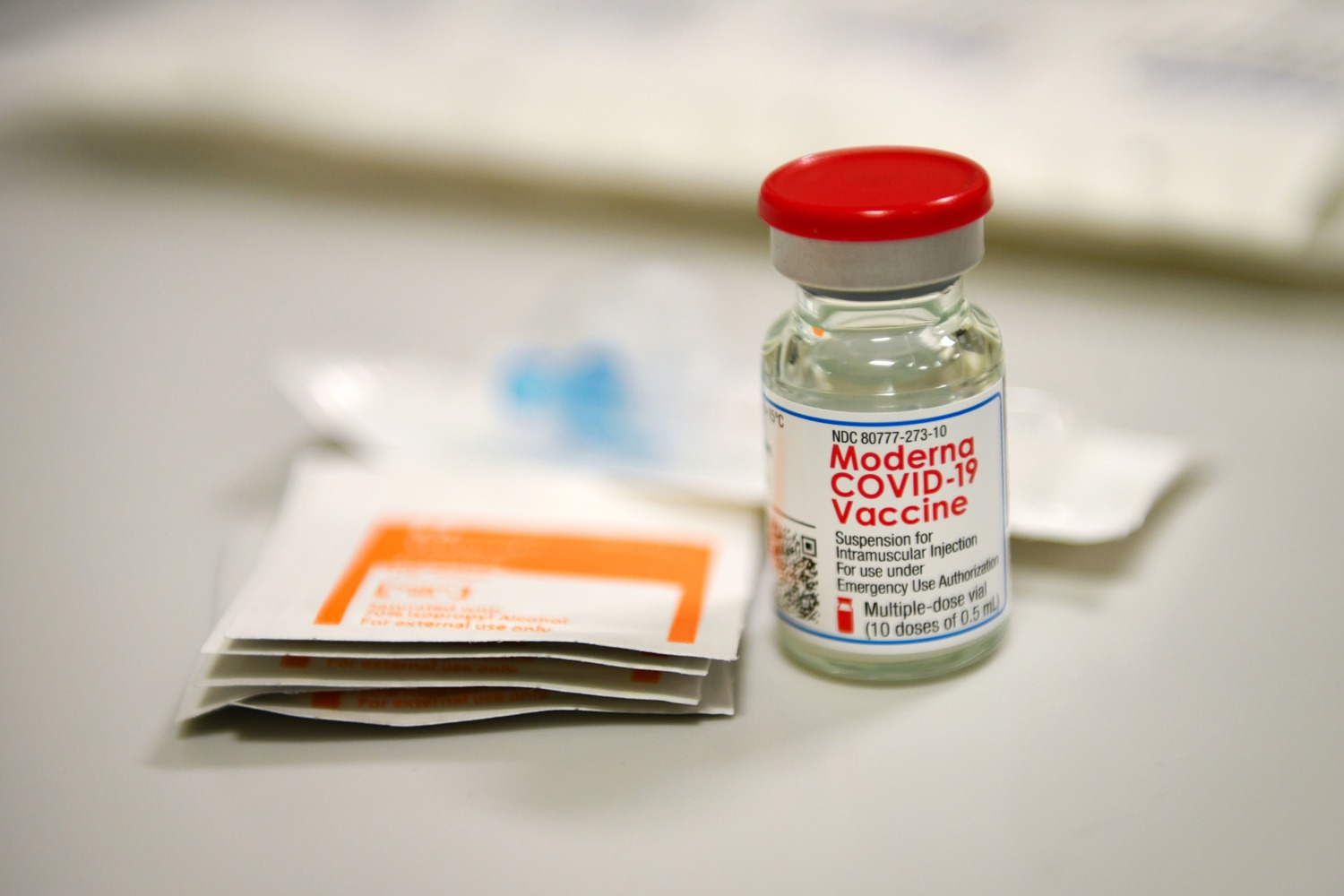
Image context: the cover uses a real U.S. Air Force photograph of a COVID-19 vaccine vial rather than a diagram. It does not show a VVM, but it shows the right unit of action: the individual vial, where a heat-history indicator becomes useful only because the decision has to travel with the dose itself.[6]
The Mechanism: Time And Temperature Add Up
The central mistake is to treat heat exposure as a single event. In practice, a vial can be harmed by a shorter period at a higher temperature or a longer period at a less extreme temperature. A good cold-chain system therefore has to remember not just "was it hot?" but "how much heat, for how long, relative to this vaccine's stability?"
The VVM answers that with a chemical color change. Gavi's summary of the WHO/UNICEF policy statement describes the monitor as a circular indicator with a heat-sensitive inner square that starts light and darkens when exposed to heat.[4] PAHO adds the important calibration detail: VVMs are designed for different vaccine types according to heat stability, with classes tied to 37 C, 25 C, or 5 C behavior and an endpoint reached when the square matches the dark reference circle.[3]
That makes the VVM more like an exposure integrator than a thermometer. A thermometer tells the worker the temperature now. A logger may tell a supervisor what happened inside a refrigerator over time. A VVM tells the person holding a vial whether the cumulative heat exposure attached to that vial has crossed the use boundary.[1][2][3]
This vial-level placement is the design breakthrough. WHO's Vaccine Management Handbook treats VVMs as one part of a broader temperature-monitoring system that also includes tools for cold rooms, refrigerators, and electronic logging devices.[2] The VVM does not compete with those tools. It carries the last-mile decision forward when the vial leaves the controlled box and enters a less predictable workday.
Why It Changed Outreach Work
Before VVMs, a broken refrigerator or uncertain transport history could force blunt choices: discard large quantities to avoid using compromised vaccine, or trust incomplete memory and risk giving doses that had silently lost potency. VVMs made the decision more local and less wasteful. In the 2006 Yogyakarta earthquake, Gavi's account says damaged health-center refrigeration would ordinarily have led to unrefrigerated vaccines being discarded; by checking the monitors, health workers could see that many doses were still usable, saving up to 50,000 doses from waste.[4]
That example shows both sides of the device. VVMs protect patients from ineffective heat-damaged vaccine, but they also protect programs from throwing away viable vaccine after a disruption. The public-health value is not only safety in the narrow sense. It is continuity. If every cold-chain interruption automatically destroys confidence in every vial nearby, outreach becomes fragile. If each vial carries a readable heat history, the response can be more exact.
The history explains why the idea mattered most in places where refrigeration could not be assumed. The VVM concept was developed in 1979 by WHO and PATH with USAID funding, and the first monitors became available on oral polio vaccine in 1996.[4] Oral polio vaccine was a logical early use case because campaigns often pushed vaccine into hot, mobile, field conditions. A label that added only a few cents per vial, in Gavi's historical account, could change whether heat uncertainty became campaign paralysis.[4]
The Boundary: Heat Memory Is Not Full Quality Control
The VVM works because it is narrow. It does not certify that every part of handling was correct. It does not replace expiry dates, national guidance, continuous temperature monitoring, refrigerator maintenance, stock rotation, trained staff, or documentation.[2][3] PAHO is explicit that immunization programs and health workers should continue following national rules for continuous temperature monitoring in handling, storage, and distribution.[3]
The most important boundary is freezing. PAHO notes that vaccines can be damaged by heat or cold, but the VVM tells the worker about high-temperature exposure.[3] Gavi's WHO quotation makes the same distinction: all vaccines are sensitive to heat and some are sensitive to freezing, while VVMs are useful for detecting excessive temperature exposure.[4] A vial can therefore have an acceptable-looking VVM and still require scrutiny if freezing is suspected, if it is expired, if the diluent has been mishandled, or if local open-vial policy says it must be discarded.
That boundary is not a weakness. It is why the device is usable. A VVM gives one strong signal at the exact place where that signal is needed. The cold-chain system around it supplies the rest: refrigerators, carriers, loggers, shake tests where applicable, expiry checks, session rules, supervision, and procurement standards.[2][3][5]
What The Small Label Really Buys
VVMs matter because they convert uncertainty into a visible decision at the edge of care. The health worker does not have to reconstruct every hour of transport from memory. The label has been absorbing the heat history all along. If the inner square remains lighter than the reference circle, the vial has not reached the monitor's discard endpoint; if it matches or darkens beyond the reference, the heat-history signal has crossed the line.[3]
That simple visual rule is also why training remains part of the mechanism. The label only changes outcomes if people know where to look, how to compare the square and circle, and when to defer to other cold-chain rules. WHO's 2015 handbook explicitly places VVMs inside temperature-monitoring implementation guidance, not outside the system as a shortcut.[2] The device makes good judgment faster; it does not remove the need for judgment.
The best way to read the VVM is therefore modest and powerful at the same time. It is not a magic proof of potency. It is not a decorative trust badge. It is heat memory at vial scale: a small chemical record that follows the dose until the last decision point, helping workers avoid both unsafe use and unnecessary waste.[1][3][4]
Sources
- World Health Organization, "Vaccine vial monitor (VVM)" (June 21, 2021) - concise technical overview of VVMs as vial-attached indicators of cumulative heat exposure.
- World Health Organization, Vaccine Management Handbook: How to monitor temperatures in the vaccine supply chain (WHO/IVB/15.04, 2015) - implementation context for VVMs alongside cold-room, refrigerator, and electronic temperature-monitoring tools.
- Pan American Health Organization, "Guidelines for healthcare workers on the proper interpretation of vaccine vial monitors and their use" (October 31, 2023) - practical interpretation rules, VVM classes, endpoint logic, and continuous-monitoring boundary.
- Gavi, the Vaccine Alliance, "WHO and UNICEF urge donors and member states to fund and expand use of vaccine vial monitors to ensure effective immunization" (May 3, 2007) - history, field examples, 1996 introduction, and WHO/UNICEF policy context.
- WHO Prequalification, PQS Performance Specification E006/IN05.4: Vaccine Vial Monitor (May 2024) - official performance-specification context for matching VVM behavior to vaccine stability profiles.
- Wikimedia Commons, "A vial of Moderna COVID-19 vaccine 201229-F-ZB805-0008Y.jpg" - real U.S. Air Force photograph used as the article image source.