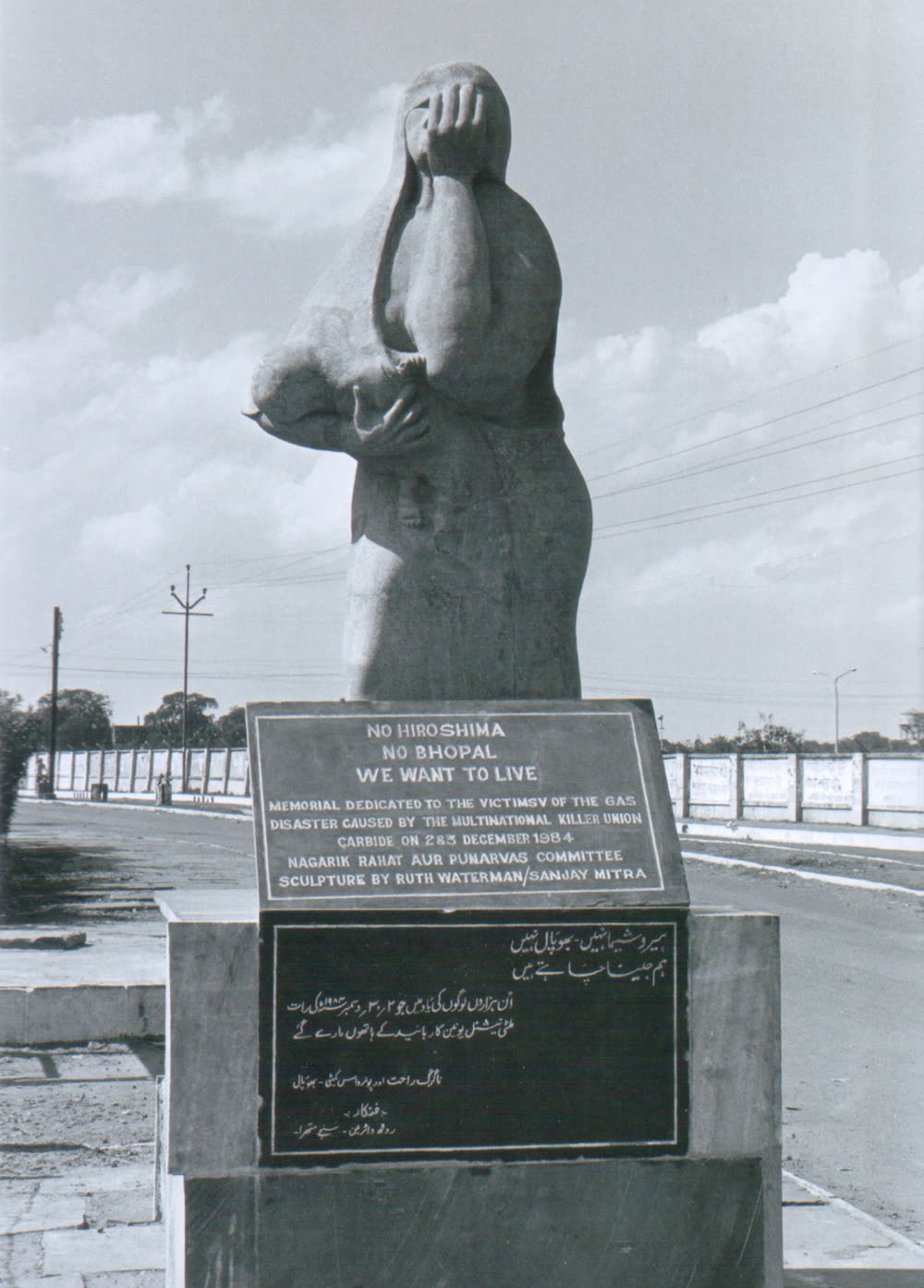
Bhopal is often compressed into one phrase: the world's worst industrial disaster. The phrase is accurate enough to identify the event, but too blunt to remember it well. What escaped from the Union Carbide India Limited pesticide plant on the night of December 2-3, 1984 was not only methyl isocyanate gas. It was also a continuing argument about whose bodies count as evidence after a disaster has left the front page.[1][4]
That is why Bhopal's memorial forms matter for health history. A statue across from the factory wall, a survivor-built museum, campaign posters, donated objects, medical records, and annual testimony all do different work. They keep the event from being filed as a closed accident. They insist that the disaster's health meaning includes acute death, chronic respiratory disease, mental distress, contaminated water, reproductive anxiety, compensation disputes, and the authority of survivors to narrate their own injury.[1][2][3][4][5]
Image context: the cover photograph shows Ruth Waterman's 1985 memorial statue, a mother fleeing with a child. Wikimedia's file record identifies the image source as Bhopal Medical Appeal and places the statue inside the Bhopal disaster category.[6] It is the right photograph for this essay because the memorial does not monumentalize a factory, a chemical tank, or a courtroom. It begins with bodies in motion.
The first memory was flight
The timeline is short at the beginning and very long afterward. Around 1:00 a.m. on December 3, 1984, Broughton's review describes a safety valve giving way and a plume of toxic gas entering the sleeping city.[1] The review estimates that more than 40 tons of methyl isocyanate leaked, immediately killing at least 3,800 people and causing serious morbidity and premature death for many thousands more.[1] Later estimates cited in the same review run higher for deaths in the first few days and for premature deaths across the next two decades, while the Indian government reported that more than half a million people were exposed.[1]
Those numbers are necessary, but they can also flatten the scene. A count of exposed people does not show what exposure felt like in a residential neighborhood where warning, diagnosis, transport, and treatment all failed at once. Broughton's account stresses that hospitals were overwhelmed and that clinicians lacked clear information about exactly what gas mixture they were treating.[1] The disaster therefore began as a public-health collapse as much as a chemical release: people fled, doctors improvised, records lagged behind bodies, and uncertainty became part of the injury.
That is what the memorial statue preserves better than a technical diagram could. A running mother and child make the first unit of memory not the plant but the household. The statue says that Bhopal's health history started in ordinary night air, in lungs, eyes, fear, corridors, and families trying to move faster than a cloud they could not see clearly enough to understand.
Compensation tried to close the file
Commemoration in Bhopal has always had to argue against premature closure. In March 1985, India enacted the Bhopal Gas Leak Disaster Act, making the government the sole representative of victims in legal proceedings.[1] In 1989, Union Carbide reached a US$470 million settlement with the Indian government, a figure Broughton describes as based on underestimates of long-term health consequences and the number of exposed people.[1] Amnesty's later account made the same point politically: the settlement was treated by survivors and advocates as radically inadequate for the scale of death, illness, and continuing contamination.[4]
That legal history matters because it shows why memory could not remain ceremonial. If compensation is calculated too narrowly, then survivors have to keep proving that injury did not end with the initial death count. If cleanup stalls, the factory site remains part of the health record. If information about exposure, toxicity, and treatment remains incomplete, then commemoration becomes a demand for knowledge as well as respect.[1][4]
The memorial statue therefore does not function like a civic plaque that politely marks an old site. It is closer to a public objection. It asks why the people who fled in 1984 should have to keep returning, decade after decade, to demonstrate that the disaster is still medically and legally unfinished.
The health record kept lengthening
The strongest reason Bhopal cannot be remembered only as an anniversary is that the health record kept changing shape. A 2020 time-trend study of Bhopal gas disaster cohorts used morbidity data collected at regular intervals from 1986 to 2016.[2] It reported that chronic respiratory morbidity continued over decades and that exposure severity and age at exposure shaped the long-term pattern.[2] In the severely exposed cohort, the highest chronic respiratory morbidity reported in the younger and older adult groups reached 38.6% and 59.5% respectively.[2]
Those figures do not turn every later symptom into a simple one-cause story. They do something more useful: they prevent the disaster from being reduced to a death toll. Bhopal injured people through time. Some harms appeared in the first hours; others stayed embedded in lungs, work capacity, household income, and clinical follow-up. In that sense, memory is not separate from epidemiology. Remembering is one way of keeping the cohort visible.
Recent research widened the temporal frame again. A 2023 BMJ Open study examined long-term health and human-capital effects using geolocated data from India's National Family Health Survey and other datasets, including 40,786 women, 7,031 men in one survey source, 13,369 men in another, and 1,260 children.[3] The authors reported evidence of long-term and intergenerational impacts, including higher disability affecting employment and higher cancer rates among men who were in utero at the time, and a possible effect on sex ratios among children born in 1985 up to 100 km from the accident.[3]
That kind of finding is exactly why Bhopal's public memory remains contested. A disaster with possible intergenerational effects cannot be contained by a single compensation date or a museum label. It keeps asking what counts as evidence, who gets monitored, who pays for care, and whether children born after the leak belong inside the moral perimeter of the event.[3][4]
A people's museum changed the narrator
The Remember Bhopal Museum, opened on December 2, 2014, the 30th anniversary of the disaster, is important because it shifted commemoration from official distance to survivor curation.[5] Museum Commons describes the project as a small survivor-linked museum filled with posters, photographs, donated artifacts, and family objects, including a child's dress and a stopped pocket watch.[5] It also notes that before the museum opened, the street sculpture and mural across from the factory walls served as a public call to memory.[5]
That sequence matters. The museum did not replace the statue. It extended the same argument into rooms, objects, oral histories, and curatorial choices. A statue can hold one urgent image: flight. A museum can hold the slower afterlife: medical paperwork, campaign materials, household relics, photographs, and the language survivors use when they are not being translated into court categories or disaster statistics.[5]
This is the commemoration problem at the center of Bhopal. Official memory often wants a stable form: a date, a monument, a paragraph, a wreath. Survivor memory often wants an accountable form: clean water, health monitoring, compensation, disclosure, criminal process, and a public story that names the continuing burden. Amnesty's 2024 report page framed the 40th anniversary in exactly those terms, calling for additional compensation, cleanup contributions, health monitoring, healthcare, information disclosure, and cooperation with pending legal processes.[4]
The memorial keeps assigning duties
The statue's mother and child are not a full history of Bhopal. They do not show the design decisions that made the plant dangerous, the failed safety systems, the settlement arithmetic, the epidemiological debates, the contaminated site, or the organizing work of survivors. But they do establish the correct moral direction. The story begins with people exposed against their will and then asks what institutions owed them afterward.
That direction is easy to lose in disaster memory. The more famous a catastrophe becomes, the more it risks turning into shorthand. Bhopal can become a lesson in industrial safety, corporate liability, emergency preparedness, environmental regulation, or toxicology. It is all of those things. But a health memory has to keep returning to the body: whose breathing changed, whose work changed, whose pregnancy became anxious, whose child inherited risk, whose water became suspect, whose paperwork failed to match lived illness.[1][2][3][4]
The best commemoration does not freeze suffering in place. It keeps obligations legible. Bhopal's memorial statue, survivor museum, and medical literature together make one claim: public health memory is not finished when the dead are named or the anniversary passes. It is finished only when the living no longer have to prove, again and again, that the disaster is still in their lungs, records, neighborhoods, and children.
Sources
- Edward Broughton, "The Bhopal disaster and its aftermath: a review," Environmental Health, 2005 - open-access review covering the leak timeline, exposure estimates, health effects, legal settlement, and public-health lessons.
- S. De, D. Shanmugasundaram, S. Singh, N. Banerjee, K. K. Soni, and R. Galgalekar, "Chronic respiratory morbidity in the Bhopal gas disaster cohorts: a time-trend analysis of cross-sectional data (1986-2016)," Public Health, 2020 - DOI landing page for the cohort study on respiratory-morbidity trends and severity findings.
- Anita Raj, Prashant Bharadwaj, Lotus McDougal, Gordon C. McCord, and Arushi Kaushik, "Long-term health and human capital effects of in utero exposure to an industrial disaster: a spatial difference-in-differences analysis of the Bhopal gas tragedy," BMJ Open, 2023 - open PMC copy covering long-term and intergenerational effects.
- Amnesty International, "Bhopal: 40 Years of Injustice," 2024 - report landing page and recommendations on compensation, cleanup, health monitoring, healthcare, information disclosure, and legal accountability.
- Gretchen Jennings, "Remember Bhopal Museum: A Victory for Museums of Difficult History," Museum Commons, 2014 - account of the survivor-linked museum, its December 2, 2014 opening, donated objects, and relation to the statue and factory wall.
- Wikimedia Commons, "File:Ruth Waterman Memorial Statue of the Bhopal disaster in 1985.jpg" - source page for Bhopal Medical Appeal's photograph used as the article image.