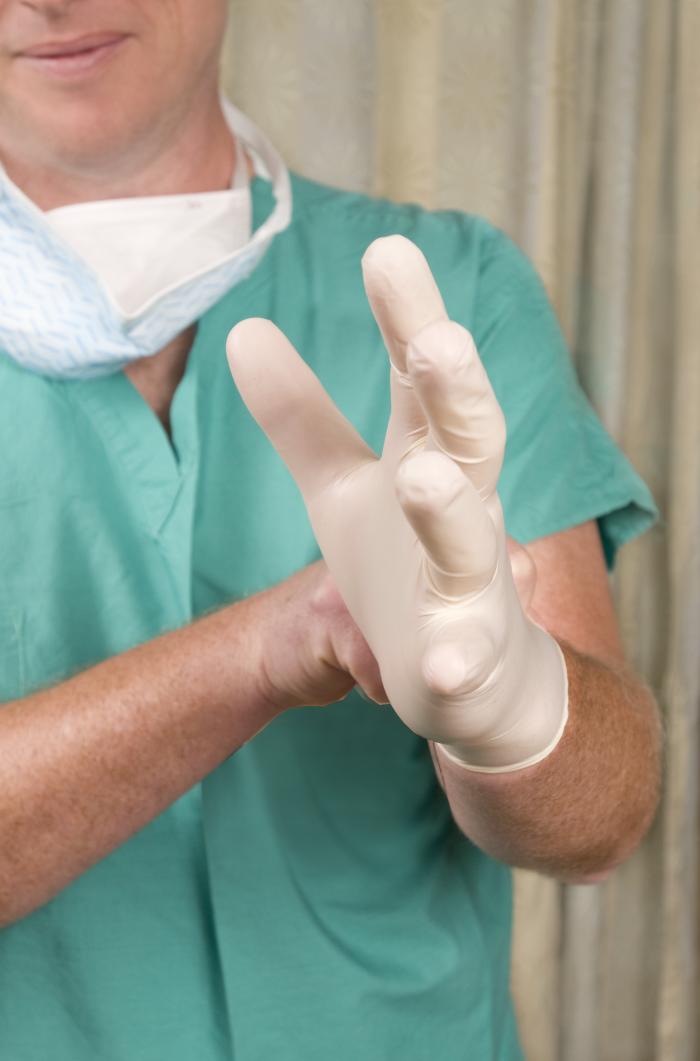
Universal precautions are easy to shrink into one image: a clinician pulling on gloves. The CDC documents are sharper than that. The real invention was not latex. It was a new default for uncertainty. Once HIV made it clear that medical history, appearance, and known diagnosis could not reliably sort every infectious exposure in advance, the safer clinical rule became: treat blood and selected body fluids from all patients as potentially infectious when exposure is anticipated.[1][2]
That sentence changed the moral and operational geometry of care. Before the universal-precautions turn, a special category could attach to a known or suspected patient. After it, the important question moved away from "Who is this patient?" and toward "What exposure might this task create?" The patient's identity became less central than the route of possible transmission: blood, mucous membrane, non-intact skin, needles, scalpels, splashes, and contaminated surfaces.[1][2]
Image context: the lead image is a 2011 CDC PHIL photograph of a healthcare provider putting on gloves. It is not a symbolic stock illustration or diagram. It shows the small work practice that made the policy legible at the bedside: a barrier chosen before the patient's infection status is the deciding fact.[6]
Timeline anchors
- 1983: CDC's hospital isolation guidance included "Blood and Body Fluid Precautions" for patients known or suspected to have bloodborne infection.[2]
- 1985: CDC developed the strategy of universal blood and body-fluid precautions in response to concerns about HIV transmission in healthcare settings.[3]
- August 21, 1987: CDC's HIV-transmission guidance recommended universal precautions for all patients, especially in emergency-care settings where blood exposure risk is higher and infection status is often unknown.[1]
- June 24, 1988: CDC clarified which fluids were covered, how gloves and barriers should be used, and why universal precautions did not apply equally to every secretion or excretion.[2]
- 1991 and 2001: OSHA's Bloodborne Pathogens Standard gave the workplace-safety side a regulatory frame, later revised after the Needlestick Safety and Prevention Act to emphasize safer devices and sharps-injury logs.[4]
- 1996-2007: CDC/HICPAC folded universal precautions and body substance isolation into standard precautions, widening the default beyond bloodborne risk alone.[5]
The key sentence is about unreliable identification
The 1987 CDC recommendation begins its universal-precautions section with the premise that still matters: medical history and examination cannot reliably identify all patients infected with HIV or other bloodborne pathogens.[1] That is the hinge. The document does not say every patient is equally risky, or that all contact is dangerous. It says the screening method is incomplete, and therefore the exposure rule has to stop depending on perfect prior identification.
The numbers in the same section explain the pressure behind that move. As of June 30, 1987, CDC had followed 883 health-care workers with documented percutaneous or mucous-membrane exposures to blood or body fluids of HIV-infected patients: 708 had percutaneous exposures and 175 had mucous-membrane or open-wound contamination.[1] Among 351 workers with percutaneous exposures who had acute and convalescent serum samples, three seroconverted.[1] Those figures did not make occupational HIV transmission common. They made it real enough that relying on memory, labels, or visible suspicion was a weak control system.
Read closely, CDC's answer was not to isolate every patient. It was to universalize the blood-and-fluid rule. Gloves were recommended for touching blood, body fluids, mucous membranes, or non-intact skin; masks, eyewear, or face shields for procedures likely to generate droplets; gowns or aprons for likely splashes; immediate washing after contamination and after glove removal; and puncture-resistant containers placed as close as practical to the point of use.[1] The document also discouraged recapping, bending, breaking, or hand-manipulating used needles.[1]
That bundle matters because it is not one behavior. It is a choreography around the likely exposure. Universal precautions made the task, not the patient's social category, carry the decision.
The 1988 clarification prevented the rule from becoming fog
A universal rule can become sloppy if it is too broad to operate. CDC's 1988 update is valuable because it narrows the map without weakening the default. It says universal precautions apply to blood and other body fluids containing visible blood; to semen and vaginal secretions; and to tissues and fluids such as cerebrospinal, synovial, pleural, peritoneal, pericardial, and amniotic fluids.[2]
The same update explicitly says universal precautions do not apply to feces, nasal secretions, sputum, sweat, tears, urine, and vomitus unless they contain visible blood, because epidemiologic studies had not implicated those materials in HIV or HBV transmission in the health-care or community setting.[2] That boundary is not a loophole. It is the evidence discipline inside the policy.
This is the point most easily lost in popular memory. Universal precautions were not a command to fear every body substance in the same way. They were a way to stop pretending that known diagnosis was the only trigger for protection while still recognizing that transmission routes differ. Blood was central; selected sterile-body-space fluids and sexual fluids belonged in the covered set; sweat did not become blood by metaphor.[2]
OSHA turned the default into a workplace system
The CDC documents made the clinical logic explicit. OSHA made much of the same logic part of the employer's safety architecture. OSHA's current worker-protection summary explains that universal precautions were originally recommended by CDC in the 1980s to protect workers from HIV, HBV, and other bloodborne pathogens regardless of a patient's infection status.[4] OSHA's Bloodborne Pathogens Standard applies universal precautions to contact with blood and other potentially infectious materials, and requires employers to use engineering and work-practice controls to eliminate or minimize exposure.[4]
That shift is important because a bedside default cannot survive on individual virtue alone. A worker can intend to avoid a sharps injury and still be handed a bad device, an overflowing container, a rushed procedure, poor training, or a culture that treats exposure reporting as troublemaking. OSHA's standards page points to requirements around exposure-control plans, safer-device consideration, employee input on engineering controls, and sharps-injury logs after the 2001 revision tied to the Needlestick Safety and Prevention Act.[4]
CDC/NIOSH's current bloodborne-risk page shows the same hierarchy in practical language. Exposure can occur through needlesticks, other sharps injuries, or contact with patient blood or body fluids; prevention includes reporting, safer sharps devices, sharps disposal, work-practice controls, engineering controls, and PPE.[3] Gloves still matter, but the modern frame is not "wear gloves and hope." It is source of exposure, device design, disposal system, work rule, training, and post-exposure response.[3][4]
Standard precautions widened the inheritance
The later CDC/HICPAC standard-precautions framework keeps universal precautions visible as an ancestor rather than a complete present-day answer. The 2007 isolation-precautions guideline says standard precautions combine the major features of universal precautions and body substance isolation.[5] The result applies to all patients in all healthcare settings regardless of suspected or confirmed infection status, and it includes hand hygiene, PPE chosen by anticipated exposure, safe injection practices, and careful handling of contaminated patient-care equipment.[5]
That expansion shows both the strength and the limit of the 1980s move. Universal precautions solved a bloodborne uncertainty problem with unusual clarity. Standard precautions then generalized the deeper insight: infection control works better when baseline practices do not wait for perfect diagnosis. Respiratory etiquette, safe injection practices, patient protection from contaminated hands or equipment, and transmission-based precautions for known or suspected pathogens all sit on top of that default.[5]
The continuity is the important part. A clinician does not need to know everything before doing the ordinary protective things that match the task. The system assumes uncertainty and designs around it.
What the source still teaches
Universal precautions are sometimes remembered as an AIDS-era fear response. The documents support a better reading. They were a disciplined answer to incomplete identification. CDC did not say casual contact transmitted HIV; it said casual contact was not the route, and that bloodborne exposure deserved consistent barriers precisely because infection status could be unknown or unavailable in real time.[1][2]
That distinction kept two harms in view at once. Under-protection put workers at risk through blood, sharps, mucous membranes, and damaged skin. Over-labeling put patients at risk through stigma, denial of care, and false separation between "dangerous" and "ordinary" bodies. Universal precautions cut through that split by making the exposure route ordinary to manage.
The best reading, then, is not "assume everyone has HIV" as a crude slogan. It is more exact: do not make the patient's known diagnosis carry work that the procedure itself can carry. If venipuncture, trauma care, dental work, delivery, laboratory handling, or cleanup may expose a worker to blood or covered body fluids, the protective step belongs to the task. That was the durable change. It made safety less dependent on a label and more dependent on a repeatable clinical default.[1][2][5]
Sources
- Centers for Disease Control, "Recommendations for Prevention of HIV Transmission in Health-Care Settings" (MMWR, Aug. 21, 1987) - primary CDC guidance defining universal blood and body-fluid precautions and the occupational-exposure evidence behind them.
- Centers for Disease Control, "Update: Universal Precautions for Prevention of Transmission of Human Immunodeficiency Virus, Hepatitis B Virus, and Other Bloodborne Pathogens in Health-Care Settings" (MMWR, June 24, 1988) - clarification of covered fluids, protective barriers, and scope limits.
- CDC/NIOSH, "Bloodborne Infectious Disease Risk Factors" (updated Feb. 13, 2025) - current occupational-risk and prevention context for sharps injuries, blood/body-fluid exposure, controls, PPE, and post-exposure response.
- Occupational Safety and Health Administration, "Bloodborne Pathogens - Worker protections against occupational exposure to infectious diseases" - current OSHA explanation of universal precautions, OPIM, PPE, standard precautions, and regulatory scope.
- CDC/HICPAC, "III. Precautions to Prevent Transmission of Infectious Agents" from the 2007 Isolation Precautions guideline - standard-precautions framework combining universal precautions and body substance isolation.
- CDC Public Health Image Library, "ID# 13551" - Amanda Mills photograph of a healthcare provider donning latex gloves, public-domain source for the article image.