Love Canal is usually remembered as the place where toxic waste pushed through a neighborhood and helped create Superfund. EPA's own history page now preserves the case through a cluster of archival articles, press releases, cleanup milestones, and site records, which is fitting: Love Canal survives in public memory as both neighborhood trauma and administrative file.[4] That memory is accurate, but it can become too neat. The sharper health lesson is that families were asked to live inside uncertainty long before agencies could make the uncertainty administratively tidy.
The site began as a failed canal project, then became a chemical disposal area. EPA's current Superfund profile says Hooker Electrochemical Company used the abandoned Love Canal between 1942 and 1953 to dispose of more than 21,000 tons of hazardous chemicals. The buried drums sat in a makeshift 16-acre landfill that was later covered, leased to the Niagara Falls Board of Education, and surrounded by an elementary school and homes.[1] By the late 1970s, the memory problem was no longer only what had been buried. It was what residents could smell, see, fear, and document while government science tried to catch up.
That is why Love Canal belongs in health history rather than only environmental law. The crisis forced exposure, illness reports, property, pregnancy, school safety, evacuation, cleanup, and liability into one public-health question: what should a government do when the evidence is serious enough to disrupt lives but not yet complete enough to satisfy every later demand for certainty?
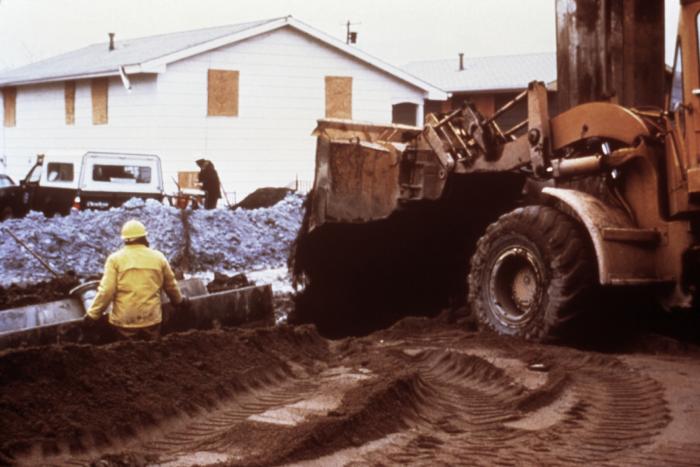
Image context: this article uses CDC's 1981 photograph of Love Canal cleanup work because the machinery matters. The crisis did not end with a declaration or a headline. It became soil removal, containment, monitoring, home demolition, relocation files, and long aftercare for a community whose trust had already been broken.[1][5]
Timeline anchors
- 1942-1953: Hooker Electrochemical Company disposed of hazardous chemicals in the abandoned canal.[1]
- 1953: the landfill was covered and the property entered the school-and-housing chain that made exposure a residential problem.[1][2]
- August 1978: New York and federal officials moved toward emergency action after contamination and resident health fears became impossible to treat as local nuisance complaints.[2]
- May 21, 1980: President Carter declared an emergency supporting temporary relocation of about 700 families, with EPA describing the evidence as suggestive enough to justify action before definitive studies were complete.[3]
- 1980: Congress enacted CERCLA, the Superfund law; EPA's site profile explicitly links the severity of Love Canal contamination to the creation of federal hazardous-waste cleanup legislation.[1]
- 2004: EPA removed Love Canal from the National Priorities List after completed cleanup actions, while land-use controls and monitoring remained part of the site's afterlife.[1]
A neighborhood made the exposure visible
EPA Region 2 administrator Eckardt C. Beck's 1979 account is valuable because it reads like an institution encountering a disaster before it had a mature script for such disasters. Beck called Love Canal one of the most appalling environmental tragedies in American history and stressed that the deeper danger was repeatability: it could happen elsewhere unless the country moved faster to prevent it.[2]
The facts he listed were both chemical and domestic. A 1978 New York Times lead cited in the EPA Journal account described 82 different compounds, including 11 suspected carcinogens, moving upward into backyards, basements, and a school area.[2] Beck also described corroding drums, dying vegetation, chemical puddles, odors, skin burns, miscarriage concerns, birth-defect reports, and high white-blood-cell counts under observation.[2] The article should not be read as a final epidemiologic adjudication of every claimed outcome. It is more important as a contemporaneous record of why ordinary residence had become intolerable.
That distinction matters. Love Canal's memory is not strengthened by pretending that every health question was instantly settled. It is strengthened by noticing the governance gap. Residents were not asking an academic question about perfect causal attribution. They were asking whether pregnant people, infants, children, and families should remain in houses beside a leaking chemical landfill while agencies gathered stronger evidence.
Relocation happened before perfect certainty
The May 1980 EPA press release makes the public-health threshold unusually explicit. Deputy Administrator Barbara Blum said health studies were preliminary and not fully confirmed, but that this was not an ordinary situation. The completed studies were, in EPA's phrasing, sufficiently suggestive of a threat to public health that prudence dictated relocation while more definitive studies continued.[3]
That is the hinge of the Love Canal lesson. Public health sometimes acts under a burden different from courtroom proof or journal closure. Waiting can be a decision too. In Love Canal, waiting meant keeping families in homes where exposure concerns had already overwhelmed the normal boundary between private residence and hazardous-waste site.
The relocation scale also changed the meaning of the case. The 1980 declaration covered about 700 families for temporary relocation.[3] EPA's current profile says FEMA ultimately evacuated about 950 of more than 1,050 families from a 10-square-block area, while all but two nearby families were evacuated and affected homes were demolished in 1982.[1] Those numbers keep the crisis from shrinking into one famous protest image or one agency memo. A neighborhood had to be moved because a waste-disposal decision from decades earlier had become a health-policy emergency.
Superfund turned memory into liability architecture
Love Canal is remembered politically because it exposed a missing tool. Beck's 1979 EPA Journal essay identified the liability question plainly: old waste sites changed owners, dangers surfaced later, and the country lacked secure mechanisms for deciding who would pay when health-related danger appeared.[2] The 1980 relocation release made the same point more directly, arguing that Americans would not be free from the toxic-waste legacy without Superfund legislation giving EPA authority and funds to clean hazardous-waste sites before they damaged public health.[3]
That is why commemoration should not stop at tragedy. Love Canal helped make a new administrative category: the abandoned hazardous-waste site as a federal health and cleanup responsibility. EPA's current site profile states that the severity of contamination led to CERCLA, commonly called Superfund, and that Love Canal was placed on the first National Priorities List in September 1983.[1]
The law did not undo the exposure. It did not restore the old neighborhood as it had existed before. It did something more bureaucratic and more durable: it gave the federal government a way to name, rank, fund, enforce, and revisit hazardous-waste cleanups. Memory became an operating system.
Cleanup did not erase the boundary
EPA's current profile describes the cleanup as complete, with the site removed from the National Priorities List in September 2004. It also describes continuing operation, maintenance, and monitoring: landfill-cap inspection, groundwater wells, contaminated-liquid collection, treatment systems, five-year reviews, institutional controls, deed limits, and zoning restrictions.[1]
That afterlife is important. A cleaned hazardous-waste site is not the same thing as a forgotten site. Some areas remain limited to commercial or industrial use; other areas were judged suitable for normal residential use. The site is therefore remembered not only through disaster language but through land-use grammar: where people can live, what must be monitored, what must be inspected, and what restrictions must travel with property.[1]
This is the mature version of the Love Canal memory. The first memory is fear: waste in basements, children near a school, families unsure whether their homes are making them sick. The second memory is mobilization: residents, journalists, state officials, EPA, FEMA, courts, and Congress forcing a response. The third memory is maintenance: caps, drains, treatment, reviews, and restrictions that remain because exposure prevention has to be managed long after national attention moves on.[1][2][3]
What the site asks us to remember
Love Canal should not be commemorated as a simple morality tale in which bad disposal produced obvious harm and then law solved it. The sources show a harder sequence. Industrial waste was buried. A neighborhood was built. Complaints accumulated. Chemical and health evidence emerged unevenly. Residents made private fear public. Officials decided that suggestive evidence could be enough for relocation. Congress built a national cleanup framework around a category of danger that could no longer be treated as local misfortune.[1][2][3]
The health lesson is therefore about timing and proof. If agencies wait for complete certainty, families may be left inside exposure while knowledge matures. If agencies act too loosely, they can damage trust, property, and credibility. Love Canal remains powerful because it sits at that uncomfortable boundary and shows what happens when the cost of delay falls first on residents.
The neighborhood's name now carries more than contamination. It carries a demand that environmental health be allowed to see homes, schools, groundwater, pregnancy, childhood, property, and federal liability as one system. The cleanup photograph belongs here because it shows the eventual machinery of response. But the memory begins earlier, with residents insisting that the evidence problem was already a life problem.
Sources
- U.S. Environmental Protection Agency, "LOVE CANAL: Superfund Site Profile" - site background, disposal history, relocation scale, cleanup stages, National Priorities List dates, current status, and institutional controls.
- Eckardt C. Beck, "The Love Canal Tragedy," EPA Journal (January 1979) - contemporaneous EPA account of contamination reports, resident concerns, emergency response, and the liability gap around abandoned hazardous-waste sites.
- U.S. Environmental Protection Agency, "EPA, New York State Announce Temporary Relocation of Love Canal Residents" (May 21, 1980) - emergency relocation release describing preliminary but suggestive health evidence and the policy case for Superfund authority.
- U.S. Environmental Protection Agency, "EPA History: Love Canal" - EPA historical resource hub linking archival press releases, articles, cleanup milestones, and Superfund profile materials.
- Centers for Disease Control and Prevention Public Health Image Library, "ID#: 5534" - 1981 CDC photograph of Love Canal cleanup work used as the article image.