
CDC's food-thermometer video is only a few seconds long, which is exactly why it is worth annotating. The scene is deliberately simple: a hamburger patty is cooking, a thermometer enters from the side, and the temperature reading becomes the deciding fact.[1][5] Nothing in the clip tries to make home cooking look technical or elite. The public-health move is smaller and stronger: replace "it looks done" with "it reached a safe internal temperature."
That shift matters because ordinary kitchens reward visual confidence. People learn to read browning, grill marks, firmness, juices, smell, and time. Those cues can be useful for flavor and texture, but CDC's current prevention guidance draws a hard safety boundary: the only way to tell if food is safely cooked is to use a food thermometer, because color and texture cannot reliably prove safety for most foods.[3] The video compresses that whole rule into one tiny kitchen interruption. It does not ask viewers to memorize microbiology. It gives them a repeatable checkpoint.
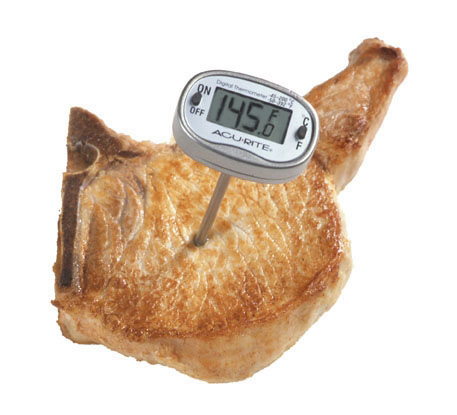
Image context: the cover photograph is a USDA image of a thermometer inserted into pork. It is a real food-safety photograph, not an illustration or diagram. It belongs here because the whole article turns on a physical act: inserting a probe and letting temperature, rather than appearance, decide whether cooking has crossed the safety threshold.[6]
The video makes measurement feel ordinary
The strongest thing about the clip is its refusal to over-explain. A food thermometer appears almost like a kitchen utensil that should have been there all along.[1] That is good risk communication. Food poisoning prevention often fails when advice feels like a separate ritual layered on top of cooking. The thermometer works better when it becomes part of the cooking act itself, like a spatula, timer, or cutting board.
CDC's written video page says the short is about how and when to use a thermometer to check food temperatures and prevent food poisoning.[2] That plain wording matters. The thermometer is not presented as a way to make food fancier. It is presented as a way to close an uncertainty gap. Heat has to reach the interior where harmful germs may survive; the surface can brown before the center has become safe.[3][4]
That is why the hamburger example is well chosen. Ground meat is structurally different from a whole steak or chop. Grinding can move surface contamination through the product, so the center matters. CDC's safer-food table gives the consumer rule: ground meat, including beef and pork, should reach 160°F, all poultry should reach 165°F, and whole cuts of beef, veal, lamb, and pork should reach 145°F followed by a three-minute rest.[4] The video does not recite the whole table, but it demonstrates the habit that makes the table usable.
The side insertion is not a throwaway detail
In the clip, the thermometer goes into the patty from the side.[1][5] That matters because a thin food can fool a top-down probe. If the sensing area is not actually in the center, the reading can become a false reassurance. CDC's prevention page links thermometer use to correct placement, and its broader cooking advice treats internal temperature as the safety fact rather than the food's surface appearance.[3]
This is the useful way to read the video: not as a complete training course, but as a cue to a larger discipline. The thermometer has to be clean, inserted into the right part of the food, and read against the right target temperature. It should also be used when reheating leftovers, where CDC notes that microwaved food should reach 165°F and that standing time helps cold spots absorb heat from hotter areas.[3]
That last point is easy to overlook. The same measuring logic applies beyond burgers. Casseroles, leftovers, poultry, and reheated microwave meals all create situations where the outside can look acceptable while the coldest point remains underheated.[3][4] The thermometer is therefore less a meat gadget than a way to make uneven heating visible.
The article's lesson is not "cook everything hotter"
A common misreading of food-safety advice is that safety always means maximum heat. The better lesson is targeted verification. CDC's safer-food guidance separates categories because foods do not all carry the same cooking rule.[4] Fish with fins, whole cuts of pork, ground beef, poultry, casseroles, leftovers, and egg dishes are not interchangeable. Some foods also need rest time after cooking, which allows internal heat to finish the safety work.[4]
This distinction matters for quality as well as safety. If a cook relies only on fear, they may overcook everything and eventually stop trusting the guidance because the results are dry or disappointing. The thermometer offers a better bargain: cook to the relevant safety threshold, not to a vague state of culinary anxiety. In that sense, the device can make food safer and better at the same time.
The CDC video works because it makes that bargain visually quick. It does not scold the cook for wanting dinner to look good. It simply interrupts appearance with a number.[1] Once the number enters, the cook has a different kind of evidence.
What the short leaves out, and why the writing has to fill it in
Because the video is so compressed, it cannot carry the entire food-safety system. It does not show handwashing, cross-contamination control, refrigerator timing, thawing, or recalled-food handling. CDC's current prevention guidance keeps those pieces together under the four-step frame: clean, separate, cook, and chill.[3] Temperature verification is the "cook" step's measurement layer, not the whole household safety plan.
That boundary is important. A burger cooked to the right temperature can still be part of a risky meal if raw juices contaminated a ready-to-eat salad, if leftovers sat too long in the danger zone, or if reheating left cold pockets in a casserole.[3] The thermometer is powerful because it solves one narrow problem very well. It does not solve every food-handling problem around it.
The best use of the video, then, is as a mental reset. When a cook is tempted to trust color, firmness, grill marks, or a recipe's exact time, the clip says: check the center. If the food category requires a temperature, use the thermometer and the correct target.[1][3][4] That is the habit the article wants to preserve. In a home kitchen, safety often depends on small behaviors that happen before anyone feels sick, before any outbreak is visible, and before a meal looks suspicious. A probe in the right place is one of those behaviors.
Sources
- Centers for Disease Control and Prevention, "Always use a food thermometer to check temp while cooking," YouTube video, released Aug. 20, 2019.
- Centers for Disease Control and Prevention, "Video: Always Use a Food Thermometer" (Feb. 14, 2024) - CDC video page describing the thermometer-check message and food-poisoning prevention context.
- Centers for Disease Control and Prevention, "Preventing Food Poisoning" (updated Nov. 24, 2025) - four-step food-safety frame, thermometer rule, color/texture boundary, reheating guidance, and chilling window.
- Centers for Disease Control and Prevention, "Safer Food Choices" (updated Jan. 31, 2025) - safer cooking temperatures for poultry, whole cuts of meat, ground meat, eggs, seafood, and higher-risk foods.
- Wikimedia Commons, "File:Always use a food thermometer to check temp while cooking.webm" - CDC video provenance page documenting the YouTube ID, release date, description, and CDC authorship.
- Wikimedia Commons, "File:Pork thermometer.jpg" - USDA photograph used as the article image.