UKPDS is often remembered through a flattened sentence: lower glucose works, metformin won, and modern type 2 diabetes care became obvious.[1][2][4] The primary sources support a tighter reading. UKPDS did not hand clinicians one universal rule. It showed, first, that tighter glycaemic control in newly diagnosed type 2 diabetes produced a clear microvascular benefit; second, that metformin in overweight patients had a distinctive and unusually attractive outcome profile; third, that blood-pressure control was producing its own large vascular gains inside the same study world; and fourth, that some of the biggest cardiovascular payoffs from early glucose control only became fully visible years after the trial phase had ended.[1][2][3][4]
That sequence matters because the afterlife of UKPDS has been stronger than the 1998 glucose paper by itself. If you read only the main sulphonylurea-or-insulin report, you do not get a clean macrovascular victory lap.[1] If you read only the metformin paper, you can mistake a subgroup result with a specific clinical texture for an all-purpose doctrine.[2] If you read the 2008 follow-up without the original trial, the legacy effect can look like a magic property of early treatment rather than the delayed consequence of a long randomized separation in exposure.[4] A close reading puts those layers back in order.
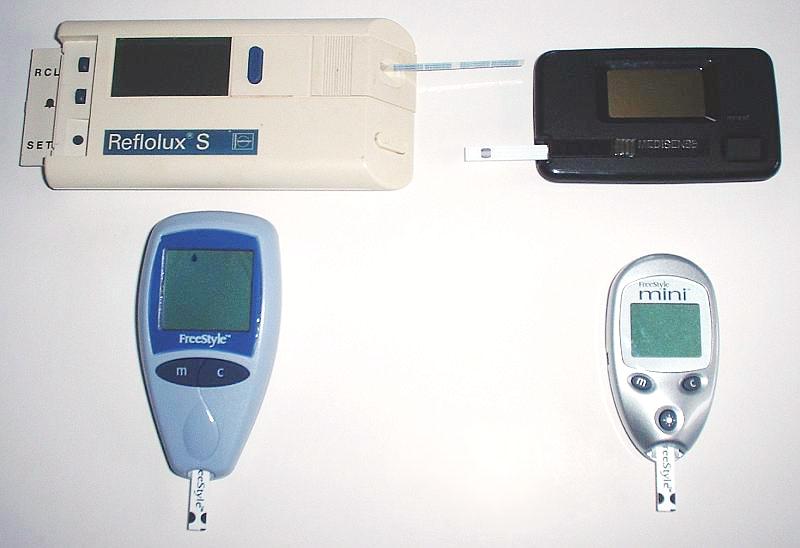
Image context: the lead image uses a real Wikimedia Commons photograph of four blood glucose meters spanning the 1980s to the early 2000s. It belongs here because UKPDS was built inside an era when repeated glucose measurement was becoming more portable, more routine, and more tightly tied to treatment adjustment rather than remaining a purely laboratory event.[6]
Timeline anchors before interpretation
- 1977: UKPDS begins enrolling patients with newly diagnosed type 2 diabetes across UK sites.[5]
- 1977-1997: the main trial runs across 23 UK clinical sites and ultimately includes 5,102 participants.[5]
- September 1998: UKPDS 33 and 34 report the glucose-control and metformin findings, while UKPDS 38 reports the blood-pressure results.[1][2][3]
- 2008: the 10-year post-trial follow-up shows that some benefits of early glucose control persist or emerge even after between-group HbA1c differences disappear.[4]
These dates are the first correction to the folk memory. UKPDS was not one paper with one headline. It was a long program of linked randomized comparisons in newly diagnosed disease, followed by a post-trial period that changed the meaning of the original results.[1][2][3][4][5]
1. The main glucose paper was about a treatment system, not a moral command
The Oxford summary is useful because it keeps the scale visible: UKPDS followed 5,102 patients with newly diagnosed type 2 diabetes over two decades of trial work.[5] That detail matters. The study was not asking whether late, refractory diabetes could be fixed by discipline. It was asking what early improvement in glycaemic exposure could alter before complications had fully hardened.
UKPDS 33 then made the treatment contrast concrete. Over 10 years, median HbA1c was 7.0% in the intensive group versus 7.9% in the conventional group, an 11% reduction in exposure.[1] The result most worth keeping is not a vague sense that "better control is better." It is the pattern of the endpoints. Relative to conventional treatment, intensive therapy reduced any diabetes-related endpoint by 12% and microvascular endpoints by 25%.[1] That is a real gain, and it is why the paper stayed canonical.
The boundary is just as important. In the same report, diabetes-related death fell 10% and all-cause mortality 6%, neither statistically convincing, while myocardial infarction showed a 16% reduction that stopped just short of conventional significance (P=0.052).[1][5] The paper therefore did not prove that glucose lowering had already delivered a full macrovascular settlement in 1998. It proved something narrower and still historically decisive: early intensive control clearly bent the microvascular curve in newly diagnosed type 2 diabetes.[1]
That is also why the adverse-event language matters. Patients in the intensive arm had more hypoglycaemic episodes, and weight gain was higher, especially with insulin.[1] UKPDS 33 was not a parable about virtue rewarded. It was a trial of a heavier treatment package that bought specific gains at real cost.
2. The metformin paper did not merely repeat the first result with a friendlier drug
UKPDS 34 is often remembered as the paper that made metformin feel inevitable.[2] Read closely, it did something a little different. It focused on overweight patients with newly diagnosed type 2 diabetes and showed a pattern that looked stronger, cleaner, and clinically easier to live with than the main sulphonylurea-or-insulin comparison.[2]
Median HbA1c was 7.4% in the metformin group versus 8.0% with conventional treatment.[2] More important, the endpoint profile was unusually persuasive: risk reductions of 32% for any diabetes-related endpoint, 42% for diabetes-related death, and 36% for all-cause mortality.[2] PubMed's abstract summary also notes the practical advantage that shaped metformin's afterlife: compared with insulin and sulphonylureas, the drug came with less weight gain and fewer hypoglycaemic attacks.[2]
That combination explains why metformin outlived the trial not just as one more glucose-lowering agent, but as the first-line pharmacologic default for many patients. The point is not that UKPDS discovered metformin in 1998. The point is that the study gave metformin a distinctive clinical identity inside type 2 diabetes care: useful glycaemic control, fewer hypoglycaemic penalties, and endpoint signals that looked better than the public had been taught to expect from glucose lowering alone.[2]
Still, the source should not be simplified into a universal slogan. This was an overweight subgroup paper inside a larger trial program, not a timeless command that one drug solves the full disease.[2] That distinction matters because the rest of UKPDS kept showing that type 2 diabetes outcomes are distributed across more than one risk axis.
3. UKPDS also argued against glucose monism
One of the easiest mistakes in diabetes history is to treat UKPDS as though it were only a glycaemia story. UKPDS 38 says otherwise.[3] In the embedded hypertension study, mean blood pressure during follow-up was 144/82 mm Hg with tighter control versus 154/87 mm Hg with less tight control.[3] The payoff was large: 24% lower diabetes-related endpoints, 32% lower diabetes-related deaths, 44% lower stroke risk, and 37% lower microvascular endpoints.[3]
Those numbers do not cancel the glucose findings. They reorder them. Type 2 diabetes was already being shown, within the same research program, as a disease whose complication burden could not be reduced to HbA1c alone.[1][3] Microvascular damage responded strongly to better glycaemic exposure, but major vascular outcomes were also being pulled by blood-pressure management in ways too large to ignore.[3]
This is one reason UKPDS matters historically beyond its most famous table. It helped move type 2 diabetes away from a sugar-only imagination and toward a multifactorial risk model. If later routine care became more interested in lipids, blood pressure, smoking, kidneys, and cardiovascular protection, UKPDS helped prepare that shift by showing early that one biomarker could not carry the whole disease burden.[3][5]
4. The deepest UKPDS lesson arrived after the randomized phase ended
The 2008 post-trial follow-up is the hinge that changed the meaning of the earlier papers.[4] After the trial phase, between-group HbA1c differences were lost within about a year.[4] If short-run exposure separation were the whole story, the benefit should have faded with it. Instead, the sulphonylurea-insulin group kept a 9% reduction in any diabetes-related endpoint and a 24% reduction in microvascular disease, while risk reductions for myocardial infarction (15%) and death from any cause (13%) emerged over time.[4]
The metformin story also persisted. In overweight patients, the post-trial paper reports continued reductions of 21% in any diabetes-related endpoint, 33% in myocardial infarction, and 27% in all-cause mortality.[4] Oxford's later summary names the pattern directly: a legacy effect.[5] The phrase is useful because it stops the reader from imagining UKPDS as a trial that either "worked" or "didn't work" at one frozen publication date. Early separation in risk-factor exposure kept paying after the visible biochemical gap had narrowed.[4][5]
This is the point at which UKPDS becomes more than a 1998 artifact. The randomized phase established the direction of travel. The follow-up showed that timing itself belonged to the treatment effect.[4] Early years of better control were not instantly interchangeable with later catch-up. That is a harder and more durable lesson than the simpler maxim that lower is always better.
The strongest reading of the source stack
Reading A: UKPDS proved aggressive glucose lowering is the master key to type 2 diabetes
This reading survives because the trial was large, famous, and genuinely practice-changing.[1][2][5] It captures one truth: better early glucose control clearly reduced microvascular complications, and metformin in overweight patients delivered a stronger-than-expected clinical profile.[1][2]
Reading B: UKPDS proved that early type 2 diabetes is modifiable, but only through layered risk management and with outcome timing that differs by endpoint
This reading fits the sources better. UKPDS 33 gave the clearest early win on microvascular disease, not a settled immediate macrovascular triumph.[1] UKPDS 34 showed that metformin mattered partly because its harms and benefits were differently balanced in overweight patients.[2] UKPDS 38 demonstrated that blood-pressure control was carrying major vascular and retinal gains on its own axis.[3] Then the 2008 follow-up showed that some cardiovascular benefit from early glucose control arrived late, after the randomized glycaemic separation itself had disappeared.[4]
That is why UKPDS remains contemporary. It did not prove that type 2 diabetes can be reduced to one number or one drug. It proved that newly diagnosed disease is historically consequential terrain: early exposures matter, microvascular benefit arrives sooner than some macrovascular benefit, metformin had a special place but not a monopoly on meaning, and vascular protection in diabetes has to be read across more than one control surface.[1][2][3][4][5]
Sources
- UK Prospective Diabetes Study (UKPDS) Group, "Intensive blood-glucose control with sulphonylureas or insulin compared with conventional treatment and risk of complications in patients with type 2 diabetes (UKPDS 33)" (Lancet, 1998) - PubMed abstract with the HbA1c separation, 12% any-endpoint reduction, and 25% microvascular reduction.
- UK Prospective Diabetes Study (UKPDS) Group, "Effect of intensive blood-glucose control with metformin on complications in overweight patients with type 2 diabetes (UKPDS 34)" (Lancet, 1998) - PubMed abstract with the overweight-patient metformin results and the lower-weight-gain/lower-hypoglycaemia profile.
- UK Prospective Diabetes Study Group, "Tight blood pressure control and risk of macrovascular and microvascular complications in type 2 diabetes: UKPDS 38" (BMJ, 1998) - PubMed abstract for the embedded hypertension comparison and its stroke, retinal, and diabetes-endpoint reductions.
- Holman RR, Paul SK, Bethel MA, Matthews DR, Neil HAW, "10-year follow-up of intensive glucose control in type 2 diabetes" (New England Journal of Medicine, 2008) - PubMed abstract for the post-trial legacy-effect results.
- Oxford Diabetes Trials Unit, "UK Prospective Diabetes Study (UKPDS)" - official study overview with trial scale, dates, and summary of the glucose, blood-pressure, and post-trial findings.
- Wikimedia Commons, "File:Glucose meters.jpg" - documentary photograph of four blood glucose meters from different device generations.