Reye syndrome is easy to remember only as a warning sentence. Many adults know the rule before they know the event: do not give aspirin to children with chickenpox or flu-like illness. That memory is useful, but it hides the way the rule was built. The change did not begin as a tidy package-label decision made in Washington. It began as a rare pediatric syndrome described in 1963, widened into a surveillance problem during the late 1970s and early 1980s, hardened through case-control epidemiology in 1980 and 1982, and only later settled into the over-the-counter warning language that now looks permanent.[1][2][3][4][6][7]
That sequence matters because the public-health question was not simply whether aspirin was dangerous in the abstract. It was whether a common household medicine, used during the exact viral illnesses that often preceded Reye syndrome, was contributing enough risk to justify changing what physicians recommended, what parents bought, and what manufacturers printed on the bottle.[2][3][4][5][6] The strongest reading of the episode is narrower than a morality tale and stronger as history: surveillance, epidemiology, professional warning, media amplification, and consumer substitution all moved before the label fully caught up.
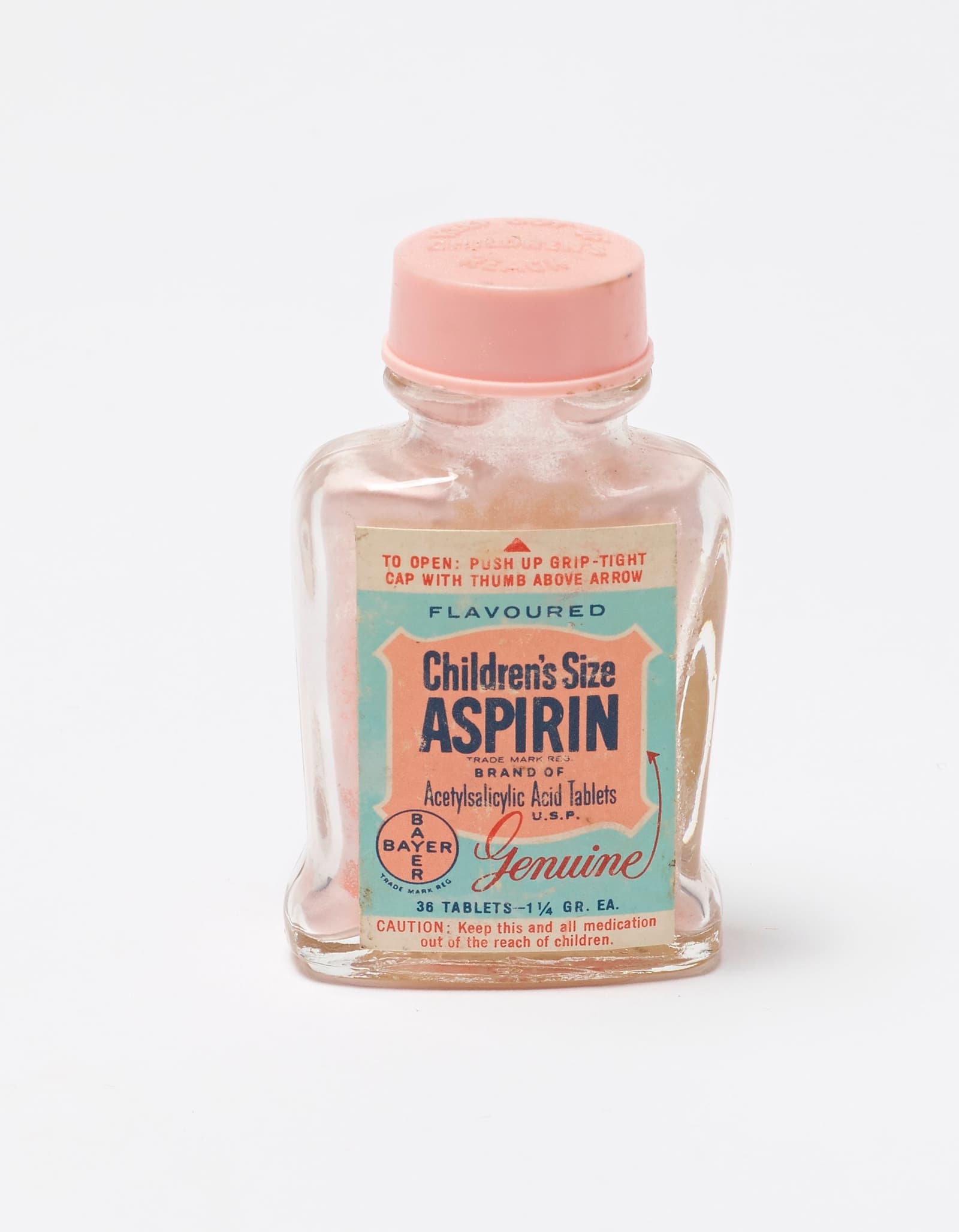
Image context: the lead image is a real photograph of a Bayer flavored children's aspirin bottle. It belongs here because this article is about a specific consumer object and the way its ordinary place in family medicine cabinets was altered by an evidence chain, not by abstract toxicology alone.[8]
Timeline anchors before interpretation
- October 12, 1963: R. Douglas Reye, Graeme Morgan, and Jim Baral publish the Lancet paper describing encephalopathy with fatty degeneration of the viscera as a distinct childhood disease entity.[1]
- 1980: a Pediatrics outbreak study during influenza A finds that all 7 Reye patients had taken salicylates, compared with 8 of 16 ill classmate controls, and that the patients tended to have received larger doses.[3]
- June 11, 1982: CDC publishes the Surgeon General's advisory against salicylate use in children with influenza or chickenpox, estimating 600-1,200 U.S. cases annually and a 20%-30% death rate among reported cases.[2]
- 1982: a JAMA case-control study frames aspirin as a risk factor in Reye syndrome, strengthening the epidemiologic case beyond one outbreak cluster.[4]
- 1980-1985: national marketing and physician-mention data later show steep declines in children's aspirin use alongside rising acetaminophen substitution and falling Reye reporting.[5]
- 1986: according to a later policy analysis, FDA-required aspirin labeling arrives after most of the decline in Reye incidence has already occurred.[6]
1. The first event was recognition, not proof
The 1963 Lancet paper matters because it gave clinicians a nameable syndrome before anyone knew how to prevent it.[1] Reye and colleagues were not writing about aspirin policy, media messaging, or retail warnings. They were trying to mark out a recognizable clinical pattern in children with acute encephalopathy and fatty change in organs, especially the liver.[1] In historical terms, that first move is smaller than later public memory and more important. A disease has to become visible before it can become governable.
That early visibility was not yet a causal answer. Through the 1960s and 1970s, Reye syndrome remained a frightening but relatively uncommon pediatric catastrophe that often appeared after viral illness.[1][2] The syndrome's rarity complicated everything. A common medicine and a rare disease do not automatically produce an obvious signal. Most children who received aspirin did not develop Reye syndrome, and many febrile illnesses ended uneventfully. The event reconstruction therefore has to begin with this asymmetry: the eventual warning did not come from one glaring toxic disaster but from a low-frequency, high-severity association that had to be assembled through surveillance and comparison.[2][3][4]
2. The real hinge was not one bottle, but one comparison
The 1980 Starko study is important because it changed the argument from anecdote to structured contrast.[3] During an influenza A outbreak, investigators compared 7 patients with Reye syndrome against 16 ill classmates who served as controls.[3] The prodromal illnesses looked broadly similar, but medication use did not. All 7 patients had taken salicylates; only 8 of 16 controls had, and the patients had generally received larger doses.[3]
That does not sound like a giant trial, and it was not. What made it powerful was fit. The control subjects had the same kind of community viral illness environment without the same neurologic collapse. In other words, the study did not ask whether sick children took medicine. It asked whether children who crossed into Reye syndrome looked different from children who had the same outbreak around them and stayed on the ordinary side of it.[3]
The 1982 JAMA case-control paper broadened that logic and made it harder to dismiss the salicylate signal as one local fluke.[4] By the time the Surgeon General's advisory appeared in June 1982, CDC was able to say openly that the epidemiologic evidence was strong enough to justify a warning to parents and health-care personnel.[2] This is the critical shift in the chain. Reye syndrome did not become a warning-label issue because aspirin suddenly changed. It became a warning-label issue because comparison studies changed what public-health authorities were willing to infer from a rare but devastating pattern.[2][3][4]
3. June 1982: the federal warning moved before perfect closure
The CDC advisory from June 11, 1982 still reads like an institution deciding that the practical threshold for action had been crossed.[2] The language is careful but decisive: because salicylates such as aspirin had been associated with Reye syndrome in children with influenza and chickenpox, the Surgeon General advised against their use in those diseases.[2] CDC also spelled out the stakes in plain epidemiologic terms, estimating 600-1,200 U.S. cases each year, mostly among children aged 5 to 16, with death in 20%-30% of reported cases.[2]
What matters here is the order of operations. The advisory did not wait for a mechanistic explanation at the molecular level, and it did not wait for a packaging solution. It treated the available case-control evidence as sufficient for behavior change because the syndrome was severe, the exposed population was large, and alternatives for pain and fever relief already existed.[2][3][4][6] That sequence is the opposite of the myth that public-health change begins only after a final regulatory text appears. In this episode, professional warning came first.
4. The fever aisle changed before the label became the law of the bottle
The best evidence on this point comes from the afterlife studies. Arrowsmith and colleagues' 1987 Pediatrics paper reports that annual CDC case reporting declined markedly between 1980 and 1985, while pharmaceutical marketing data showed sharp decreases in the use and purchase of children's aspirin and increasing physician mentions of acetaminophen for flu and chickenpox.[5] That is not proof of one single causal lever. It is proof that the retail and prescribing environment was already moving.
The 1992 Milbank Quarterly analysis makes the timing even sharper. Its abstract states that the media played a central role in changing aspirin use among children after reports of the association and that, by the time FDA-required aspirin labeling arrived in 1986, most of the decline in Reye incidence had already occurred.[6] This is one of the most useful corrections in the whole story. The label mattered, but it did not do the earliest heavy lifting by itself. By the mid-1980s, the new norm had already spread through clinicians, news coverage, parents, and pharmacy choices.[5][6]
That interpretation also explains why the event feels different from a classic product recall. Aspirin was not removed from the market. Instead, its meaning narrowed. A medicine that had once been casually aimed at children's fever had to be repositioned around age, illness context, and warning language. The public-health outcome came less from eliminating the product than from changing who was now supposed to use it, and when.[2][5][6][7]
5. What the current bottle preserves
The contemporary Bayer Genuine Aspirin label still carries the Reye syndrome warning in explicit form.[7] It tells readers that children and teenagers who have or are recovering from chickenpox or flu-like symptoms should not use the product, and it adds the familiar instruction to seek medical advice if behavioral changes with nausea and vomiting occur because these can be an early sign of Reye syndrome, described there as a rare but serious illness.[7]
That persistence matters because it shows how a once-contested association became ordinary packaging language. The label is not a museum relic. It is the surviving surface of an older argument. By the time the warning became part of routine OTC text, the syndrome had already rewritten consumer behavior, physician recommendation patterns, and the place of acetaminophen in pediatric fever care.[5][6][7]
The strongest two interpretations
Interpretation A: the FDA label was the decisive intervention that solved the problem
This reading survives because the warning label is what later generations can still see.[7] It captures one real truth: once a risk enters package text, the warning becomes durable, standardized, and hard to forget.
Interpretation B: surveillance and public warning changed behavior first, and the label later locked the new norm into the bottle
This reading fits the source chain better. The aspirin-linked outbreak and case-control studies arrived in 1980 and 1982.[3][4] The Surgeon General's advisory followed in 1982.[2] National marketing data later showed falling children's-aspirin use and rising acetaminophen substitution across 1980-1985.[5] The policy-afterlife analysis then concluded that most of the decline in Reye incidence had already happened by the time FDA-required labeling appeared in 1986.[6]
What would weaken Interpretation B? Evidence showing that consumer behavior and case reporting stayed flat until labeling became mandatory would do it. The studies cited here point the other way. The sequence looks like a warning-and-substitution story first, and a packaging codification story second.[5][6]
Why this reconstruction still matters
Reye syndrome changed pediatric fever care because it showed how a rare syndrome can reorganize an everyday medicine cabinet when three conditions line up: the outcome is severe, the association is epidemiologically persuasive, and there is an easy substitute already on the shelf. The bottle changed because the evidence changed, but the timeline shows that retail language was not the opening move. Surveillance, comparison, and public warning got there first.[2][3][4][5][6][7]
That is the lasting lesson from 1963 to 1986. A package warning looks like the endpoint of regulation. In this case it was also the fossil of a faster public-health shift, one that had already taught parents, doctors, and manufacturers to read children's aspirin differently before the text became permanent.
Sources
- R. D. Reye, G. Morgan, and J. Baral, "Encephalopathy and fatty degeneration of the viscera. A disease entity in childhood." Lancet (October 12, 1963) - PubMed record for the original paper that described the syndrome as a distinct childhood entity.
- Centers for Disease Control and Prevention, "Surgeon General's Advisory on the Use of Salicylates and Reye Syndrome" (MMWR, June 11, 1982) - the federal warning against salicylate use in children with influenza or chickenpox, with CDC's case and mortality estimates.
- Karen M. Starko, Charles G. Ray, Lilia B. Dominguez, W. Lawrence Stromberg, and D. Frank Woodall, "Reye's syndrome and salicylate use." Pediatrics (December 1980) - PubMed record for the influenza-outbreak case-control study comparing 7 patients with 16 ill classmates.
- Robert J. Waldman, William N. Hall, H. McGee, and Gail Van Amburg, "Aspirin as a risk factor in Reye's syndrome." JAMA (June 11, 1982) - PubMed record for the case-control study that strengthened the aspirin-risk argument.
- Janet B. Arrowsmith, Donald L. Kennedy, James N. Kuritsky, and Gerald A. Faich, "National patterns of aspirin use and Reye syndrome reporting, United States, 1980 to 1985." Pediatrics (June 1987) - PubMed record for the national trend analysis linking falling children's-aspirin use with declining Reye reporting.
- Vicki Paden and Lisa Frisch, "Effects of professional and media warnings about the association between aspirin use in children and Reye's syndrome." Milbank Quarterly (1992) - PubMed record for the analysis arguing that most of the decline had occurred by the time FDA-required labeling began in 1986.
- DailyMed, "Bayer Genuine Aspirin (aspirin) tablet" - current OTC label page showing the persistent Reye syndrome warning language.
- Wikimedia Commons, "File:Bayer Flavoured Children's Size Aspirin Bottle - DPLA - 7f425b90325e8c51722e1a86333918ff (page 1).jpg" - source page for the documentary bottle photograph used as the article image.
Editor’s Pick Review
This piece wins the 24-hour editor pick on execution depth and evidence control. It keeps a clear event-reconstruction spine from 1963 to 1986, anchors the narrative with multiple dated inflection points, and sustains high factual density without losing readability. The argument boundary is handled well: the article distinguishes between epidemiologic association, policy timing, behavior change, and labeling codification instead of flattening them into a single-cause story.
Quality metrics in the 24-hour candidate pool were strongest here: top-tier source depth, strong numeric anchoring, complete EN/ZH publication pair, and quiz integrity. Image-policy compliance is also clean under the updated stricter gate. The visual is immersive and topic-grounded (a real documentary photograph of the exact consumer object discussed), while analytical/diagram-style visuals are absent.