HbA1c is often explained too quickly. Patients hear that it is their "three-month average," then understandably read it as a smoother version of today's glucose. The test does something more specific than that.[1][2] HbA1c works because glucose in the bloodstream binds to hemoglobin inside circulating red blood cells, and that glycation stays in place for the life of the cell.[1][4] The lab is therefore reading accumulated exposure, not the current hour.
That distinction is the whole article. A finger-stick or CGM trace answers, "What is the glucose level now, or over the last few minutes?" HbA1c answers, "What glucose environment have these red cells been living through as they circulated?"[1][2][4] Those are related questions, but they are not interchangeable. Once you see that, both the strength and the weakness of HbA1c become easier to understand.
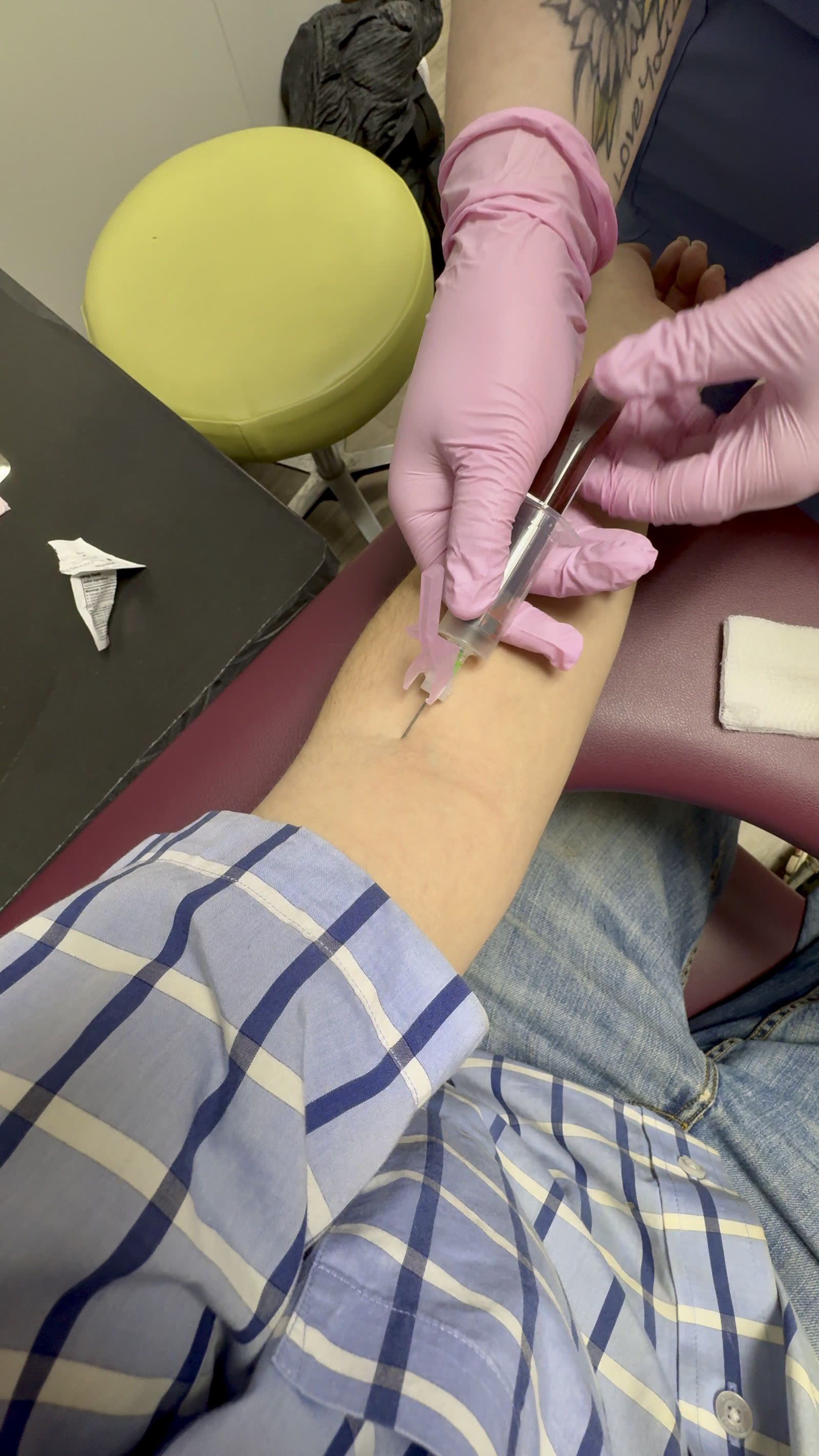
Image context: the cover uses a real documentary photograph of venipuncture from Wikimedia Commons. That is the right visual here because HbA1c enters care as a lab sample, not as a visible symptom. The important action happened earlier, inside the bloodstream, while hemoglobin was being glycated over time.[6]
Timeline anchors before the mechanism
- 2007: a continuous-glucose study published in Diabetologia showed that HbA1c tracked mean glucose most strongly over the preceding 8 to 12 weeks, reinforcing its use as a long-horizon marker rather than a same-day reading.[4]
- 2011: WHO issued its abbreviated report accepting glycated hemoglobin as a diagnostic tool for diabetes in appropriately standardized settings, helping move HbA1c from a monitoring marker into the diagnostic workflow.[3]
- 2024: CDC and NIDDK continued to state the current operating boundary clearly: HbA1c reflects about the past 2 to 3 months or 3 months, but recent weeks weigh more heavily than older ones, and conditions affecting red-cell life span or hemoglobin can distort the result.[1][2][5]
1. The test works because hemoglobin keeps a chemical record
The core chemistry is simple. Hemoglobin carries oxygen inside red blood cells. Glucose circulating in blood can attach to that hemoglobin, and the amount of attached glucose rises as bloodstream glucose rises.[1][2] NIDDK's patient guide puts the mechanism cleanly: the higher the glucose level in the bloodstream, the more glucose will attach to hemoglobin.[1]
That means HbA1c is not measuring free glucose directly. It is measuring the percentage of hemoglobin molecules that have become glycated.[1][2] The lab result is therefore one step removed from the thing patients often care about most. It is an indirect marker, but an indirect marker built on a useful feature: red blood cells stay in circulation for a limited time, so their hemoglobin carries a running record of exposure rather than a momentary spike.[1][2][4]
This is why HbA1c remains clinically valuable. Glucose moves up and down with meals, exercise, stress, illness, sleep disruption, and medication timing.[1][2] A single fasting glucose can miss that motion. HbA1c compresses many exposures into one interpretable percentage, which is why it became attractive both for long-term monitoring and, later, for diagnosis.[1][3]
2. "Three-month average" is directionally right, but it is better understood as a weighted memory
The phrase "three-month average" is not wrong. It is just blunter than the physiology. NIDDK states that HbA1c represents a long-term average, but also notes that blood glucose levels within the past 30 days have a greater effect on the A1C reading than those in previous months.[1] That detail matters because it explains why recent improvement can start to move the number before a full quarter has passed, while yesterday's meal still does not dominate the result.
The 2007 continuous-glucose study led by Nathan and colleagues makes the same point in a more formal way. HbA1c correlated strongly with continuous-glucose measurements over the preceding 8 and 12 weeks, supporting the view that the test is best read as accumulated recent glycemia, not as a same-day metabolic status check.[4] In practice, that means HbA1c behaves like a weighted memory. It is long enough to smooth ordinary day-to-day noise, but short enough that a major change in treatment or adherence can start to show within weeks.[1][4]
This helps explain a common mismatch in clinic conversations. A patient may arrive with much better home numbers over the last two weeks and still have an HbA1c that looks disappointingly high. That does not mean the home numbers are false. It means the red-cell archive is still carrying older exposure from earlier weeks.[1][2][4]
3. The diagnostic appeal comes from standardization, not from perfection
HbA1c did not become a diagnostic tool just because it was convenient. It became acceptable when standardization improved enough that one laboratory's number could be meaningfully compared with another's. NIDDK now states that, for diagnosis, the blood sample should be analyzed with an NGSP-certified method consistent with the assays used in the Diabetes Control and Complications Trial.[1] WHO's 2011 report similarly accepted HbA1c for diabetes diagnosis, but only in settings with quality-assured, standardized measurement.[3]
That standardization is what makes the threshold language possible. CDC and NIDDK both state the current cut points: below 5.7% is normal, 5.7% to 6.4% indicates prediabetes, and 6.5% or above indicates diabetes, with confirmation needed unless the clinical picture is already obvious.[1][2] The attraction is practical. Unlike fasting plasma glucose or an oral glucose tolerance test, HbA1c does not require fasting and is less sensitive to short-term swings on the morning of the draw.[1][2]
But the important boundary is that convenience did not erase biology. The number is only as trustworthy as the red-cell and hemoglobin assumptions under it. HbA1c is powerful because it standardizes a chemically plausible memory trace. It becomes misleading when that memory trace is no longer behaving in the usual way.[1][3][5]
4. The main failure mode is not "bad math." It is altered red-cell life or altered hemoglobin
Once HbA1c is understood as glycated hemoglobin accumulated over red-cell survival, its major weakness becomes almost obvious. If red blood cells do not live their usual span, or if the hemoglobin itself is atypical, the archive changes shape.[1][5]
NIDDK lists several circumstances that can alter the result: recent blood loss, sickle cell disease, erythropoietin treatment, hemodialysis, and transfusion can change A1C values by changing red-cell life span or composition.[1] NGSP states the principle even more directly: any condition that shortens erythrocyte survival or decreases mean erythrocyte age can falsely lower HbA1c, regardless of assay method.[5] The logic is straightforward. Younger red cells have had less time to accumulate glycation, so the result can look better than the patient's actual glucose exposure.
The reverse problem can happen too. NIDDK notes that iron-deficiency anemia can produce a falsely high A1C result.[1] NGSP adds that iron deficiency is associated with higher HbA1c and that iron replacement lowers HbA1c and fructosamine concentrations.[5] Here the issue is not simply laboratory error. It is that hemoglobin chemistry and red-cell turnover are part of what the test is reading. If those conditions change, HbA1c may stop behaving like a clean proxy for glycemia.[1][5]
That is why HbA1c should never be treated as a sovereign number. When the A1c and the direct glucose evidence do not fit together, clinicians are supposed to suspect interference, not force the patient to match the lab story.[1][5] The test is excellent inside its operating assumptions. Outside them, it can drift.
5. What HbA1c can do, and what it cannot do
Used properly, HbA1c is still one of the most efficient markers in chronic diabetes care. It can summarize sustained exposure, help estimate complication risk, and provide a common language for treatment goals.[1][2] CDC still links higher A1C levels with higher complication risk and uses 7% or less as a common management target for many adults with diabetes, while stressing that individual goals differ.[2]
But HbA1c cannot tell you whether the patient is hypoglycemic right now, whether glucose swings are wide, or whether today's post-meal peak was severe.[1][2] It also should not be used indiscriminately for every diagnostic situation. NIDDK explicitly says the A1C test should not be used to diagnose type 1 diabetes, gestational diabetes, or cystic-fibrosis-related diabetes.[1] That boundary is worth preserving because it reminds readers that one elegant number is still only one instrument.
The most durable way to read HbA1c, then, is not as a verdict but as a time-structured clue. It tells you how much glycemic exposure hemoglobin has recorded across recent weeks. If the red cells are ordinary and the assay is standardized, that clue is powerful. If the red cells are turning over abnormally, if hemoglobin variants are present, or if anemia is reshaping the signal, then the clue has to be checked against direct glucose evidence before anyone builds treatment decisions on it.[1][5]
Sources
- National Institute of Diabetes and Digestive and Kidney Diseases, "The A1C Test & Diabetes" - NIDDK overview of what HbA1c measures, why recent 30 days matter more, diagnostic thresholds, and conditions that alter red-cell survival or hemoglobin.
- Centers for Disease Control and Prevention, "A1C Test for Diabetes and Prediabetes" (May 15, 2024) - CDC explanation of sugar-coated hemoglobin, red-cell turnover over roughly 3 months, diagnostic ranges, and estimated average glucose.
- World Health Organization, Use of glycated haemoglobin (HbA1c) in diagnosis of diabetes mellitus: abbreviated report of a WHO consultation (January 13, 2011) - WHO report on standardized diagnostic use of HbA1c.
- Nathan DM, Turgeon H, Regan S., "Relationship between glycated haemoglobin levels and mean glucose levels over time" (Diabetologia, 2007; PMC) - continuous-glucose study linking HbA1c most strongly with preceding 8 to 12 weeks of mean glucose.
- NGSP, "Factors that Interfere with HbA1c Test Results" (updated November 21, 2024) - assay and interpretation limits involving hemoglobin variants, altered erythrocyte survival, iron deficiency, and renal disease.
- Wikimedia Commons, "File:Drawing blood from a vein through phlebotomy and venipuncture.jpg" - source page for the documentary blood-draw image used as the article cover.