Tuskegee is often summarized as if the whole scandal were already complete in 1932: a racist and unethical study began, poor Black men were observed without proper consent, and the moral lesson is obvious. That version keeps the outline and drops the mechanism. The sharper question is why the study kept going once syphilis stopped being an untreatable disease. The original design was already exploitative. The later decades made it worse, because observation hardened into deliberate non-treatment after penicillin changed what standard care meant.[1][2][3][4]
That sequencing matters because it changes how the episode should be read in 2026. Tuskegee was not only a case of bad intentions at the start. It was a long administrative failure in which a federal study could survive changes in medicine, changes in ethics, and internal objections, right up until outside exposure forced the government to stop it.[1][2][4]
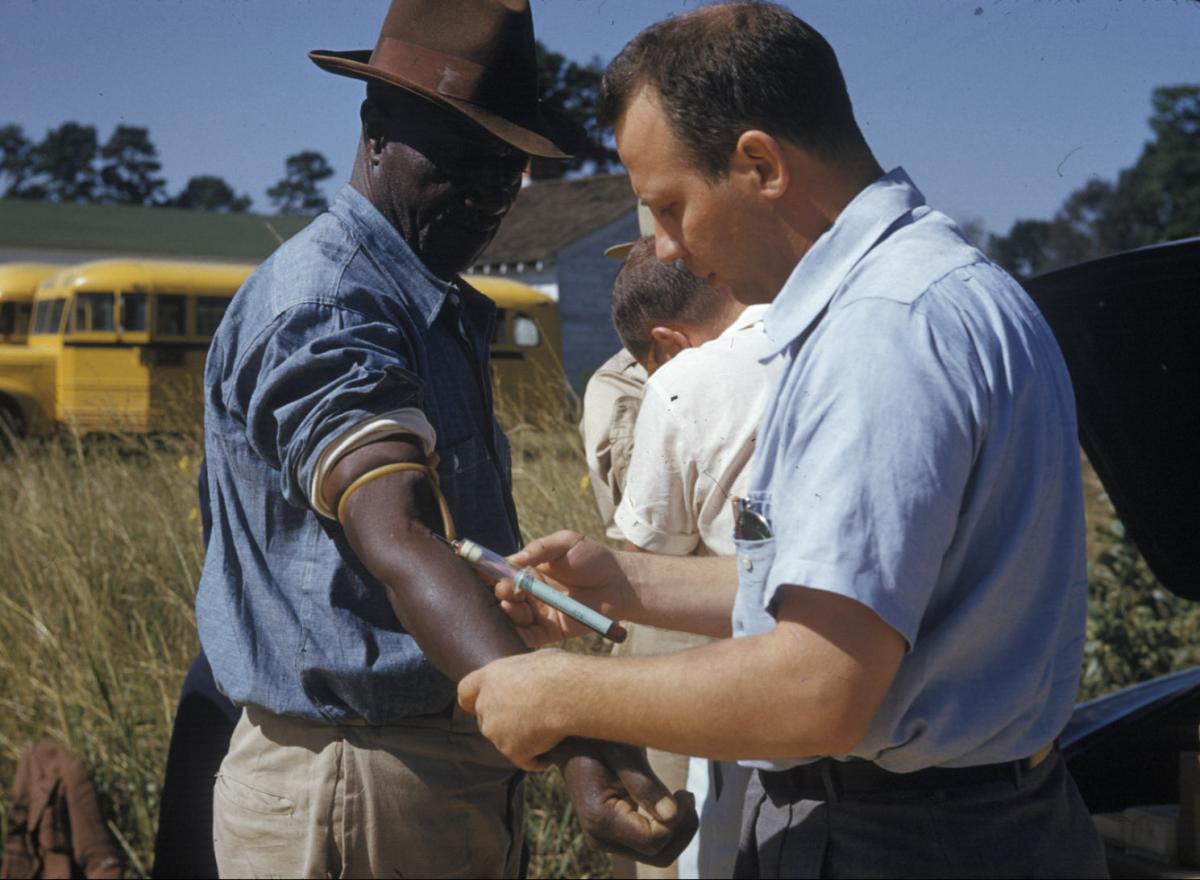
Image context: the cover image is an archival National Archives photograph connected to the study itself. It fits this article because the event being reconstructed was not a paperwork controversy in the abstract; it was a decades-long research program carried out on named communities and visible participants in Macon County, Alabama.[6]
Timeline anchors before interpretation
- 1932: the U.S. Public Health Service begins what it called the "Tuskegee Study of Untreated Syphilis in the Negro Male" in Macon County, enrolling 600 Black men, including 399 with syphilis and 201 without the disease.[1][2]
- 1943: penicillin becomes the treatment of choice for syphilis in the United States, changing the clinical meaning of continued non-treatment.[1][3]
- 1947: penicillin is widely available, and federal rapid-treatment centers are operating, yet study participants still are not offered curative therapy.[1][3]
- 1972: Associated Press reporting exposes the study on July 25, federal review follows, and the study is terminated that year.[1][2][4]
- 1974-1979: the post-Tuskegee federal response runs through the National Research Act and the commission work that produces the Belmont Report.[5]
- 1997: President Bill Clinton issues a formal federal apology to surviving participants and families.[2]
1) 1932: the study starts as exploitation, not as neutral observation
The federal government did not arrive in Macon County to discover whether research ethics might become difficult later. CDC's overview states the study enrolled Black men without informed consent and followed the natural history of untreated syphilis under the authority of the U.S. Public Health Service.[1][2] The men were told they were being treated for "bad blood," a loose local term that could cover several ailments, which already tells you something important about the study's architecture.[1][3] The core relationship was never one of fully informed participation.
That starting point matters because some later retellings quietly soften the early years by implying that no effective therapy existed, so the deepest moral failure must have come only later. The timeline does not support that comfort. Before penicillin, the study was already built on deception, unequal power, and racialized assumptions about who could be used as a long-term research population.[1][2][3]
Still, the moral status of the project changed again once medicine changed. A badly designed observational study in a pre-penicillin era is one kind of failure. A study that continues after an effective cure becomes standard is a narrower and more damning one.
2) 1943-1947: penicillin turns neglect into active withholding
CDC's museum timeline is the cleanest source for the hinge. By 1943, penicillin had become the treatment of choice for syphilis, and by 1947 it was widely available in the United States.[1][3] This is the moment when Tuskegee stops being defensible even under the study's own observational premise. The central clinical question had changed. Researchers were no longer watching the natural course of a disease that medicine could not reliably reverse. They were preserving that natural course by keeping participants outside the new treatment standard.[1][3][4]
The 1973 final report of the Tuskegee Syphilis Study Ad Hoc Advisory Panel makes that point with unusual force. The panel concluded that the study had become ethically unjustified and stated that penicillin should have been made available to the men, especially after it had become generally accessible.[4] That later judgment is important because it prevents retrospective vagueness. The issue was not only that the study looked bad by later values. Federal reviewers, looking back with the documentary record in hand, treated the failure to treat as a decisive ethical breach.[4]
This is also where the event reconstruction becomes more useful than the slogan version. Tuskegee did not persist because one early bad decision went mechanically unchanged for forty years. It persisted because institutions updated their science more quickly than they updated their obligations to the people inside the study. The paperwork functioned. The ethical conversion did not.
3) Internal concern existed, but shutdown still required exposure
One of the most sobering parts of the official timeline is how much friction the study could absorb. CDC records that concerns were raised internally before the public learned the full story, yet the study still continued until Associated Press reporting in July 1972 forced a national scandal.[1][2] That delay is a structural lesson. Bad projects do not always survive because nobody notices them. They also survive because institutional notice is weaker than institutional inertia.
Once the AP report broke, the government's posture changed quickly. The same year, an advisory panel was convened, and the study was terminated.[2][4] That sequence shows the real control point. Internal concern had not been enough. Public visibility was.
The panel's final report did not rescue the government's reputation, but it did settle the official record on a few core facts. The men had not given informed consent. They had not been offered treatment once effective therapy existed. The study was no longer justified.[4] Those are stronger conclusions than the softened language that often enters casual memory. Tuskegee did not end because the study had simply grown outdated. It ended because outside exposure made continued federal defense impossible.
4) After 1972, the legacy moved from scandal to research governance
The federal afterlife of Tuskegee matters because this is where memory turns into rules. HHS's Office for Human Research Protections presents the National Research Act as the law that created the National Commission for the Protection of Human Subjects of Biomedical and Behavioral Research, and it places the Belmont Report inside that same chain as the commission's ethical framework for respect for persons, beneficence, and justice.[5]
That does not mean Tuskegee alone created every modern protection. Human-subject regulation has multiple lineages, including Nuremberg, later federal policy, and other U.S. scandals.[5] But Tuskegee clearly functioned as one of the cases that made abstract ethics politically unavoidable in domestic research governance. The shift after 1972 was not cosmetic. Research participants had to become legible to review systems as people with rights, not just as useful bodies inside a protocol.[5]
CDC's retrospective page keeps the endpoint visible as well: in 1997, President Clinton formally apologized on behalf of the United States.[2] An apology, of course, did not repair what the study had already done. Its value lies elsewhere. It marks official recognition that the harm was not only medical and not only historical. It was governmental.
The strongest two interpretations
Interpretation A: Tuskegee is mainly a story about primitive medicine in a pre-antibiotic era
This reading captures the study's early chronology and misses the event's decisive turn. The official sources do not support treating Tuskegee as a tragedy completed before effective therapy existed. Penicillin changed the case. Continuing the study after that point converted background neglect into active withholding.[1][3][4]
Interpretation B: Tuskegee became most indefensible when modern therapy arrived and the study kept its subjects outside standard care
This interpretation fits the source stack better. It keeps the exploitative 1932 launch in view, but it also identifies the later threshold where the study's ethical status became even harder to defend. That threshold is why Tuskegee still matters for research governance. It shows that scientific progress does not protect subjects by itself. Institutions still have to decide that new knowledge changes what they owe the people already in their custody.[1][2][3][4][5]
What the reconstruction changes
The cleanest conclusion is narrower than the usual memory line and more useful. Tuskegee was not only a racist study that started badly and lasted too long. It was a federal research system that failed to convert a cure into an obligation. Once penicillin became standard, continuing the study meant preserving disease where treatment should have interrupted it.[1][3][4]
That is why the episode still belongs in present-tense health thinking. The central risk in human-subject research is not only bad design at the beginning. It is the possibility that institutions keep extracting knowledge after the moral basis for continuing has already collapsed. Tuskegee remains the American case study in what that collapse looks like when bureaucracy, medicine, and race are all moving on different clocks.[1][2][4][5]
Sources
- Centers for Disease Control and Prevention, "U.S. Public Health Service Syphilis Study at Tuskegee Timeline" (official chronology of enrollment, penicillin, exposure, and closure).
- Centers for Disease Control and Prevention, "U.S. Public Health Service Syphilis Study at Tuskegee" (official overview, participant counts, and later apology).
- CDC Museum, "The Untreated Syphilis Study at Tuskegee Timeline" (official museum chronology highlighting the 1943-1947 penicillin threshold).
- U.S. Department of Health, Education, and Welfare, Final Report of the Tuskegee Syphilis Study Ad Hoc Advisory Panel (1973; National Library of Medicine PDF).
- U.S. Department of Health and Human Services, "The Belmont Report" (OHRP page on the National Research Act commission and the principles of respect for persons, beneficence, and justice).
- National Archives, "Tuskegee Syphilis Study photograph" (archival source page for the article image).