Radon is one of those public-health risks that becomes harder to judge precisely because one part of the story is so widely known. Most people have heard that smoking dominates lung-cancer risk. Fewer remember the second half: radon is still the second leading cause of lung cancer in the United States, and the majority of radon deaths may occur among smokers without making radon irrelevant to everyone else.[1] That combination produces a durable misunderstanding. People hear "radon matters most for smokers" and convert it into "radon barely matters for nonsmokers," or "if my basement does not smell strange, my house is probably fine," or "a number below one action threshold means I can stop thinking about it."
The evidence is narrower and more useful than that. Radon is an odorless radioactive gas generated from the natural decay of uranium in rocks and soil. It enters buildings through cracks, joints, gaps around pipes, drains, and other ground-contact routes, then varies with geology, building tightness, ventilation, season, and room location.[1][2] In practice, the decisive step is not intuition. It is testing.
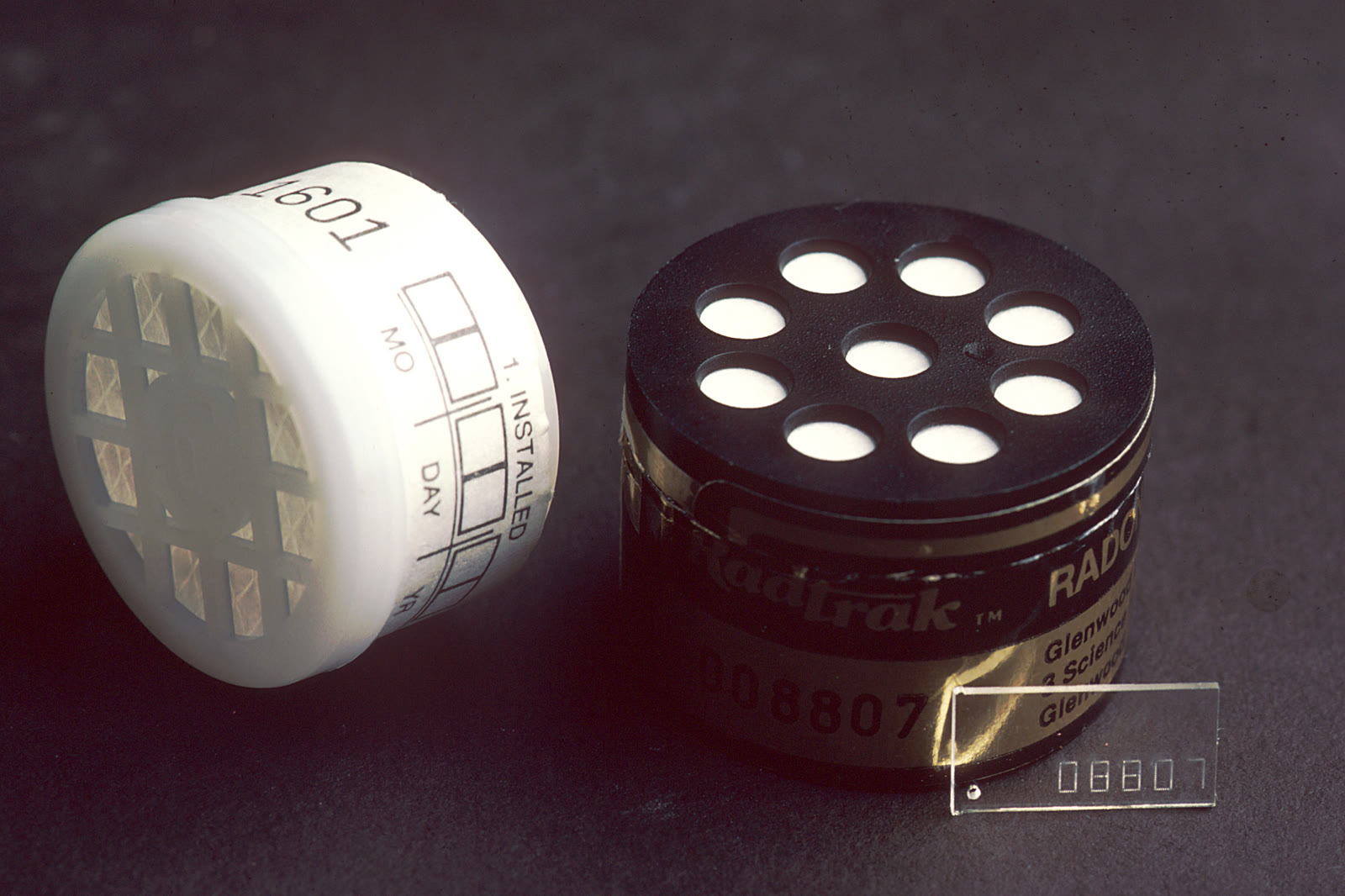
Image context: the lead image shows real household radon test devices. That documentary choice fits the argument because residential radon is not a visible hazard a reader can infer from taste, smell, or neighborhood reputation; it only becomes concrete when a specific home is actually measured.[5]
Timeline anchors: when the modern radon picture locked in
- 2005: the pooled European residential radon analysis led by Sarah Darby found lung-cancer risk rising about 16% per 100 Bq/m3, with no convincing threshold below which risk disappeared.[2][3]
- 2009: WHO's indoor-radon handbook set the most influential global public-health reference point: aim for 100 Bq/m3 if possible, and do not exceed 300 Bq/m3 where country conditions make the lower level unattainable.[2]
- 2021: a systematic review and meta-analysis focused on never-smokers still found a significant residential-radon association, estimating an adjusted excess relative risk of about 0.15 per 100 Bq/m3.[4]
- Current U.S. framing: NCI still summarizes the domestic burden at roughly 15,000 to 22,000 radon-related lung-cancer deaths each year, with more than 10% of those deaths occurring among nonsmokers.[1]
Those markers matter because they remove two tempting shortcuts at once. Radon is neither a niche basement curiosity nor a hazard that only exists when tobacco is present.
Myth 1: "Radon is mainly a smoker's issue, so nonsmokers can mostly ignore it"
Smoking absolutely changes the risk math, but it does not erase radon's independent role. WHO states that radon is much more likely to cause lung cancer in people who smoke, estimating smokers to be about 25 times more at risk from radon than non-smokers at comparable exposure.[2] That is exactly why public messaging keeps pairing the two. But NCI's fact sheet is just as clear about the other side of the relationship: more than 10 percent of radon-related lung-cancer deaths occur among nonsmokers.[1]
That boundary matters because a multiplier and a monopoly are not the same thing. Smoking multiplies harm; it does not own the entire causal lane. The 2021 never-smoker meta-analysis reinforces that point by showing that residential-radon risk does not vanish once tobacco is removed from the model.[4] In other words, "I do not smoke" is not a substitute for measurement. It only means the absolute risk profile is different from that of a smoker living in the same house.
This is the most useful public-health way to say it: tobacco makes radon worse, but radon remains a lung-cancer exposure even when tobacco is absent.[1][2][4]
Myth 2: "If the basement feels normal or the neighbor tested low, the rest of the house is basically safe"
This is where residential radon becomes counterintuitive. The gas has no smell, color, or taste, so the human senses contribute almost nothing to risk detection.[2] NCI therefore states the practical rule plainly: testing is the only way to know whether a home has elevated radon levels.[1]
Even that sentence is often under-read. NCI adds that homes next door to each other can have different indoor radon levels, making a neighbor's test result a poor predictor of your own house.[1] WHO pushes the same point from the building-science side. Radon levels depend on local geology, the permeability of underlying soils, the paths available for gas to enter the building, the exhalation of radon from some building materials, and the exchange rate between indoor and outdoor air.[2] That is a long way of saying that two houses on the same street can behave differently because the exposure pathway is hyperlocal.
Floor level is more complicated than the basement cliché suggests. WHO notes that radon levels are usually higher in basements, cellars, and living spaces in contact with the ground, but also states that considerable radon concentration can be found above the ground floor.[2] The right inference is not "ignore the basement." It is "do not stop the analysis at the basement." If a house has a strong entry route and weak ventilation, the gas can matter well beyond the room where it entered.
Myth 3: "A number below 4 pCi/L means there is no real risk, and one quick test settles the question"
Thresholds help households decide when to act. They do not divide the world into "safe" and "unsafe" houses with scientific finality.
NCI summarizes the EPA action recommendation for homes at or above 4 pCi/L and notes that about 1 in 15 U.S. homes is estimated to meet or exceed that level.[1] That threshold is operationally useful. It tells people where remediation should stop being theoretical. But the European pooled analysis found risk increasing with exposure without identifying a reassuring lower boundary where the relationship disappeared.[3] WHO's public-health response to the same problem was to recommend a lower preferred residential reference of 100 Bq/m3 and a ceiling of 300 Bq/m3 where countries cannot realistically reach 100.[2]
Those numbers only make sense if they are read as policy thresholds, not metaphysical guarantees. A house measuring 3.8 pCi/L has not crossed into a magic zero-risk zone. It has simply landed below one U.S. action trigger while still sitting inside a dose-response world.[1][2][3]
The same logic explains why one short reading should not automatically close the file. NCI says short-term detectors can measure from 2 to 90 days, while long-term tests run for more than 90 days and give a better estimate of average radon level because concentrations vary by day, month, weather, and pressure conditions.[1] WHO likewise recommends estimating annual mean exposure with measurements of at least 3 months when possible, while allowing protocol-compliant short-term tests in time-sensitive situations such as home sales or post-mitigation checks.[2] The operational lesson is simple: a quick test can be useful, but a long test is the better guide to the house you actually live in.
Myth 4: "If a home does test high, fixing it is basically a major reconstruction project"
This is another place where public imagination outruns the evidence. WHO's fact sheet lists several standard mitigation routes for existing buildings: increasing under-floor ventilation, installing a radon sump system in the basement or under a solid floor, blocking passage from basement spaces into living areas, sealing floors and walls, and improving ventilation more broadly.[2] It also notes that passive systems can reduce indoor radon levels by more than 50%, and that adding radon ventilation fans can lower levels even further.[2]
That does not mean every house gets the same fix. Entry routes differ, foundations differ, and the contractor workflow still has to match the building. But the evidence does support a calmer conclusion than the one many homeowners jump to. A high radon result is usually not a philosophical problem and not a demolition problem. It is a mitigation problem.
NCI adds the policy payoff: reducing radon levels in homes above the EPA action level could cut lung-cancer deaths by about 5,000 in the United States.[1] Once the issue is framed that way, household testing stops looking like fussy indoor-air perfectionism. It becomes basic risk sorting followed, when needed, by practical building work.
What the evidence-backed posture looks like
The strongest position is neither complacent nor theatrical.
- Test every home you live in or seriously plan to buy, because local geology and building pathways beat intuition.[1][2]
- Read thresholds as action tools, not as proof that numbers just below them are biologically irrelevant.[1][2][3]
- Prefer long-term measurement when time allows, because the risk you live with is an average exposure problem rather than a single-week snapshot.[1][2]
- Treat smoking status as a risk amplifier, not as permission for nonsmokers to ignore the house.[1][2][4]
- If a result is high, move from argument to mitigation, because standard reduction methods are real and established.[1][2]
That is the real correction to the common residential-radon myths. Radon is invisible, but it is not abstract. House by house, it is measurable. Measured exposure can be interpreted. Interpreted exposure can be reduced. The only truly weak strategy is pretending that a gas with no smell, no taste, and strong house-to-house variation can be judged without a detector.
Sources
- National Cancer Institute, "Radon and Cancer" fact sheet - U.S. death estimates, nonsmoker burden, testing windows, neighbor-house variation, and the EPA action level.
- World Health Organization, "Radon and health" fact sheet - indoor pathways, building-to-building variation, reference levels, and mitigation methods.
- Darby S, Hill D, Auvinen A, et al., "Radon in homes and risk of lung cancer: collaborative analysis of individual data from 13 European case-control studies" (BMJ, 2005) - pooled residential dose-response evidence.
- Torres-Duran M, Ruano-Ravina A, Kelsey KT, et al., "Residential radon and lung cancer characteristics in never smokers. A systematic review and meta-analysis" (Archivos de Bronconeumología, 2021) - residential-radon risk quantified in never-smokers.
- Wikimedia Commons, "File:Radon test kit.jpg" - photographic source for the radon detectors used as the article image.