

As of 2026-04-01 UTC, the most useful way to watch three official AED training videos is to treat them as one lesson about pause control rather than as separate pieces of emergency education.[1][2][3] The American Red Cross clip teaches the civilian sequence with almost no wasted motion. The American Heart Association video folds the AED into a compressions-first rhythm so the device never becomes an excuse to stop doing the rest of the job. Mayo Clinic then shows the box itself as a speaking instrument: open it, follow the prompts, clear for analysis, shock if instructed, and go straight back to hands. Watched together, the collection makes a sharper point than any one clip can manage alone. Public-access defibrillation works by shrinking the dead time inside cardiac arrest.
That framing matters because outside-hospital cardiac arrest remains brutally time-sensitive. NHLBI says nine out of 10 people who have a cardiac arrest outside a hospital die, often within minutes, and that immediate CPR plus defibrillation can save a life.[7] The Red Cross explains the timing problem in operational terms: first responders may take about 6 minutes to arrive, and the chance of survival can fall by about 10% per minute when defibrillation is delayed.[5] Those numbers are why an AED belongs in the same sentence as CPR. FDA describes an AED as a portable device that analyzes heart rhythm and, when appropriate, delivers a shock through pads placed on the chest; the machine gives voice prompts so laypeople can act even under stress.[6] Read beside the videos, the device stops looking like a magic cabinet on a wall and starts looking like a public interface for one narrow medical task: get the right rhythm decision fast, then get out of the way so compressions continue.
That is also why the phrase "anti-pause system" is more useful than the simpler phrase "shock box." The shock matters, but the longer chain matters more. Someone has to recognize collapse, call 911, start compressions, expose the chest, place the pads correctly, stop touching the patient long enough for the device to analyze, deliver the shock if the AED advises one, and then resume CPR immediately.[4][5][6][8] AHA's CPR guidance still centers high-quality compressions at 100 to 120 per minute and treats early AED use as part of the same rescue sequence rather than as a separate event.[8] The videos below keep returning to that same discipline. Their real lesson is not simply "attach pads." Their lesson is that every unnecessary pause steals blood flow from a brain and heart that are already living on borrowed seconds.
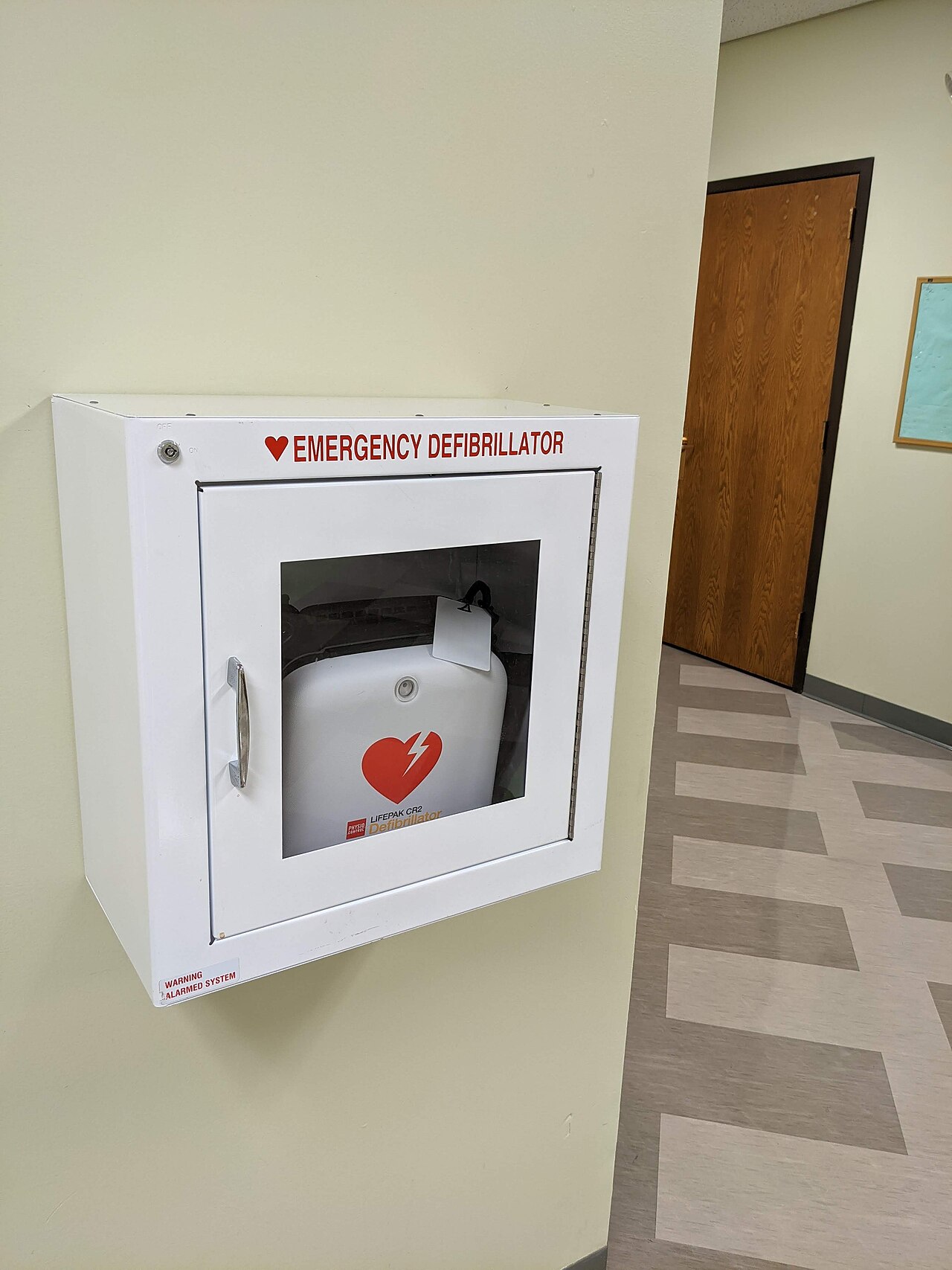
Image context: the cover uses a documentary Wikimedia Commons photograph of a wall-mounted AED cabinet. That image belongs here because this article is about public access as much as about the device itself. An AED only changes outcomes if a bystander can spot it, trust it, and reach it quickly enough to let the machine start talking.[9]
Video 1: Red Cross makes the AED legible enough that a bystander can move before panic hardens
The American Red Cross video is the cleanest introduction because it treats AED use as a public sequence rather than a professional secret.[1] Around the opening moments, the clip quickly establishes the civic frame: confirm unresponsiveness, call for emergency help, begin CPR, and bring the AED into the scene without making the device feel exotic.[1][4] That choice matters. Many people freeze not because the steps are impossibly complicated, but because the box on the wall still feels like hospital property that ordinary hands should not touch. The Red Cross video works against that instinct by flattening the distance between the public and the machine.
That flattening is more important than it sounds. The Red Cross written guidance argues that the first several minutes are critical and that an AED can help restart the heart until professionals arrive.[4][5] The video's power comes from making that claim feel administratively simple. Open the case. Turn on the unit. Expose the chest. Apply the pads as pictured. Stop touching when the machine tells you to clear. Shock if the device advises it. Resume care.[1][4] At no point does the clip ask the viewer to diagnose an arrhythmia or improvise medical judgment. It asks the viewer to trust a bounded workflow.
That is why the Red Cross video functions as more than a tutorial. It is a permission structure. Cardiac arrest is visually dramatic, and bystanders often misread drama as proof that they should wait for someone more qualified. The Red Cross strips away that excuse. Its instructional tone says that the public part of defibrillation has already been engineered. The pads are diagrammed. The voice prompts are built in. The sequence has been simplified in advance. The bystander's job is not to invent medicine. The job is to keep the first minute from dissolving into frightened stillness.[1][4][5]
Video 2: AHA insists the AED should enter the CPR rhythm, not interrupt it
The American Heart Association video matters because it refuses to let the AED become the star of the scene.[2] Instead, it places the device inside a larger rescue rhythm: call 911, push hard and fast, bring in the AED as soon as it arrives, follow the prompts, and return to compressions immediately after the shock or no-shock decision.[2][8] That sequencing is crucial. If viewers start imagining the AED as a substitute for CPR, they misunderstand both the device and the physiology.
The clip's deeper value appears in the transitions. Around the middle stretch, the AHA video keeps compressions visually central even while the AED enters the scene.[2] That choice lines up with AHA's written CPR guidance, which still defines high-quality adult CPR around a compression rate of 100 to 120 per minute, adequate depth, and minimal interruptions.[8] The AED is indispensable when a shockable rhythm is present, but uninterrupted blood flow remains the bridge that keeps the myocardium and brain viable while the machine is being readied. In other words, the device does not replace the hands. It disciplines when the hands briefly stop and how fast they return.
That is the anti-pause logic in its clearest form. The public often imagines an AED as an event: the box appears, everyone stands back, electricity happens, and the rescue pivots on that one dramatic instant. The AHA video tells a better story. The shock is one moment inside a sequence whose quality depends on what happens before and after it.[2][8] Pads placed quickly, a clean "clear" for rhythm analysis, no one touching during shock delivery, then immediate return to compressions. The video is therefore doing two jobs at once. It teaches a device workflow, and it protects viewers from turning that workflow into passive theater.
Video 3: Mayo Clinic turns the device voice into the real interface between medicine and the public
Mayo Clinic's video is the strongest on the device itself because it slows down the interaction between the rescuer and the machine.[3] The clip shows that once the AED is opened, the public user is not facing a silent medical instrument. The user is facing a guided system with diagrams, commands, and prompts that break the task into small decisions.[3][6] That matters because bystander hesitation often clusters around the mechanical details: where the pads go, whether clothing needs to be moved, when to step back, whether the machine might shock the wrong person, and what to do immediately after it speaks.
The Mayo presentation is useful because it keeps translating those anxieties into mechanical facts. FDA's AED guidance makes the same point in prose: the device analyzes the heart rhythm, decides whether a shock is needed, and walks the rescuer through the process with prompts.[6] The bystander is not deciding whether ventricular fibrillation is present. The bystander is creating the conditions that let the machine decide correctly. Chest exposed, pads attached as indicated, nobody touching during analysis, nobody touching during shock delivery, then hands back on the chest.[3][6] The video turns that sequence into something the viewer can picture performing rather than merely reading about.
What makes this especially valuable is that Mayo does not romanticize the machine. The video does not suggest that public defibrillation succeeds because the cabinet contains advanced technology and therefore guarantees rescue.[3] It suggests something narrower and more realistic. The device is good at one job, but it only works when the human around it manages the scene properly. A rescuer who keeps touching the patient during analysis can confuse the reading. A rescuer who delays restarting compressions after the device finishes can waste the rhythm decision the AED just made. The Mayo clip therefore brings the article's argument into full focus: the machine is powerful, but its public-health power lies in how well it organizes brief, necessary pauses and how clearly it orders the return to action.[3][6]
What the three videos reveal together
Viewed in sequence, the three videos converge on one disciplined public script. Red Cross makes the device approachable enough that a bystander will actually open it.[1][4][5] AHA keeps the AED from eclipsing CPR and shows that the device belongs inside a compressions-first rescue rhythm.[2][8] Mayo clarifies the machine-human handoff, showing how voice prompts and pad diagrams turn a frightening medical object into a usable public tool.[3][6] Each clip teaches a different layer of the same doctrine: recognition, access, rhythm analysis, shock delivery, and rapid return to compressions.
That layered reading matters because cardiac arrest punishes delay more harshly than many other emergencies.[5][7] The nearest bystander cannot repair the myocardium, diagnose the full cause of collapse, or deliver hospital care. But the bystander can do something smaller and decisive: keep the early rescue sequence moving. Call 911. Start CPR. Get the AED. Let it analyze. Shock if advised. Resume compressions fast. In that sense, public-access defibrillation is not a story about turning civilians into cardiologists. It is a story about designing the first few minutes so ordinary people can carry them without wasting the pauses that matter most.
Sources
- American Red Cross, "How to Use an AED on an Adult," YouTube video.
- American Heart Association, "Hands-Only CPR with an AED – Man," YouTube video.
- Mayo Clinic, "Automated external defibrillators: How to use an AED," YouTube video.
- American Red Cross, "Using an AED" - step-by-step public guidance on AED use and integration with CPR.
- American Red Cross, "What is CPR?" - emergency-response timing and why early CPR/AED use matters before responders arrive.
- U.S. Food and Drug Administration, "How AEDs in Public Places Can Restart Hearts" - overview of rhythm analysis, voice prompts, and layperson use.
- National Heart, Lung, and Blood Institute, "Cardiac Arrest - What Is Cardiac Arrest?" - outside-hospital mortality, CPR, and AED context.
- American Heart Association, "What is CPR?" - high-quality CPR overview and early AED guidance.
- Wikimedia Commons, "File:AED on a wall.jpg" - photographic file page for the AED image used in this article.