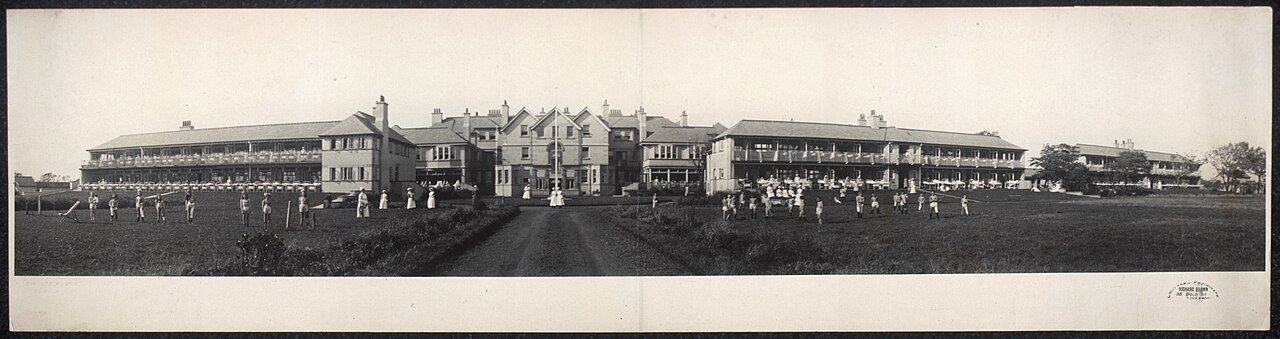
Tuberculosis did not leave the sanatorium because doctors suddenly discovered that mountain air had been foolish all along. It left when the decisive work of treatment stopped being tied to a building and started being tied to a regimen. In the sanatorium era, care was organized around place: isolation from the community, prolonged bed rest, food, fresh air, sun, hygiene rules, and constant supervision.[1] In the chemotherapy era, the center of gravity shifted toward timed drug combinations, bacteriological follow-up, and the service capacity needed to keep treatment going wherever the patient lived.[2][4][5]
That is the comparison worth making in 2026, because it keeps two easy mistakes in view at once. The first is to mock sanatoria as pure theatrical medicine. The second is to imagine that antibiotics simply "replaced" them in one clean step. The historical record is more exact. Sanatoria were a rational bundle for a disease that had no durable drug cure; early chemotherapy then arrived in stages, first shortening the authority of the institution, then exposing the limits of monotherapy, and finally making home treatment plausible once the drug program itself became strong enough.[1][2][3][4]
Timeline anchors for the transition
- 1854: Hermann Brehmer founded the first European tuberculosis sanatorium in Goebersdorf, establishing the classic climate-and-rest model.[1]
- Late 19th to mid-20th century: sanatoria spread across Europe and North America as the main institutional answer to pulmonary tuberculosis.[1]
- 1944: streptomycin entered the tuberculosis story, the first effective antibiotic active against TB.[2]
- 1946: para-aminosalicylic acid, or PAS, extended the move beyond monotherapy.[2]
- 1948: the Medical Research Council published its landmark streptomycin investigation, making chemotherapy a public comparative question rather than a laboratory hope.[3]
- 1952: isoniazid arrived, helping create the triple-therapy era that made treatment both stronger and faster.[2]
- 1956: the Tuberculosis Chemotherapy Centre opened in Madras to test whether mass domiciliary chemotherapy could substitute for sanatorium care in a high-burden, low-bed setting.[4]
- 1959: the Madras one-year report concluded that, despite sanatorium advantages, domiciliary chemotherapy was comparable and that most patients could appropriately be treated at home if an adequate service existed.[4]
- 1966: the Madras five-year follow-up reported similar long-run outcomes, with relapse rates of 7% for home patients and 10% for sanatorium patients, and bacteriologically quiescent disease in 90% and 89% respectively at five years.[5]
1. What the sanatorium actually did
The sanatorium was never just "fresh air." Its real claim was that it could turn a chronic infectious disease into a disciplined environment. The historical review by Martini and colleagues describes the core package clearly: patients were kept in a place designed for rest, balanced diet, sunshine, moderate exercise, and close medical supervision.[1] The buildings themselves mattered. Terraces, verandahs, meadows, gardens, and long open wards were not decorative additions. They were part of the treatment logic.
That logic made sense because tuberculosis before chemotherapy was a disease of long time horizons and uncertain turnarounds. Patients in sanatoria were not usually passing through for a week of observation. Martini's review notes that stays could last from six months to seven, eight, or even 16 years.[1] In other words, the institution was standing in for the absent curative drug. If doctors could not quickly sterilize the infection, they could at least reorganize the patient's day, separate the sick from the healthy, and create a controlled setting in which rest, nutrition, and surveillance might give the body a chance.
The social side of that regime mattered as much as the clinical side. Wellcome's sanatorium history makes the point bluntly: from morning to evening, the patient's day was regulated, sometimes down to reading, writing, sleep, and mandatory rest hours. In the photograph of Mont Alto Sanatorium that Wellcome discusses, patients sit in deckchairs during "rest hour" under direct observation.[7] That is a useful corrective to the sentimental picture of alpine recovery. The sanatorium was a treatment architecture, but it was also a surveillance architecture.
Seen from that angle, the sanatorium was not merely trying to heal lungs. It was trying to solve three problems at once: contagion, convalescence, and adherence. When no short-course cure existed, controlling the environment looked like the most serious thing medicine could offer.
2. Chemotherapy changed the unit of cure
The antibiotic turn did not instantly abolish the older world, but it changed what counted as the active ingredient. Stewart and Zwick's review of the chemotherapy transition lays out the sequence: streptomycin in 1944, PAS in 1946, and isoniazid in 1952.[2] That timeline matters because it shows why the shift away from place was gradual. The first drug was powerful but incomplete. Monotherapy could improve patients and still fail to finish the disease. Resistance and relapse remained live threats.[2][3]
That is why the 1948 Medical Research Council streptomycin investigation still belongs in this story.[3] Its importance was not simply that a new drug looked dramatic. It staged a public comparison between the old therapeutic world and the new one. Tuberculosis was no longer being discussed only as a question of whether the patient could be housed, rested, and fed long enough in the right climate. It was being tested as a question of regimen design and comparative outcomes.
Even then, the institution had not disappeared. The MRC trial still sat inside the sanatorium-era inheritance of bed rest, hospitalization, and prolonged observation.[3] What changed was the intellectual hierarchy. The building was no longer the main therapeutic idea. The drugs were.
That reversal becomes clearer once the sequence reaches triple therapy. Stewart and Zwick note that antibiotic treatment eventually rendered convalescent sanatorium care obsolete and helped move TB treatment into the outpatient setting.[2] That sentence can sound abrupt, but what it really means is precise: once a timed combination regimen could do the decisive physiological work, the cure no longer had to be housed in a mountain institution. It could travel with the service.
3. Madras proved that the service, not the scenery, was now the hard part
The Madras studies are the cleanest evidence in this comparison because they were designed exactly around the institutional question. The 1959 report begins with a practical constraint: India was estimated to have 2.5 million active tuberculosis cases but only 23,000 tuberculosis beds.[4] In that setting, the issue was not whether a sanatorium might offer advantages. It obviously did. The issue was whether a country with too few beds could afford to make institutional care the definition of proper treatment.
The authors answered that question with unusual frankness. After comparing home and sanatorium treatment over 12 months, they wrote that despite the manifest advantages of sanatorium care, including rest, adequate diet, nursing, and supervised medicine-taking, the merits of domiciliary chemotherapy were comparable to those of sanatorium treatment, and that it would therefore be appropriate to treat the majority of patients at home if an adequate service were established.[4]
That phrase "adequate service" is the hinge of the whole twentieth-century transition. The old model had concentrated labor, discipline, and observation in one place. The new model had to reproduce enough of that reliability without the walls. It had to deliver drugs, monitor sputum, follow contacts, keep records, and respond to failure, all while the patient remained in ordinary life.[4][5]
The 1966 five-year follow-up made the point even harder to ignore. Across 193 newly diagnosed sputum-positive patients, the home and sanatorium groups stayed strikingly close over the long run.[5] Relapse rates over follow-up were 7% for home patients and 10% for sanatorium patients. Tuberculosis deaths were 5% and 6% respectively among the remainder after excluding non-tuberculous deaths, while bacteriologically quiescent disease at five years stood at 90% for home patients and 89% for sanatorium patients.[5] Those are not the numbers of a therapeutic collapse outside the institution. They are the numbers of a treatment system learning that the drug program, if supported properly, matters more than the terrace.
This was not just a medical rearrangement. It was also a political one. Once home treatment could match the sanatorium closely enough, the scarce resource ceased to be climate and bed space. It became administrative capacity: clinics, follow-up, drug supply, transport, recordkeeping, and enough trust to keep people in care.
4. What did not disappear
The sanatorium did not vanish because tuberculosis became simple. It vanished because its strongest functions were redistributed. Isolation remained a public-health issue. Adherence remained a problem. Poverty, crowding, and delayed diagnosis remained determinants of who got sick and who finished therapy. What changed was the tool that most directly altered prognosis.
That is why the sanatorium should be remembered neither as a joke nor as a golden age. It was a serious answer to a pre-chemotherapy problem. Its decline was not a victory of common sense over fantasy. It was the result of a narrower and more material change: the power to alter TB outcomes moved from supervised environment toward supervised regimen.[1][2][4][5]
The archival verandahs still matter because they show what medicine had to build when it could not yet carry cure in a packet of drugs. The Madras studies matter because they show what happened once it could. Tuberculosis treatment did not simply move from hospital to home. It moved from architecture to timetable.
Sources
- M. Martini, V. Gazzaniga, and M. Behzadifar, "The history of tuberculosis: the social role of sanatoria for the treatment of tuberculosis in Italy between the end of the 19th century and the middle of the 20th" (Journal of Preventive Medicine and Hygiene, 2018) - historical review of the sanatorium regime, its architecture, and its long-duration treatment logic.
- C. Stewart and E. Zwick, "Tuberculosis sanatorium treatment at the advent of the chemotherapy era" (BMC Infectious Diseases, 2020) - overview of the shift from pre-1944 sanatorium treatment through streptomycin, PAS, and isoniazid to outpatient chemotherapy.
- Medical Research Council, "Streptomycin Treatment of Pulmonary Tuberculosis" (British Medical Journal, 1948) - original investigation marking the public comparative turn from bed-rest-era treatment toward chemotherapy.
- Tuberculosis Chemotherapy Centre, Madras, "A Concurrent Comparison of Home and Sanatorium Treatment of Pulmonary Tuberculosis in South India" (Bulletin of the World Health Organization, 1959) - one-year controlled comparison concluding that domiciliary chemotherapy could substitute for sanatorium care if an adequate service existed.
- J. J. Y. Dawson, S. Devadatta, Wallace Fox, S. Radhakrishna, C. V. Ramakrishnan, P. R. Somasundaram, H. Stott, S. P. Tripathy, and S. Velu, "A 5-Year Study of Patients with Pulmonary Tuberculosis in a Concurrent Comparison of Home and Sanatorium Treatment for One Year with Isoniazid plus PAS" (Bulletin of the World Health Organization, 1966) - five-year follow-up showing similar long-run outcomes for home and sanatorium groups.
- Wikimedia Commons, "File:Open air Tuberculosis wards, Liverpool, Leasowe, England.jpg" - archival photograph source page for the image used in this article.
- Wellcome Collection, "The history of sanatoriums and surveillance" - institutional history emphasizing rest-hour discipline, supervision, and the regulated daily life of sanatorium patients.