Public talk about N95s often collapses into a shortcut that sounds plausible but leaves out the part that does the practical work. The shortcut says an N95 is simply a stronger mask because it filters 95% of particles, so any version that feels reasonably snug should count as basically the same tool. That framing is incomplete. A NIOSH-approved N95 respirator does use highly efficient filter media, but its protection depends on a second condition that a loose mask does not meet: inhaled air has to go through the filter instead of slipping around the edges.[1][5]
That is why the distinction between a respirator and a surgical mask is sharper than the public vocabulary often suggests. CDC's current healthcare respiratory-protection guidance says surgical masks can help block splashes and large droplets, but they do not provide a reliable level of protection from aerosolized particles because of the loose fit between mask and face.[1] Respirators are built for a different job. They are supposed to form a tight seal, and the program around them includes model selection, training, seal checking, and formal fit testing.[1][2][3]
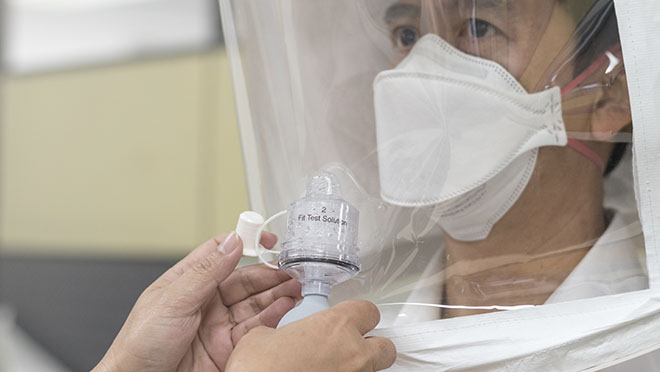
Image context: the cover uses a real CDC fit-testing photograph rather than a product shot of a boxed respirator. That choice fits the article because the argument is about a procedure, not a brand fetish. The decisive moment is whether a given respirator actually seals on a given face under test conditions that mimic speech and movement.[2]
Time anchors before the myths
- January 13, 2011: a Journal of Hospital Infection study compared user seal checks with quantitative fit testing and found that self-checks missed a large share of bad fits across two common N95 models.[4]
- May 16, 2013: CDC/NIOSH captured the fit-testing photograph used here, showing that respirator use in practice lives inside a screening workflow rather than at the point of purchase alone.[2]
- January 15, 2025: CDC's healthcare respiratory-protection page restated the design boundary clearly: surgical masks are loose-fitting and not respiratory protective devices, while N95 respirators are meant to fit tightly and provide a known level of protection when used in a full program.[1]
- 2025: CDC's fit-testing guidance and OSHA's respiratory-protection standard both continue to require repeat fit testing, underscoring that seal quality is not a one-time assumption you carry forever from one mask to the next.[2][3]
Those dates matter because they keep the topic from drifting into slogan territory. The technical and regulatory record has been consistent on the core point for years: filtration efficiency alone is not the same thing as delivered protection on a human face.[1][2][3][4][5]
Myth 1: "An N95 is just a better loose mask"
It is better only because it is not supposed to be loose.
CDC's healthcare guidance draws the line plainly. Surgical masks may work as splash barriers and as source control, but they do not reliably protect the wearer from aerosolized particles because the face seal is loose.[1] By contrast, NIOSH-approved filtering facepiece respirators such as N95s are designed to fit tightly and to filter at least 95% of airborne particles.[1][5] The number and the seal belong to the same sentence. If one part is detached from the other, the public often ends up imagining the respirator as if it were a more serious-looking surgical mask. It is not.
The NIOSH myth-vs-fact infographic makes the same point from the other direction. It says a NIOSH-approved N95 forms a seal against the user's face, preventing particle penetration around the edges, while the filter itself has passed tests showing protection against at least 95% of airborne particles.[5] That means the respirator's performance is not just about what the material can do in isolation. It is about whether the wearer has forced most incoming air to travel through that material at all.
This is the first correction the public conversation usually needs. The real contrast is not "thin mask versus thick mask." It is "loose barrier versus tight respirator." Once that distinction is clear, many later arguments become easier to sort.
Myth 2: "If it feels snug and the user seal check seems fine, the fit problem is solved"
A user seal check matters, but it does a different job from a formal fit test.
CDC's fit-testing page explains that qualitative and quantitative fit tests are meant to determine whether a respirator actually fits, and OSHA requires an annual fit test for any respirator that forms a tight seal to the face.[2] A user seal check is still important during donning, because workers need to catch obvious leakage before entering a hazardous setting. But OSHA's own training requirements distinguish checking the seal from proving that the respirator fits.[3] The first is an immediate pre-use step. The second is a formal validation step.
The 2011 Journal of Hospital Infection study shows why that distinction exists. Lam and colleagues tested 204 nursing students on two common 3M N95 models and compared the user seal check with quantitative fit testing, which they treated as the gold standard.[4] For the 3M 1860S respirator, only 12.8% of participants noticed leakage on the user seal check, yet 38.7% failed quantitative fit testing.[4] For the 3M 1862 respirator, 15.7% flagged leakage on the user check, but 42.7% failed the quantitative test.[4] Sensitivity was only 15.2% for one model and 23.0% for the other.[4] In plain language, many people who believed the mask seemed fine were still wearing a poor fit.
That is the practical reason self-checking cannot carry the whole burden. A respirator can feel acceptable at rest and still leak materially when the wearer talks, turns, bends, or simply has facial geometry the model does not match well. CDC's fit-testing guidance emphasizes that quantitative testing measures face-seal leakage numerically while the wearer performs simple exercises, including speaking, to make the seal prove itself under use conditions rather than at one still moment.[2]
The better correction is therefore narrower than the myth. A user seal check is worth doing every time. It just is not evidence that fit testing can be skipped.[2][3][4]
Myth 3: "Once you pass one N95 fit test, you have solved N95 fit in general"
You have solved one model, one size, and one current version of your own face.
CDC's fit-testing guidance says each brand, model, and size of respirator fits slightly differently, which is why you should be fit tested every time you wear a new model, manufacturer type or brand, or size.[2] OSHA states the same logic in regulatory language: fit testing is required before initial use, whenever a different facepiece is used, and at least annually thereafter.[3] OSHA also requires additional fit testing when physical changes could affect fit, including dental changes, facial scarring, cosmetic surgery, or obvious changes in body weight.[3]
That is an important operational boundary because many real-world failures come from treating respirators as interchangeable commodities once the name "N95" is on the box. They are not. One model may seal well on one worker and poorly on another. A person who passed in one half-facepiece does not automatically pass in the next. OSHA's quantitative standard makes the threshold concrete: a tight-fitting half facepiece must achieve a fit factor of 100 or greater to pass the quantitative test.[3] That threshold exists because the seal is expected to hold up with a safety margin, not because "looked snug enough" is considered good engineering.
The NIOSH infographic adds another useful edge case. Altering or decorating an N95 voids approval because the respirator can no longer be guaranteed to provide the necessary level of protection.[5] Even small changes matter because the device is certified as a system, not as raw fabric with straps attached as an afterthought.
What the evidence-backed picture actually is
The strongest way to think about N95 protection is as a three-link chain:
- certified filter performance
- a tight face seal
- verification that one specific model still fits one specific wearer under actual test conditions
If the conversation drops the second and third links, the respirator starts to look like a magic fabric. If it drops the first, the respirator turns into a mere piece of molded plastic. The real device is neither. It is a tested filter inside a tested interface, used inside a program that expects human faces to vary and seals to fail unless they are checked.[1][2][3][4][5]
That is why "N95 versus mask" is not mainly a style distinction. It is a workflow distinction. The respirator earns its advantage only when the filter, the seal, and the fit-testing discipline stay connected.
Sources
- CDC / NIOSH, "Healthcare Respiratory Protection" (January 15, 2025) - distinction between loose-fitting surgical masks and tight-fitting N95 respirators, plus the requirement that respirators be used within a respiratory-protection program.
- CDC / NIOSH, "Fit Testing" (2025) - explanation of qualitative versus quantitative fit testing, annual retesting, and the need to retest when brand, model, size, or facial conditions change.
- Occupational Safety and Health Administration, "29 CFR 1910.134 Respiratory protection" - regulatory fit-testing requirements, retesting triggers, and the quantitative fit-factor threshold of 100 for tight-fitting half facepieces.
- Lam SC, Lee JKL, Yau SY, Charm CYC, "Sensitivity and specificity of the user-seal-check in determining the fit of N95 respirators." Journal of Hospital Infection 77(3), 2011 - evidence that user seal checks missed many poor fits when compared with quantitative fit testing.
- CDC / NIOSH, "It's Not What You Think! N95 Myth v/s Fact" - infographic stating that a NIOSH-approved N95 protects through both a facial seal and filter performance, and that altering the respirator voids approval.