A hemoglobin result tells a clinician how concentrated the blood's oxygen-carrying protein is. It does not, by itself, settle whether another bag of red cells will help. Transfusion brings potential benefit alongside risks, including circulatory overload and serious reactions. Choosing when to give it requires evidence about patients' outcomes.[5]
The Canadian Transfusion Requirements in Critical Care (TRICC) trial, published on February 11, 1999, made that decision experimentally testable.[1] Its paper rewards reading in an unusual order: first the eligibility rules, then the treatment instructions, and only then the result. Each changes what the headline can reasonably mean.
Start with who could enter
TRICC enrolled 838 critically ill patients whose blood volume had been restored after initial treatment. Active blood loss, as defined in the protocol, excluded enrollment. The restrictive group received red cells below 7 g/dL, aiming for 7–9 g/dL; the liberal group received them below 10 g/dL, aiming for 10–12 g/dL. Transfusions were given one unit at a time, with hemoglobin checked afterward.[1]
At 8 g/dL, the same laboratory result could trigger a transfusion in one group but not the other. The trigger starts treatment; the maintenance range guides what follows. Neither defines normal hemoglobin for everyone.
Read the mortality result without rounding away uncertainty
Average red-cell use was 2.6 units per patient with the restrictive policy and 5.6 with the liberal policy. Thirty-day mortality was 18.7% versus 23.3%, respectively, with P = 0.11. The abstract also explicitly reserved judgment about patients with acute myocardial infarction and unstable angina.[1]
The numerical direction favors restriction, but the primary mortality comparison does not establish superiority at the conventional significance threshold. Equally, a result above that threshold does not prove that two treatments are identical. Both shortcuts turn an uncertain estimate into a more confident story than the evidence warrants.
The American Statistical Association's 2016 statement supplies a useful reading discipline: a p-value measures neither an effect's size nor the probability that a hypothesis is true. A scientific conclusion should not turn entirely on which side of a cutoff the number falls.[3] Here, the reader should keep separate questions separate: how much treatment changed, what happened to mortality, and how precisely the difference was estimated.
This is also why a resource-saving result cannot carry the whole clinical argument. Fewer bags would be a poor achievement if patients paid for them with worse outcomes. The outcome comparison has to remain beside the reduction in treatment.
A later trial tested another ICU population
In October 2014, the Transfusion Requirements in Septic Shock (TRISS) investigators reported a separate randomized comparison. They tested transfusion at hemoglobin levels of 7 g/dL or less against 9 g/dL or less, using red cells processed to remove most white blood cells.[4]
Among 998 patients analyzed, ninety-day mortality was 43.0% and 45.0%, respectively. The relative risk was 0.94, with a 95% confidence interval of 0.78–1.09. The lower-threshold group received a median of one unit, compared with four in the higher-threshold group.[4]
The interval includes no difference and some possible harm, as well as benefit. Still, the study supplied direct evidence for another clinical setting while again substantially reducing transfusion exposure. That is how a practice gains support: additional populations are studied, rather than silently folded into the first trial's conclusion.
The recommendation acquired conditions
The 2023 AABB international guidelines reviewed 45 adult randomized trials involving 20,599 participants. For most hospitalized adults with stable circulation, the panel recommended considering transfusion below 7 g/dL. It allowed different thresholds in specified settings, including cardiac surgery, orthopedic surgery and preexisting cardiovascular disease.[5]
The recommendation's wording matters. Considering transfusion still requires attention to symptoms, other treatment options and the overall clinical situation. The guideline supports a default within a defined population; it does not turn a laboratory number into a self-sufficient instruction.[5]
The heart-attack boundary remained consequential
The Myocardial Ischemia and Transfusion trial (MINT), reported in 2023, directly tested restrictive and liberal transfusion strategies in 3,504 patients with acute myocardial infarction and anemia. Death or another myocardial infarction within thirty days occurred in 16.9% of the restrictive group and 14.5% of the liberal group. The estimated risk ratio was 1.15, with a 95% confidence interval of 0.99–1.34 and P = 0.07.[6]
Again, failure to cross the significance threshold did not establish equivalence. This time, the direction of the estimate favored the liberal strategy, and the interval remained compatible with meaningful harm from restriction. The authors explicitly said such harm could not be excluded.[6]
In August 2025, AABB announced a conditional recommendation favoring a liberal strategy for hospitalized patients with acute myocardial infarction and hemoglobin below 10 g/dL. The panel considered four trials involving 4,311 patients and emphasized individual clinical context.[7] This was a separate population receiving a separate evidence judgment.
Read this sequence as a lesson in how to carry evidence forward. A useful treatment threshold travels with its eligibility conditions, outcome and uncertainty. Remove those qualifications and a carefully tested policy becomes a slogan. Keep them attached and the next trial has a precise question to answer.
Sources
- Paul C. Hébert et al., “A Multicenter, Randomized, Controlled Clinical Trial of Transfusion Requirements in Critical Care,” New England Journal of Medicine 340:409–417 (February 11, 1999) — original TRICC report, hosted by Stanford Medicine.
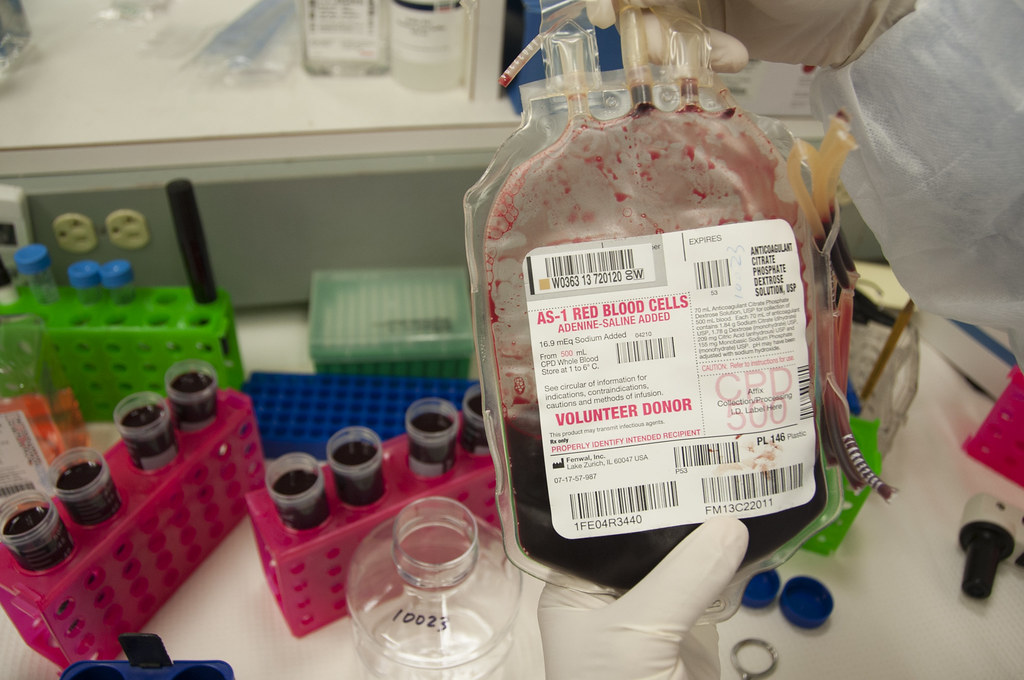
- US Food and Drug Administration, “Blood Research: Saving Lives (8369)” — Jason Liu inspecting a blood unit; photograph by Michael J. Ermarth, taken August 1, 2013.
- American Statistical Association, statement announcement on statistical significance and p-values (March 7, 2016) — six principles for interpreting statistical evidence.
- Lars B. Holst et al., “Lower versus Higher Hemoglobin Threshold for Transfusion in Septic Shock,” New England Journal of Medicine (2014) — original TRISS report, hosted by the University of Bergen.
- Jeffrey L. Carson et al., “Red Blood Cell Transfusion: 2023 AABB International Guidelines,” JAMA (October 12, 2023) — guideline text hosted by the American Association of Critical-Care Nurses.
- Jeffrey L. Carson et al., “Restrictive or Liberal Transfusion Strategy in Myocardial Infarction and Anemia,” New England Journal of Medicine (2023) — original MINT report and uncertainty around its primary outcome.
- AABB, “Expert Panel Recommends Liberal Transfusion Strategy for Hospitalized Patients With AMI” (August 20, 2025) — conditional recommendation and its clinical scope.