A shrimp allergy belongs in a medical history. Trouble begins when it acquires a second identity: “iodine allergy.” That phrase appears to connect dinner with an injection in a CT scanner, turning a shared chemical element into an explanation for two different kinds of reaction.
The connection is unsupported. A 2021 review of iodine-containing medicines found no evidence that iodine itself explained their allergic reactions, and no evidence for a general cross-allergy among these substances.[1] Correcting the label, however, takes more care than crossing out a word. The original reaction may have been frightening, clinically important and worth documenting in much greater detail.
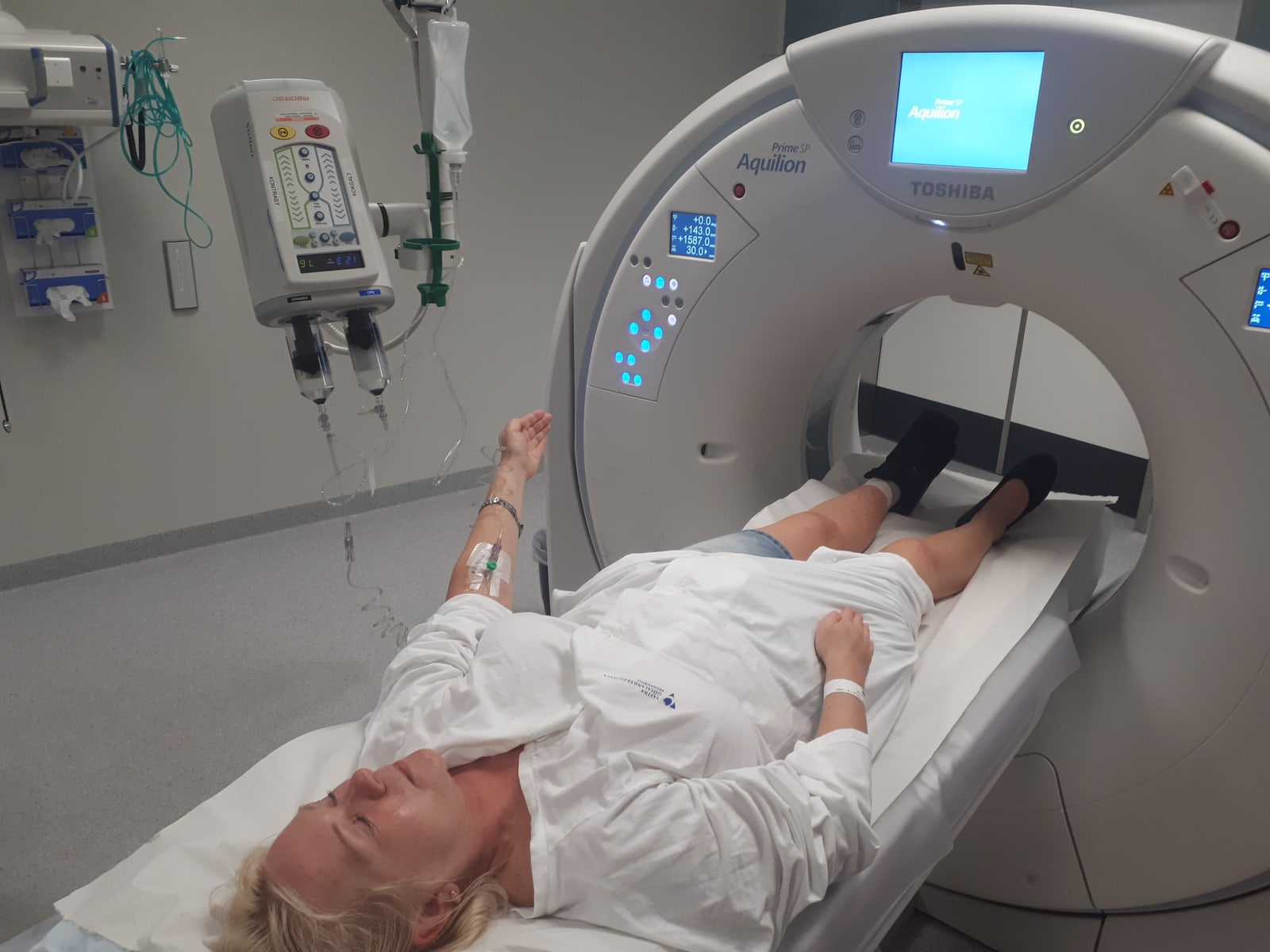
A shared element cannot establish a shared allergy
Iodinated contrast has a specific imaging job. It changes how X-rays pass through the areas it reaches, making blood vessels and other structures easier to distinguish. The word “iodinated” describes part of the compound's chemistry.[3] It does not identify the substance responsible for a person's immune response.
Shellfish allergy involves proteins. The 2014 food-allergy practice parameter, developed by the allergy societies' Joint Task Force, identifies muscle proteins including tropomyosin and explains why seafood's iodine content does not establish a connection to contrast reactions. Its recommendation explicitly rejects using fish or shellfish allergy as evidence of a special radiocontrast risk.[4]
This is a useful test of the myth's logic. Two exposures can contain the same element while presenting the body with very different compounds. Finding that element in both supplies a resemblance; showing that it caused both reactions requires separate evidence.
The 2021 review examined 81 included articles across contrast agents, amiodarone, povidone-iodine and other substances. Its conclusion concerned the unsupported iodine explanation.[1] It did not make adverse reactions to those products disappear. A person can need a particular medicine or preparation avoided without needing every iodine-containing substance treated as equivalent.
The correction had to reach the consultation
By 2019, the American Academy of Allergy, Asthma & Immunology had turned this problem into a teaching exercise. Its Choosing Wisely course presents a virtual patient with seafood allergy whose planned CT angiogram has prompted concern from a radiologist. The learner must take a history, assess the concern and communicate a recommendation.[5]
The course's format reveals the practical difficulty. Knowing a fact about allergens is only part of the work. Someone must explain why a precaution that sounds protective does not follow from the patient's actual history. The course teaches against routine pretreatment with corticosteroids and antihistamines solely because of seafood allergy.[5]
The distinction is easy to lose in a short conversation. “You reacted to shrimp” records an event. “You are allergic to iodine” adds a proposed mechanism and spreads its implications across other exposures. Once the second statement replaces the first, the record has become broader and less informative at the same time.
A useful correction therefore preserves the food allergy and removes the unsupported connection. The patient's experience remains evidence; the explanation attached to it remains open to correction.
The stronger warning comes from a previous contrast reaction
The 2026 ACR Manual on Contrast Media puts modern iodinated contrast's allergic-like reaction rate at approximately 0.6% overall, with 0.04% severe. Expressed with a common denominator, those estimates correspond to about six allergic-like reactions and 0.4 severe reactions per thousand administrations. Severe reactions are included in the overall figure.[6]
These are population estimates, not a personal forecast. The manual identifies a previous allergic-like or unknown-type reaction to the same contrast class as the strongest historical risk factor, associated with roughly fivefold higher risk on re-exposure.[6]
There is a nuance that blunt myth-busting can miss. The manual associates unrelated allergies generally with a modest increase in reaction risk, but says shellfish and povidone-iodine allergies carry no greater risk than other allergies. That is why “no special shellfish risk” is more accurate than claiming that every patient's risk is identical.[6]
The relevant comparison is therefore between kinds of history. A food reaction, an injection that caused temporary warmth and a previous severe contrast reaction should not collapse into one checkbox. Their differences are precisely what the next clinical decision needs.
Replace the shortcut with a usable account
RadiologyInfo, the patient resource reviewed by radiology societies, describes temporary warmth, flushing and a metallic taste after intravenous iodine-based contrast. Those sensations need to be distinguished from symptoms such as hives, wheezing or throat swelling. It also notes that a rash may develop hours to days later.[3] Timing and symptoms give the history its shape.
The 2025 joint ACR/AAAAI consensus recommends recording the specific contrast agent and reaction details. It advises no premedication for an isolated shellfish or iodine-allergy history. For a previous mild immediate contrast reaction, it generally recommends switching agents when feasible without premedication; a severe previous reaction calls first for considering alternative imaging.[7]
Those severity-based recommendations should not become a home treatment plan. The consensus acknowledges limited high-quality evidence, and decisions after a previous allergic-like contrast reaction belong with the imaging team, with allergy expertise when needed. If iodinated contrast remains necessary after a severe immediate reaction, it recommends additional precautions and a hospital setting prepared to treat anaphylaxis.[7]
For the patient, the useful contribution is a concrete account: what was given, what happened, how soon it began and what treatment followed. Records from the earlier examination can help the team recover missing details. Kidney disease and other medical conditions also belong in the assessment; debunking an allergy myth does not settle every question about contrast suitability.[3]
The goal is a record that carries more information into the scanner room. A remembered reaction deserves to arrive with its details intact, rather than hidden behind the name of an element.
Sources
- Nicole R. Wulf, John Schmitz and Amy Choi, “Iodine allergy: Common misperceptions” (2021) — review of iodine-containing compounds and the evidence for cross-reactivity.
- Mikael Häggström, “Contrast CT.jpg” (July 16, 2018), Wikimedia Commons — original clinical photograph and provenance.
- RadiologyInfo, “Contrast Materials” (reviewed August 25, 2024) — imaging mechanism, injection sensations, delayed reactions and medical history.
- Hugh A. Sampson et al., “Food allergy: A practice parameter update—2014,” Joint Task Force on Practice Parameters — Summary Statement 4 and accompanying discussion of seafood proteins and contrast.
- AAAAI, “Applying Choosing Wisely Recommendations with Seafood Allergic Patients who Require Radiocontrast Procedures” (course opened February 6, 2019) — case simulation and pretreatment recommendation.
- American College of Radiology, ACR Manual on Contrast Media (2026), “Patient Selection and Preparation Strategies,” printed page 5 — reaction rates and relative importance of allergy histories.
- Carolyn Wang et al., “Management and Prevention of Hypersensitivity Reactions to Radiocontrast Media,” joint ACR/AAAAI consensus (2025) — full article hosted by the Buenos Aires allergy association.