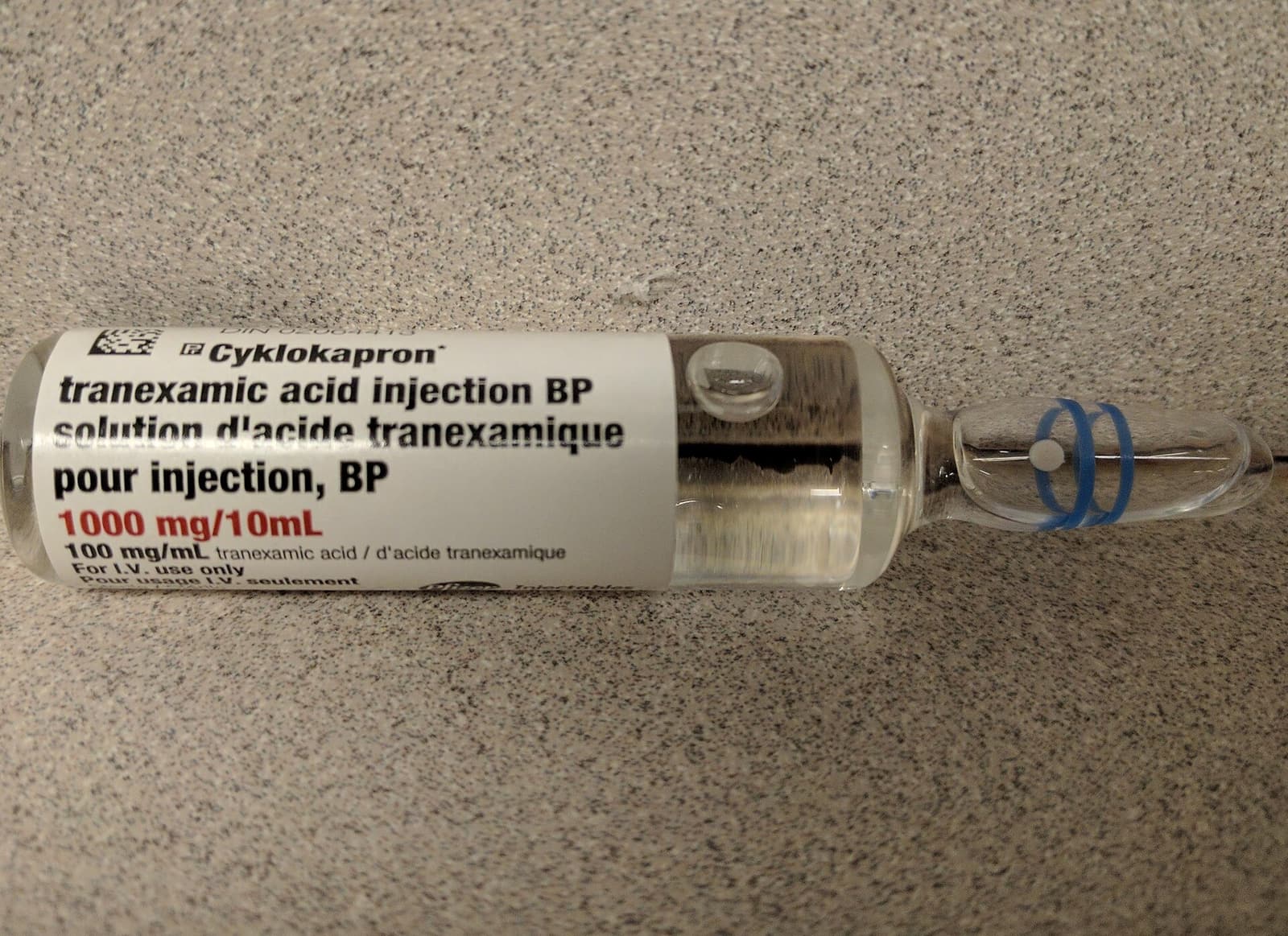
Postpartum hemorrhage is frightening because it compresses physiology, logistics, and time into the same emergency. A uterus may fail to contract firmly. A genital-tract tear may keep bleeding. Retained tissue or clotting problems may complicate the picture. The visible problem is blood loss, but the public-health problem is sequence: recognize the bleeding early, start the right package of care, and prevent the body's first useful clots from being dissolved before they can stabilize the wound surface.[1][3]
Tranexamic acid matters in that sequence because it does not try to make the uterus contract, replace blood volume, repair a laceration, or perform surgery. It does one narrower job. As a lysine analogue, it inhibits plasminogen activation and stabilizes fibrin clots, reducing fibrin breakdown at the moment when the bleeding site needs clot structure to hold.[4] That mechanism is why the drug can be powerful and still limited. It preserves a clotting scaffold; it does not create a complete hemorrhage response by itself.
The timeline makes the mechanism sharper. In 2017, the WOMAN trial reported results from 20,021 women with clinically diagnosed postpartum hemorrhage after vaginal birth or caesarean section, recruited from 193 hospitals in 21 countries.[2] Death due to bleeding was lower with tranexamic acid than with placebo: 155 of 10,036 patients, or 1.5%, versus 191 of 9,985, or 1.9%.[2] The larger signal appeared when treatment began within 3 hours of birth: 89 of 7,466 women, or 1.2%, died from bleeding in the tranexamic-acid group versus 127 of 7,402, or 1.7%, in the placebo group.[2]
Those numbers do not say "one vial fixes hemorrhage." They say timing and mechanism lined up. The drug was most useful while the bleeding death pathway was still in the interval where antifibrinolysis could protect the forming clot.
Why clot protection is not the same as clot creation
Hemostasis is often described as if the body simply forms a clot and the job is done. In real bleeding, clot formation and clot breakdown run against each other. Fibrin gives the clot its mesh. Plasmin breaks fibrin down. Fibrinolysis is useful when the body needs to clear clots after repair, but in severe active bleeding it can undercut the structure that is trying to seal the injury.[4]
Tranexamic acid's place is therefore precise. NCBI's StatPearls summary describes it as a synthetic lysine analogue that competitively inhibits plasminogen activation, stabilizing fibrin clots and reducing bleeding.[4] Put plainly, it protects the mesh. In postpartum hemorrhage, that can matter whether the original bleeding trigger is uterine atony, trauma, or another pathway, because many causes still depend on whether blood can form and preserve an effective clot at the bleeding surface.[3]
This also explains why the drug belongs beside, not instead of, the standard hemorrhage moves. WHO's recommendation table says tranexamic acid should be considered part of the standard postpartum-hemorrhage treatment package, alongside fluid replacement, uterotonics, vital-sign monitoring, nonsurgical measures such as compression or balloon tamponade where appropriate, and surgical interventions when needed.[3] In other words, antifibrinolysis buys one kind of stability while the team addresses the bleeding source and the circulating-volume problem.
That distinction prevents two errors. The first error is to underrate tranexamic acid because it is not a uterotonic or a surgical fix. That misses the clot-breakdown mechanism. The second error is to overrate it as a magic antidote to childbirth bleeding. That misses the source-control and resuscitation work around it.[1][3]
The three-hour window is a biological and operational boundary
WHO's 2017 recommendation is unusually concrete about time: early IV tranexamic acid, within 3 hours of birth, is recommended in addition to standard care for women with clinically diagnosed postpartum hemorrhage after vaginal birth or caesarean section.[3] The same recommendation supports a fixed 1 g IV dose given at 1 ml per minute over 10 minutes, with a second 1 g dose if bleeding continues after 30 minutes or restarts within 24 hours.[3]
The clock is not arbitrary. WHO states that, based on the WOMAN trial and pooled timing evidence, tranexamic acid beyond 3 hours does not confer clinical benefit, and the guideline group does not support starting it more than 3 hours after birth.[3] It also notes that most postpartum-hemorrhage deaths occur within the first 2 to 3 hours after birth, which makes delay especially costly.[3]
This is the most important practical lesson in the article. A drug with a real mechanism can fail if the system notices the patient too late. The vial in the medicine room has no public-health value unless a midwife, nurse, clinician, or protocol can connect a measured or clinically obvious hemorrhage to a timely order, IV access, dose preparation, and continued monitoring.[3][5]
The trial result was mortality-specific, not a blanket outcome win
The WOMAN trial's result needs to be read carefully. The primary composite outcome of death from all causes or hysterectomy was not significantly reduced.[2] The clearer benefit was death due to bleeding, especially with early treatment.[2] That pattern makes clinical sense. Tranexamic acid should be expected to affect bleeding mortality more directly than hysterectomy, which can be shaped by local surgical thresholds, facility resources, transfer delays, fertility considerations, and how aggressively teams escalate to operative source control.
The trial also matters because it did not show a compensating thromboembolic penalty in the published abstracted results; adverse events, including thromboembolic events, did not differ significantly between groups.[2] That does not mean contraindications disappear. WHO's recommendation still says TXA should be avoided in women with a clear contraindication to antifibrinolytic therapy, including a known thromboembolic event during pregnancy.[3] The right lesson is bounded: in the studied emergency context, early IV TXA lowered bleeding death without making the trial's measured adverse-event profile worse, but it remains a clinical drug used inside eligibility judgment.[2][3]
That bounded reading is what makes the evidence useful. It gives postpartum-hemorrhage teams a fast intervention with a defined target, defined timing, defined dose, and defined limits.
Detection is the hinge between evidence and survival
The remaining problem is not just whether tranexamic acid works. It is whether hemorrhage is detected early enough for the drug to be used while the clock still matters. WHO's postpartum-hemorrhage page frames severe bleeding after childbirth as the leading cause of maternal mortality worldwide, causing about 70,000 maternal deaths globally each year.[1] That burden is not only a pharmacology problem. It is a recognition, staffing, supply, and escalation problem.
The E-MOTIVE trial helps explain this implementation layer. In 2023, researchers reported that early detection plus a bundled first-response treatment strategy reduced a composite severe-outcome measure compared with usual care.[5] The intervention was not simply "give a drug." It used a calibrated blood-collection drape for detection and a bundled treatment package. The primary composite outcome occurred in 1.6% of patients in the intervention group versus 4.3% in the usual-care group, and treatment adherence was much higher with the bundle.[5]
That finding belongs in the same story as tranexamic acid because it shows the delivery problem around the molecule. TXA works best when it enters a room where blood loss is being measured or recognized, protocols are ready, uterotonics and fluids are available, and escalation does not wait for visible collapse.[3][5] A hemorrhage bundle turns "remember TXA" into an action that can happen while the drug still has a biologically meaningful job.
What the vial changed
The strongest way to understand tranexamic acid in postpartum hemorrhage is not as a heroic rescue drug but as a time-sensitive clot-preservation tool. Its value sits at the intersection of three facts. First, postpartum hemorrhage can kill quickly and remains a leading global maternal danger.[1] Second, early antifibrinolysis reduces death due to bleeding in a large international randomized trial, with the clearest effect inside the first three hours.[2][3] Third, the drug only becomes real care when hemorrhage systems detect bleeding early and deliver it as part of a wider package.[3][5]
That last point is the one public memory often misses. The vial is small. The mechanism is narrow. The system requirement is large. Tranexamic acid changed postpartum-hemorrhage care because it gave clinicians a way to protect clots during the dangerous early interval, but the drug's survival value depends on everything around the dose: measurement, recognition, IV access, uterotonics, fluids, compression, procedure readiness, surgical backup, and disciplined timing.[1][3][5]
The practical conclusion is simple and strict. Postpartum hemorrhage care improves when teams treat bleeding as a clocked emergency, not as a vague complication. Tranexamic acid helps because clot breakdown has a clock too.
Sources
- World Health Organization, "Postpartum haemorrhage" - global burden framing, leading-cause statement, and estimate of about 70,000 maternal deaths each year.
- WOMAN Trial Collaborators, "Effect of early tranexamic acid administration on mortality, hysterectomy, and other morbidities in women with post-partum haemorrhage" (The Lancet, 2017; PubMed abstract) - trial size, death-due-to-bleeding results, timing subgroup, and adverse-event summary.
- World Health Organization, "Updated WHO recommendation on tranexamic acid for the treatment of postpartum haemorrhage" table, NCBI Bookshelf - 3-hour window, IV dosing, repeat-dose rule, standard-care package, and contraindication boundary.
- NCBI Bookshelf / StatPearls, "Tranexamic Acid" - mechanism summary describing tranexamic acid as a synthetic lysine analogue that inhibits plasminogen activation and stabilizes fibrin clots.
- Gallos et al., "Randomized Trial of Early Detection and Treatment of Postpartum Hemorrhage" (New England Journal of Medicine, 2023; PubMed abstract) - E-MOTIVE early-detection and bundled-treatment trial context.
- Wikimedia Commons, "File:TXAVial2017.jpg" - source page for the real photographic vial image used as this article's cover.