The easiest mistake with malaria vaccines is to imagine a shield around the child. A mosquito bites, the shield blocks everything, and malaria disappears from the story. RTS,S and R21 do something narrower, and that narrowness is exactly why they matter. They target P. falciparum, the deadliest malaria parasite globally and the dominant malaria parasite in Africa, during the early interval after infection but before the parasite has multiplied in the blood.[1][2]
That interval is the liver window. After an infected Anopheles mosquito injects sporozoites, the parasite does not immediately become the fever-and-anemia illness families recognize. It first travels to the liver, then emerges later into the blood stage that drives symptoms and severe disease. The current vaccines are not treatments for blood-stage malaria, and they are not substitutes for diagnosis when a child has fever. They are an added preventive layer designed to reduce the chance that enough parasites make it through the earliest phase to become clinical malaria.[1][2][3]
This is why the most accurate headline is not "malaria solved." It is "a new layer has entered the stack." WHO recommended broad RTS,S use in October 2021, recommended R21 in October 2023, and now describes vaccines as part of routine childhood immunization programmes across Africa.[1][2][4] That is a major scientific and delivery milestone. It also leaves the old malaria-control logic standing: nets, chemoprevention, testing, treatment, surveillance, and local vector control still do work the vaccine does not do.[1][3]
Why the target is early, and why protection is partial
Malaria has been hard to vaccinate against partly because the parasite is not a simple viral target. CDC's vaccine overview stresses several obstacles: malaria parasites have a complex life cycle, produce many potential antigens, and natural exposure does not give lifelong protection.[3] That last point matters. In high-transmission areas, repeated infections can build partial immunity against severe illness over time, but people can still become infected, carry parasites, and get sick.[3]
RTS,S and R21 work inside that biological reality rather than escaping it. They are designed against the circumsporozoite protein on the parasite's sporozoite stage, aiming immune response at the parasite before the blood-stage explosion.[3][5] Mechanistically, that makes them upstream tools. They reduce clinical episodes by lowering the probability that the infection successfully establishes and progresses; they do not sterilize every exposure and do not remove the need to test and treat breakthrough cases.[1][3]
The measured effects fit that mechanism. WHO's current malaria-vaccine Q&A says both vaccines reduced malaria cases by more than 50% during the first year after vaccination in phase 3 trials, and that a fourth dose prolongs protection.[2] CDC gives a more conservative program summary for current malaria vaccines: roughly 40% reduction in uncomplicated malaria, 30% reduction in severe malaria, and 13% reduction in all-cause mortality.[3] Those figures are strong enough to change child survival when scaled, but they are not the profile of a single-product eradication tool.
That distinction is not a downgrade. A partial vaccine can be extremely valuable when the baseline burden is large. WHO estimated 282 million malaria cases and 610,000 malaria deaths globally in 2024, with the African Region carrying about 95% of cases and deaths.[1] Children under 5 accounted for roughly three quarters of malaria deaths in that region.[1] Against that denominator, a prevention layer that reduces severe disease and mortality among young children is a major public-health gain even when it leaves many infections still possible.
The dose schedule is part of the mechanism
The vaccine effect is not just a molecule; it is a sequence. WHO's R21 announcement described a 3-dose primary series and a fourth dose a year after the third to maintain efficacy.[4] RTS,S pilot implementation also had to answer whether countries could deliver a novel four-dose schedule through ordinary childhood immunization systems.[2][3] The later R21 evidence moved through the same practical question at larger scale: TDR's summary of the Lancet publication describes a multicentre, double-blind randomized phase 3 trial in young children across four African countries, with reassuring safety and high efficacy findings.[5]
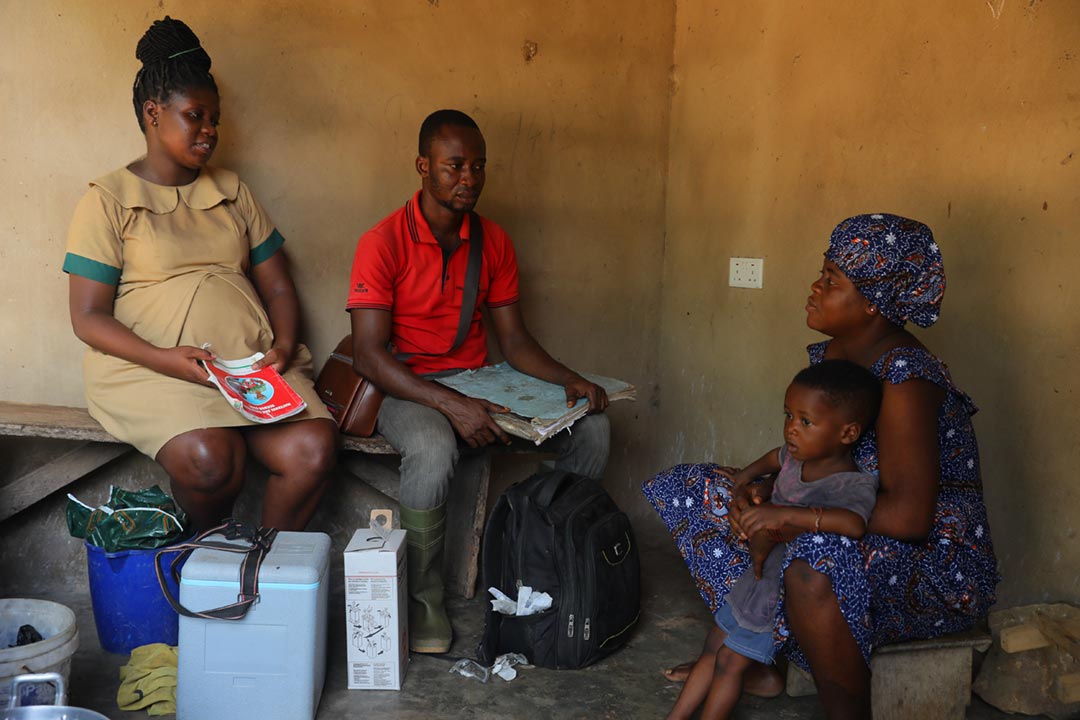
That schedule is where biology meets health-system friction. A child who receives only the first contact with the programme has not received the intended intervention. A caregiver has to return. A clinic has to have stock. A health worker has to know the schedule. The child's card has to be checked. The dose has to stay inside cold-chain rules. This is why the field photograph for this article is not incidental: a cold box, a family visit, a health worker, and a child-health booklet are part of how a liver-stage vaccine becomes real protection.[6]
The pilot evidence is useful because it tested more than immunology. From 2019 through 2023, the Malaria Vaccine Implementation Programme reached more than 2 million children in Ghana, Kenya, and Malawi.[2] WHO reports that the pilot found a vaccine-attributable 13% drop in mortality among children age-eligible for vaccination, substantial reductions in hospitalizations for severe malaria, and improved access to at least one prevention intervention, reaching more than 90% of children with either a malaria vaccine or an insecticide-treated net.[2]
The last number is easy to underread. It says the vaccine did not simply compete with the net. In the best implementation story, vaccination widened prevention access, especially for children not reliably protected by nets. CDC's pilot summary makes the same point: more than two-thirds of children in the three pilot countries who were not sleeping under an insecticide-treated net benefited from RTS,S, and introduction did not reduce bed-net use, other childhood vaccination, or care seeking for febrile illness.[3]
Seasonality changes the timing logic
R21's recommendation also made timing more visible. WHO's 2023 announcement said R21 reduced symptomatic malaria by 75% during the 12 months after a 3-dose series when given just before the high-transmission season in areas where malaria transmission is concentrated into four or five months.[4] In age-based schedules, the announcement reported 66% efficacy during the 12 months after the first three doses.[4] TDR's later note on the Lancet publication is useful because it keeps the trial scale visible: the vaccine was assessed in young children in four countries, not only in one narrowly local setting.[5]
Those numbers should not be read as proof that one vaccine is universally better than another. WHO explicitly says RTS,S and R21 have not been tested in a head-to-head trial, and there is no evidence to date showing that one performs better than the other.[2][4] The practical lesson is instead about context. In seasonal zones, aligning vaccination before the dangerous months can concentrate protection when children need it most. In perennial-transmission settings, the programme has to work more like routine age-based immunization, where protection is valuable but the exposure pressure is spread through the year.[2][4][5]
That context sensitivity is normal for malaria. Nets work differently when mosquitoes change biting behavior or insecticide resistance rises. Chemoprevention works differently when transmission is seasonal or perennial. Rapid diagnostic tests can be weakened by parasite mutations affecting target proteins.[1] A malaria vaccine is another tool inside that ecology, not a waiver from ecology.
What the vaccine does not replace
The clearest boundary comes from WHO's own malaria fact sheet: the highest impact comes when vaccines are introduced alongside other recommended interventions such as bed nets and chemoprevention.[1] This is not cautious language for its own sake. It follows from the mechanism.
Bed nets reduce exposure to mosquito bites while children sleep. Indoor residual spraying and other vector-control measures reduce transmission pressure. Seasonal or perennial chemoprevention suppresses infection risk during predictable high-risk windows. Diagnostic testing separates malaria from other febrile illness. Artemisinin-based combination therapy treats confirmed P. falciparum malaria and helps prevent mild disease from becoming severe.[1] Vaccination acts earlier than diagnosis and treatment, but it does not do their job.
The most dangerous public misunderstanding would be substitution: a caregiver assumes a vaccinated child cannot have malaria, delays testing, and a treatable fever worsens. The vaccine's real promise points the other way. Because it is partial, the system around the child still has to take fever seriously. Because it is additive, the value is highest when vaccination raises the floor of protection without pulling away the other layers.[1][2][3]
The delivery lesson
By 2026, WHO says 25 African countries are offering malaria vaccines through childhood immunization programmes, with more than 10 million children targeted annually.[2] The scientific milestone is large, but the delivery bottleneck is now just as important. WHO says supply can meet high demand, yet limited funding is keeping many countries below national target scale.[2]
That is the practical health lesson. RTS,S and R21 changed malaria control because they made the liver window targetable at population scale. But the benefit appears only when a hard sequence holds: identify eligible children, deliver multiple doses, time the programme to local transmission where needed, maintain caregiver trust, keep nets and chemoprevention in place, test fever, treat confirmed disease, and monitor outcomes.[1][2][3][6]
Malaria vaccines are therefore neither miracle nor disappointment. They are a new layer in a disease that has always required layers. Their power is not that they make mosquitoes irrelevant. Their power is that they intercept part of the parasite's early route through the child, buying a measurable reduction in illness and death while the rest of the malaria-control system keeps doing the work around them.[1][2][3]
Sources
- World Health Organization, "Malaria" fact sheet (4 December 2025) - current burden estimates, P. falciparum context, prevention and treatment stack, and vaccine placement beside nets and chemoprevention.
- World Health Organization, "Malaria vaccines (RTS,S and R21)" Q&A (updated 2026) - WHO summary of RTS,S/R21 efficacy, four-dose protection, pilot mortality impact, rollout scale, and head-to-head comparison boundary.
- Centers for Disease Control and Prevention, "Malaria Vaccines" (April 2, 2024) - vaccine development barriers, RTS,S pilot findings, effectiveness summary, and requirement to deliver vaccines with other malaria-control interventions.
- World Health Organization, "WHO recommends R21/Matrix-M vaccine for malaria prevention in updated advice on immunization" (October 2, 2023) - R21 recommendation, seasonal and age-based efficacy figures, cost-effectiveness note, and no-head-to-head-comparison caveat.
- WHO/TDR, "New Lancet publication highlights safety and efficacy of R21 malaria vaccine" (April 21, 2024) - summary of the multicentre phase 3 R21 trial publication and its safety/efficacy significance.
- Gavi VaccinesWork / WHO, "Health workers: key to the success of the Malaria Vaccine Implementation Programme" (December 1, 2023) - field reporting and photographic source for the Ghana malaria-vaccine community-visit image used in this article.