Chlorhexidine cord care is easy to flatten into a slogan: put antiseptic on the newborn's umbilical stump and infection risk falls. The better reading is narrower and more useful. The intervention works when the stump is a genuine bacterial entry point, when the surrounding delivery and home-care environment makes contamination likely, and when the alternative is not simply clean dryness but delay, handling, or harmful substances placed on the cord.
That is why the World Health Organization's current framing is not "antiseptic for every baby." WHO recommends clean, dry umbilical cord care as the baseline, while daily 4% chlorhexidine - supplied as 7.1% chlorhexidine digluconate solution or gel - is recommended in the first week after birth only in settings where harmful traditional substances are commonly applied to the cord stump.[1] The difference is not cosmetic. It is the causal mechanism.
After birth, the cord is clamped and cut. The stump then dries and separates, usually over several days, while dead tissue and nearby skin can be colonized by bacteria.[2] Most of the time, good hygiene and dry care are enough. But where birth happens with limited water, limited sterile supplies, delayed postnatal checks, or cord applications such as dung, ash, oil, or other contaminated materials, the stump becomes more than a normal healing remnant. It becomes a doorway.
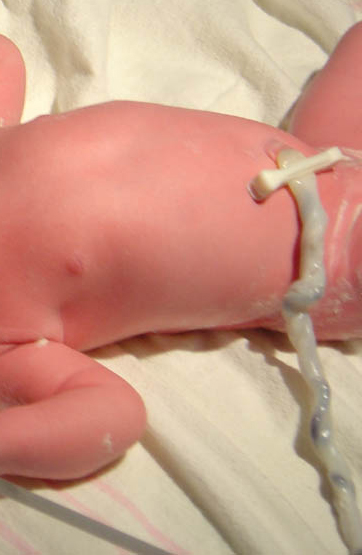
Image context: the cover shows the real object at issue - a newly clamped umbilical cord - rather than a diagram, product still, or generated medical illustration. The article's argument depends on that physicality: cord care is about a small, temporary wound surface whose risk changes with context.[6]
Timeline anchors
- 2006: a community-based cluster randomized trial in southern Nepal helped move chlorhexidine cord cleansing from plausible antisepsis into outcome evidence for omphalitis and neonatal mortality.[3]
- 2013: WHO added 7.1% chlorhexidine digluconate delivering 4% chlorhexidine for umbilical cord care to the Model List of Essential Medicines for Children, then folded cord-care guidance into postnatal recommendations.[4]
- 2022: WHO's consolidated postnatal-care guideline kept the distinction between clean, dry care and context-specific chlorhexidine use.[1]
- March 2026: an updated Cochrane review summarized evidence through December 2025, adding studies and sharpening the setting boundary: benefit is most credible in low- and middle-income settings, while high-income evidence remains very uncertain.[2]
The stump is the portal
The umbilical cord is not dangerous because it looks dramatic. It is dangerous when biology and setting line up badly. Once the cord is cut, the remaining stump contains nonliving tissue. That tissue can be colonized by bacteria from skin, hands, cloth, soil, birth surfaces, water, or anything rubbed onto the area. Cochrane's 2026 evidence summary describes omphalitis as infection of the cord stump and notes that bacteria can track along umbilical vessels into septicemia, a risk that is especially serious where hygiene and access to care are limited.[2]
That sequence is the mechanism: contamination, bacterial growth at the stump, local infection, possible bloodstream spread, and delay in recognition or treatment. Chlorhexidine interrupts the chain early. It is a broad antiseptic applied at the surface where colonization begins. It does not make birth safe by itself. It does not replace sterile delivery technique, handwashing, breastfeeding support, postnatal checks, thermal care, or antibiotics when a newborn is already ill. It lowers one route by which microbes can turn a normal anatomical transition into sepsis risk.
The local nature of the mechanism also explains why "more antiseptic" is not automatically better policy. If the baseline environment is already clean, if caregivers are reliably taught to keep the stump dry, and if harmful substances are not being applied, the remaining preventable risk may be small. In that setting, routine antiseptic can add little, may slow cord separation, and may confuse families who are otherwise being taught to leave the stump alone.[1][2]
Why the evidence is strongest in community settings
The most persuasive early evidence came from places where the mechanism had room to matter. The Nepal trial published in 2006 tested topical chlorhexidine applications to the umbilical cord in a rural community setting, not in a high-resource nursery where sterile delivery and rapid clinical review were assumed.[3] Later South Asian trials and reviews worked within a similar public-health question: can a low-cost, locally applied antiseptic reduce infections and deaths during the first days of life, when many newborns are outside continuous facility observation?
Cochrane's March 2026 update gives the cleanest modern summary. Across 18 randomized trials including 143,150 newborns, chlorhexidine applied to the cord in low- and middle-income countries likely reduced cord infections from about 87 to 62 per 1,000 newborns and may reduce deaths from about 18 to 15 per 1,000.[2] The review also found that chlorhexidine probably delays cord separation by roughly 1.85 days.[2] That delay is usually not the harm people fear, but it matters because it can change caregiver expectations, increase handling, or trigger unnecessary worry if not explained.
The numbers point to a bounded conclusion. Chlorhexidine is not a magic coating. It is a targeted antiseptic with its clearest payoff when background infection pressure is high enough for the stump to be a meaningful pathway. If the same product is moved into a low-risk setting without the same pathway, the effect can shrink into uncertainty. Cochrane explicitly notes that evidence for chlorhexidine in high-income countries is very uncertain.[2]
The policy question is not just supply
The hardest part of cord antisepsis is not proving that chlorhexidine can kill microbes. It is making the right behavior happen for the right newborns without displacing the basics. WHO's 2022 guideline puts the recommendation inside routine postnatal care, not inside a stand-alone product campaign.[1] That placement matters. Families need to know what should touch the stump, what should not, when to seek care, and why dry care remains the default in many settings.
Implementation evidence shows how uneven the last step can be. A 2024 Data for Impact policy brief on Bangladesh and Nepal described countries with long-standing chlorhexidine policies but very different reported receipt: 15% of newborns in the Bangladesh sample and 50.7% in the Nepal sample received chlorhexidine, while harmful substances were still reported for 16.9% and 22.6% respectively.[5] Those numbers make the practical issue visible. The intervention has to reach the newborns most likely to benefit, and it has to crowd out harmful applications rather than merely sit alongside them.
That is why facility delivery, antenatal counseling, community health workers, supply chains, and family belief systems are part of the mechanism. A tube or bottle in the district store does not prevent omphalitis. A caregiver using it correctly, on the right stump, under the right policy conditions, while avoiding contaminated substances, is the intervention. The distinction sounds bureaucratic until it is read through the first week of life, when a small delay in recognition can matter.
The boundary keeps the lesson honest
There are two wrong lessons to draw. The first is that chlorhexidine should be routine everywhere because it is simple and inexpensive. That ignores WHO's clean, dry baseline and the weak high-income evidence boundary.[1][2] The second is that chlorhexidine is merely a low-resource workaround and therefore less scientific than hospital newborn care. That ignores the trial record and the mechanism: in certain settings, the umbilical stump is a predictable infection portal, and a topical antiseptic changes the risk at the point where bacteria enter.[2][3]
The honest lesson is conditional. Chlorhexidine cord care works best as a context-sensitive public-health tool. It belongs where local cord practices or high infection pressure make dry care alone unreliable; it should be paired with counseling, hand hygiene, danger-sign recognition, and timely postnatal follow-up; and it should not be sold as a substitute for improving delivery conditions.
That makes the intervention more impressive, not less. Its value lies in precision. A newborn's cord stump exists for only a short window, but in that window it can concentrate the whole inequality of birth: clean hands or contaminated hands, sterile supplies or improvised materials, prompt review or distant care, harmless dryness or substances that seed infection. Chlorhexidine helps when it is placed inside that chain and aimed at the link it can actually break.[1][2][5]
Sources
- World Health Organization, WHO recommendations on maternal and newborn care for a positive postnatal experience (2022) - publication page for postnatal guidance including clean, dry cord care and context-specific chlorhexidine use.
- Cochrane, "What are the benefits and risks of using antiseptics on the umbilical cord stump of newborns for preventing sepsis and death among newborns?" (2026 evidence summary).
- Luke C. Mullany et al., "Topical applications of chlorhexidine to the umbilical cord for prevention of omphalitis and neonatal mortality in southern Nepal," The Lancet (2006), DOI page.
- World Health Organization, "Postnatal Care for Mothers and Newborns: Highlights from the WHO 2013 Guidelines" - brief noting daily 7.1% chlorhexidine digluconate for high neonatal mortality home-birth settings and clean, dry care elsewhere.
- Data for Impact, Policy Brief: Chlorhexidine for Umbilical Cord Care (June 2024) - Bangladesh and Nepal coverage findings and implementation implications.
- Wikimedia Commons, "File:Umbilicalcord.jpg" - source page for the newborn umbilical-cord photograph used as the article image.