Toxic shock syndrome became a household warning because it sat at an uncomfortable junction: a rare, fast-moving illness; a product used by millions; and an epidemiologic signal that had to be acted on before the mechanism was fully settled. The 1980 response was not a simple story of "a dangerous tampon caused a disease." It was a public-health reconstruction problem. Investigators had to define a syndrome, connect it to menstruation and tampon use, separate one brand signal from broader absorbency risk, then turn that evidence into packaging, product design, and user instructions.[1][2][3]
That sequence matters because the durable intervention was not a single recall. Rely's withdrawal was decisive, but it did not by itself make the problem legible for every later product. The deeper change was that tampon absorbency became a control point: something manufacturers had to measure, labels had to disclose, and users could compare. A frightening outbreak became a regulatory grammar.
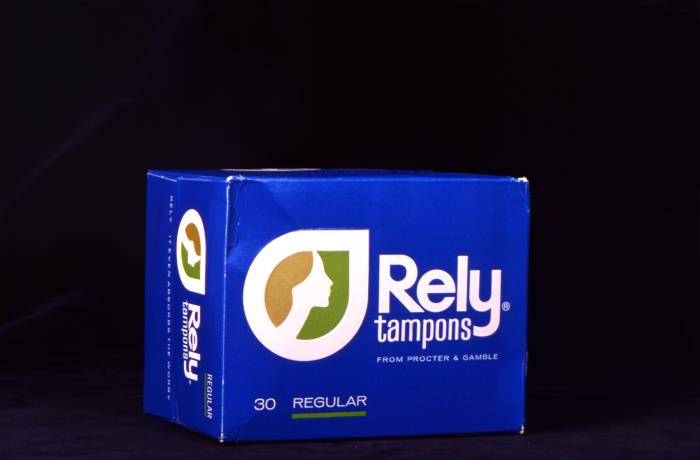
Image context: the cover photograph shows a real Rely tampon box preserved through CDC's Public Health Image Library. It is not decoration. The box is the artifact around which the response pivoted: a named product, a surveillance association, a voluntary market withdrawal, and a later labeling regime that made absorbency comparable across brands.[5]
Timeline anchors for the reconstruction
- 1978: the term toxic shock syndrome entered the medical literature in connection with severe illness associated with phage-group-I staphylococci, before the national menstrual-product crisis had fully taken shape.[6]
- Late 1979 to January 1980: Minnesota and Wisconsin investigators recognized clusters among young women during menstruation and notified CDC, according to a later clinical review of device-associated menstrual TSS.[6]
- May 23, 1980: CDC's first MMWR report described 55 cases of a newly recognized syndrome, mostly in previously healthy young women, with fever, rash, hypotension, and multisystem involvement.[1][2]
- June to September 1980: follow-up investigations linked TSS with tampon use and found a stronger risk signal for Rely than for other brands.[2][3]
- September 1980: Rely tampons were voluntarily withdrawn from the market by the manufacturer after the association became clear enough for action.[2]
- 1982: FDA required tampon labeling to warn about TSS and advise use of the minimum absorbency needed to control menstrual flow.[2][4]
- March 1990: standardized absorbency labeling took effect, creating the familiar gram-based categories still embedded in federal rules.[2][4]
1. The syndrome had to be made visible first
The first CDC report is striking because it reads like an investigation still trying to stabilize its object. The syndrome was severe, but its cause was still uncertain. CDC described primarily young women of child-bearing age who had previously been healthy, a reported case-fatality ratio that might be inflated by recognition of severe cases, and an apparent but low incidence.[1] The report also noted that Staphylococcus aureus had been isolated from the throat, cervix, vagina, or rectum in 33 of 45 cultured patients, but the causal chain was not yet fully pinned down.[1]
This is where the event differs from a clean laboratory discovery. Public health did not begin with a finished mechanism. It began with a pattern: sudden illness, menstruation, tampon exposure, shock, rash, desquamation, and clusters concentrated enough to justify surveillance. That mattered because a rare syndrome can stay invisible when every case is treated as an isolated emergency. The first move was to turn bedside fragments into a national case-finding problem.
CDC's later retrospective says that in May 1980 investigators reported 55 cases; 52 were women, and onset occurred during menstruation in 38 of 40 women for whom menstrual history was available.[2] Those proportions did not prove the full mechanism, but they changed the search space. The question became less "What unexplained shock illness is this?" and more "Which menstrual-use patterns and product characteristics make this rare illness more likely?"
2. The Rely signal forced product-specific action
The second reconstruction layer was brand and absorbency. CDC's 1990 retrospective says case-control studies in Wisconsin, Utah, and nationally found that women with TSS were more likely to have used tampons than controls, and that continuous use carried higher risk than alternating tampons with other menstrual products.[2] Subsequent studies then showed substantially greater risk among users of Rely tampons and increasing risk with higher absorbency.[2]
That distinction is important. If the evidence had stopped at "tampons are associated with TSS," the response might have been limited to general warnings. The Rely signal made the problem operational. It showed that products were not interchangeable containers. Composition, absorbency, wear pattern, and the vaginal environment could interact with bacterial growth or toxin production in ways that mattered clinically, even if no one could yet assign a single simple cause.[2][6]
Rely's withdrawal in September 1980 therefore belongs in the story as a threshold decision under uncertainty.[2] It did not require proof that every molecular step had been solved. It required a risk signal strong enough that leaving the product in circulation was harder to justify than removing it. That is a classic public-health posture: act on a converging pattern, then refine the mechanism.
The later evidence stayed careful. CDC's 1990 editorial note says the precise mechanism by which Rely increased TSS risk was unknown and that high absorbency may have been a surrogate for another effect.[2] That uncertainty does not weaken the reconstruction; it strengthens it. The response worked because it did not wait for mechanistic perfection. It converted the observable product-risk signal into a practical control point.
3. The decline came from system changes, not reassurance
The scale of the decline is the central outcome. CDC reported 890 TSS cases in 1980, with 812 associated with menstruation. By 1989, reported TSS cases had fallen to 61, with 45 menstrual. Among women with menstrual TSS, 38 of 772 died in 1980; in 1988 and 1989, CDC reported no deaths among women with menstrual TSS.[2]
Those numbers should not be read as a mystery that vanished. CDC explicitly separated menstrual and nonmenstrual trends. Nonmenstrual TSS did not fall in the same way, while menstrual TSS decreased sharply.[2][3] That pattern points away from a vague diagnostic fad and toward changes specific to menstrual-product exposure, use, and awareness.
Absorbency gives the most concrete route. In 1980, in vitro tampon absorbency ranged from 10.3 to 20.5 grams, and very-high-absorbency products above 15.4 grams were used by 42% of tampon users.[2] After the risk association was recognized, manufacturers lowered absorbency. By 1983, absorbency ranged from 6.3 to 17.2 grams, and the share of tampon users using very-high-absorbency products had fallen to 18%. By 1986, it had fallen to 1%.[2]
That is the mechanical heart of the event. The public-health response did not depend only on people remembering a scary acronym. It altered the product landscape. Fewer extremely absorbent products were available and used; labels taught a lower-absorbency rule; package inserts described warning signs; and federal rules eventually made comparison possible across brands.[2][4]
4. Labeling turned a product feature into a user-visible safety variable
The federal regulation is unusually revealing because it translates epidemiology into shelf language. Current 21 CFR 801.430 states that data show TSS is associated with menstrual tampon use and requires labeling to warn that TSS is rare but serious and sometimes fatal.[4] It also requires consumer information on warning signs, immediate tampon removal and medical attention if symptoms appear, the advisability of minimum necessary absorbency, and absorbency terms tied to measured gram ranges.[4]
That last part is easy to underappreciate. Before standardization, "super" or "regular" could function as brand vocabulary. After standardization, absorbency became a measured category: light at 6 grams and under, regular above 6 and up to 9 grams, super above 9 and up to 12 grams, super plus above 12 and up to 15 grams, and ultra above 15 and up to 18 grams.[4] The rule also says a package must explain how consumers can use the range and term to choose the minimum absorbency needed to control flow.[4]
FDA's current consumer guidance preserves the same logic in plainer language. Tampons are regulated as medical devices, FDA review includes absorbency and whether a tampon enhances growth of harmful bacteria or changes normal vaginal bacteria, and users are advised to change tampons every 4 to 8 hours, never wear one for more than 8 hours, and use the lowest absorbency needed.[3]
That is not merely individual advice. It is the endpoint of the 1980 reconstruction. The crisis moved from unexplained shock illness, to surveillance association, to product withdrawal, to absorbency reduction, to standardized labels that make a safety-relevant product variable visible at the point of use.
What the 1980 response teaches
The tempting moral is that a single bad product caused a single bad decade. The evidence is more useful than that. Rely mattered, but the larger lesson is about how public health handles rare, severe, product-associated risk. The strongest response linked several layers: active case recognition, epidemiologic comparison, manufacturer action, regulatory warnings, product redesign, standardized measurement, and a simple user rule that matched the evidence boundary.[1][2][3][4][6]
It also shows why uncertainty cannot be treated as paralysis. In 1980, investigators did not know every mechanism. They did know enough to see that menstruation-associated cases, tampon use, Rely, high absorbency, and continuous wear were clustering in ways that demanded intervention.[2][3] By 1990, the intervention had become a system: fewer high-absorbency products, mandatory TSS warnings, gram-based absorbency categories, and current FDA review of tampon safety variables.[2][3][4]
The result was not that TSS disappeared. CDC and FDA still describe it as rare, serious, and sometimes fatal.[3][4] The result was that one frightening product crisis produced a durable control architecture. Modern tampon labels carry the memory of that architecture every time they tell users what absorbency means.
Sources
- Centers for Disease Control and Prevention, "Toxic-Shock Syndrome -- United States" (MMWR, May 23, 1980; reprint page) - first CDC report describing 55 cases, clinical pattern, early uncertainty, and Staphylococcus aureus findings.
- Centers for Disease Control and Prevention, "Reduced Incidence of Menstrual Toxic-Shock Syndrome -- United States, 1980-1990" (MMWR, 1990) - retrospective on case counts, Rely withdrawal, absorbency reduction, FDA labeling, and decline in menstrual TSS.
- U.S. Food and Drug Administration, "The Facts on Tampons--and How to Use Them Safely" (content current January 31, 2025) - current FDA consumer guidance on tampon regulation, TSS risk reduction, absorbency, and 4-to-8-hour use guidance.
- 21 CFR 801.430, "User labeling for menstrual tampons" (eCFR displayed edition, May 13, 2026) - federal labeling rule covering TSS warnings, consumer information, and standardized gram-based absorbency categories.
- CDC Public Health Image Library, ID 1192, "Rely Tampons" - source page for the article image, a photograph of a Rely tampon box associated with the 1980s TSS outbreak.
- Schlievert PM, Davis CC, "Device-Associated Menstrual Toxic Shock Syndrome" (Clinical Microbiology Reviews, 2020) - PubMed record for the review of menstrual TSS recognition, device association, and the long-term shift in menstrual versus nonmenstrual case proportions.