The tempting shorthand for diethylstilbestrol is simple: doctors once prescribed DES to prevent miscarriage; decades later, cancer appeared in some exposed daughters; regulators then warned against use in pregnancy. That version is true as far as it goes, but it is too neat. It turns a long public-health failure into a single bad-drug morality tale.
The better question is sharper: what kind of safety system can detect harm when the person exposed is not the first person injured, when the injury appears years later, and when the original medical record may be missing? DES matters because it made drug safety generational. The signal did not end at the pharmacy label. It ran through pregnant patients, fetuses, adolescent cancer diagnoses, adult fertility outcomes, registry follow-up, and still-unsettled questions about later generations.[1][2]
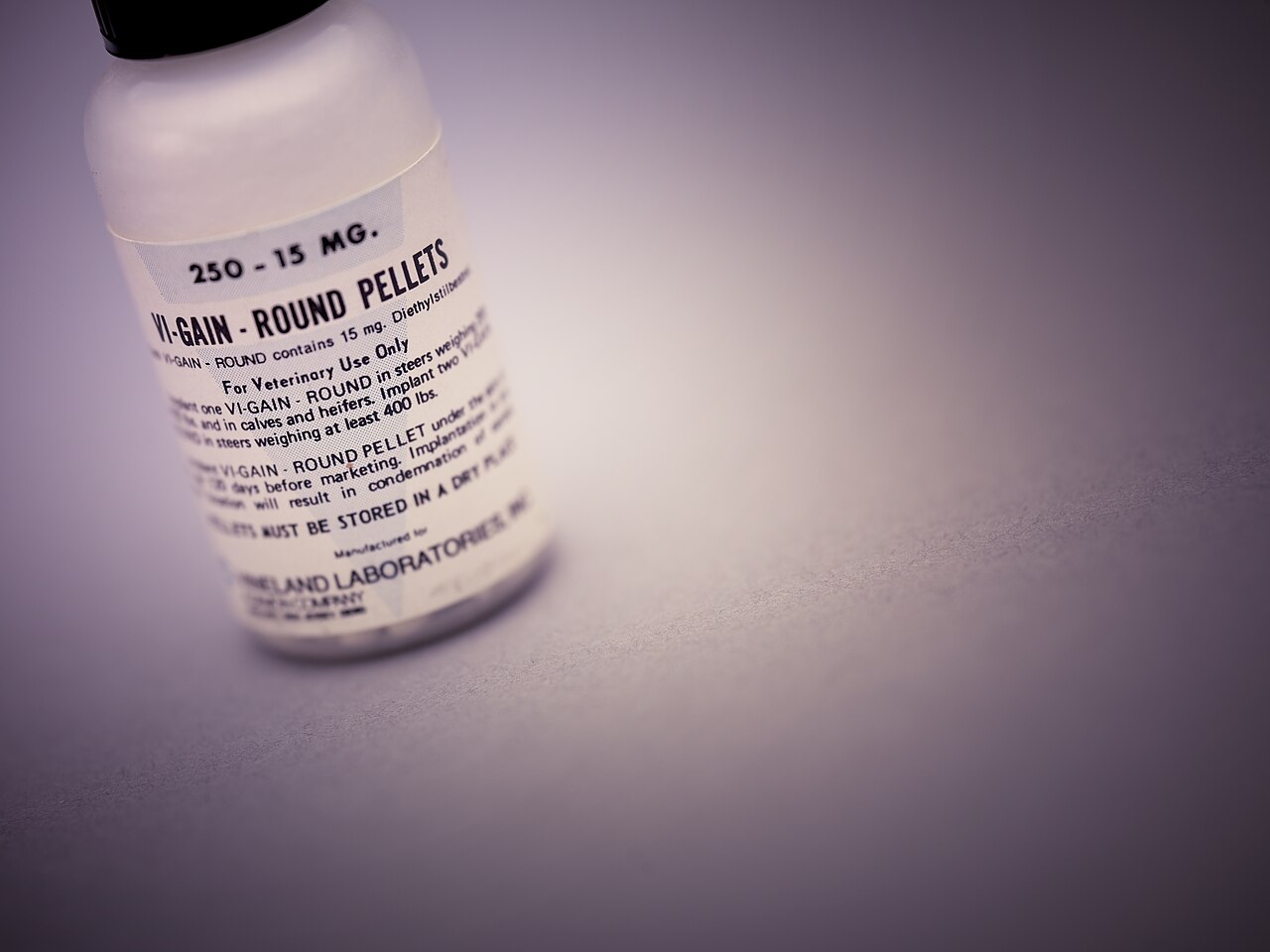
Image context: the cover photograph shows a real pre-1979 FDA-preserved container of synthetic estrogen diethylstilbestrol pellets. The pictured product is tied to veterinary use, not a pregnancy prescription bottle, but that is precisely why it fits the article: DES was not one isolated pill story. It moved through human medicine, cancer-risk surveillance, endocrine-disruption debates, and livestock regulation before becoming a broader safety warning about delayed exposure effects.[6][7]
Timeline anchors
- 1938: DES was first produced as a synthetic estrogen, according to the Institute of Medicine case study.[4]
- 1947: FDA approved new drug applications to market DES for preventing miscarriages, despite early evidence being weak and later controlled trials failing to support the promise.[4]
- 1953: a randomized University of Chicago trial reported no pregnancy benefit; the IOM case study notes that miscarriages and premature births were not reduced in the DES group.[4]
- April 1971: Herbst, Ulfelder, and Poskanzer published the rare-cancer signal in young women exposed before birth.[3]
- November 1971: FDA's drug bulletin said DES was contraindicated in pregnancy.[5]
- 1992: NCI and collaborators began long-term DES follow-up cohorts to track exposed people across outcomes that could not have been captured at birth.[2]
Myth: the problem was just that DES turned out to be carcinogenic
The cancer finding was the decisive alarm, but DES was not simply a case of a drug later found to be toxic in the usual short-window sense. NCI summarizes the core sequence: DES was prescribed to pregnant women between 1940 and 1971 to prevent miscarriage, premature labor, and related complications; use declined after studies in the 1950s showed it was not effective for those problems; in 1971, researchers linked prenatal exposure to clear cell adenocarcinoma of the cervix and vagina in a small group of young women.[1]
That is already different from an ordinary adverse-event story. The prescribing target was the pregnant patient, but the sentinel harm appeared in daughters exposed in utero. The time delay mattered. The first DES daughters with clear cell adenocarcinoma were very young, yet the exposure event had happened before they were born.[1][3] The drug therefore broke the normal expectation that safety follow-up belongs mostly to the treated adult and the weeks or months after use.
NCI's current fact sheet keeps the risk both serious and bounded. DES daughters have about 40 times the risk of developing clear cell adenocarcinoma of the lower genital tract compared with unexposed women, but the cancer remains rare: approximately 1 in 1,000 DES daughters developed it.[1] That pairing is important. A rare outcome can still be a major safety signal when it is specific, biologically plausible, and concentrated in a group with a common exposure history.
Evidence: the first failure was efficacy, not only safety
The deeper indictment begins before 1971. The Institute of Medicine case study describes DES as first produced in 1938, then prescribed from 1945 to 1971 to prevent spontaneous abortions. FDA approved DES for preventing miscarriages in 1947.[4] Yet the evidentiary base was already fragile. Early uncontrolled studies were interpreted optimistically, while later controlled work moved in the opposite direction.[4]
The University of Chicago trial is the key hinge. According to the IOM case study, every pregnant woman at the university's Lying-In Hospital became part of a trial in which one half received DES and the other half received placebo. The study found that DES did not prevent the outcomes it was supposed to prevent; the IOM summary says DES-treated women had more miscarriages and premature births, while controls had bigger, healthier babies.[4]
This is the first correction to the myth. DES was not a wonder drug that only later became tragic because of unforeseeable cancer. By the early 1950s, its pregnancy-benefit case was already badly damaged. The failure was two-layered: a drug with weak efficacy evidence stayed culturally and clinically available, and then its most devastating safety signal emerged in the next generation.
Myth: the 1971 warning ended the public-health problem
The regulatory warning mattered. The FDA drug bulletin language, reprinted in California Medicine in 1972, said DES was contraindicated in pregnancy and tied the warning to adenocarcinoma in offspring.[5] NCI likewise notes that after the 1971 research, FDA notified health-care providers that DES should not be prescribed to pregnant women.[1]
But the warning did not end the health problem, because exposed people continued aging. NCI estimates that 5 million to 10 million Americans, including pregnant women and children born to them, were exposed between 1940 and 1971.[1] That denominator turned DES into a follow-up problem rather than a finished recall story.
The practical difficulty is plain in NCI's current guidance. People trying to learn whether they or their mothers were exposed may have to search obstetrical records, pharmacy records, military records, retired physicians' files, or county medical-society storage; NCI also notes that in many cases it may be impossible to confirm exposure.[1] A safety system that depends on a patient knowing a prenatal prescription from six decades ago is already operating at a disadvantage.
Evidence: DES forced medicine to watch outcomes across lifetimes
The NCI DES Follow-up Study exists because the story could not be closed in 1971. NCI describes DES as a known human carcinogen and says millions of Americans may have been exposed.[2] It also states that the cohorts are no longer recruiting but that research findings will continue to be posted, while warning that NCI does not have information about possible unknown DES-associated conditions or complications beyond the discussed age groups and literature.[2]
That caution is not bureaucratic hedging. It is the scientific boundary. DES has been associated with clear cell adenocarcinoma, reproductive-tract changes, infertility, poor pregnancy outcomes in daughters, and other studied outcomes, but not every claimed downstream effect is equally established.[1][2] The right lesson is neither panic nor closure. It is disciplined follow-up: define exposed cohorts, track outcomes, separate signal from speculation, and keep the uncertainty visible.
The National Toxicology Program's carcinogen profile widens the frame. It classifies diethylstilbestrol as a known human carcinogen and records that past exposure occurred through miscarriage prevention, hormone replacement therapy, prostate-cancer treatment, and other medical uses. It also notes veterinary growth-promotion use and the 1979 ban on that growth-promoter use.[6] DES therefore became a rare object that connected clinical prescribing, prenatal exposure, cancer epidemiology, occupational and environmental toxicology, and food-animal regulation.
What the evidence actually teaches
The strongest DES lesson is not "never treat pregnancy complications." That would be crude and clinically useless. The lesson is that pregnancy prescribing needs unusually strong humility because the exposure unit is not one person at one time. It can include the patient, the fetus, future reproductive development, adult cancer risk, and later family history.[1][2][4]
It also teaches that efficacy and safety cannot be kept in separate boxes. If DES had clearly prevented pregnancy loss, the risk-benefit argument would still have been hard after 1971, but at least there would have been a benefit side to weigh. The IOM case study makes the history more uncomfortable: controlled evidence had already undercut the benefit claim before the rare-cancer signal became visible.[4]
Finally, DES shows why "rare" is not the same as "small." A rare cancer at 1 in 1,000 can expose a massive safety failure when the background disease is unusual, the relative risk is about 40-fold, and the exposed population reaches millions.[1] Public health has to know how to act on that kind of pattern without overstating what remains unknown.
DES is therefore best remembered as a generational evidence problem. It turned a prescription written for a pregnancy into a follow-up obligation for people born from that pregnancy. It showed that some drug harms do not fit inside trial duration, label language, or the memory of a single patient. And it left a durable standard for future safety questions: when exposure happens during development, the clock does not stop at birth.
Sources
- National Cancer Institute, "Diethylstilbestrol (DES) Exposure and Cancer" (updated January 31, 2025) - current fact sheet on DES prescribing, 1971 warning, exposed population size, clear cell adenocarcinoma risk, and follow-up guidance.
- National Cancer Institute Division of Cancer Epidemiology and Genetics, "DES Follow-up Study at the National Cancer Institute" - study background, cohort status, known adverse effects, and ongoing research boundaries.
- Herbst AL, Ulfelder H, Poskanzer DC, "Adenocarcinoma of the vagina. Association of maternal stilbestrol therapy with tumor appearance in young women" (New England Journal of Medicine, 1971) - PubMed record for the sentinel rare-cancer report.
- Institute of Medicine, "DES Case Study" in Women and Health Research: Ethical and Legal Issues of Including Women in Clinical Studies (National Academies Press, 1994) - development, approval, early studies, and controlled-trial history.
- No author listed, "Selected item from the FDA drug bulletin-November 1971: diethylstilbestrol contraindicated in pregnancy" (California Medicine, 1972) - PubMed record and free PMC link for the FDA warning as reprinted.
- National Toxicology Program, "Report on Carcinogens: Diethylstilbestrol" (15th edition profile) - carcinogen classification, exposure routes, production and veterinary-use history, and regulatory notes.
- Wikimedia Commons, "File:Synthetic Estrogen, pre-1979.jpg" - source page for the FDA photograph of a pre-1979 synthetic estrogen diethylstilbestrol container used as the article image.