The American Dental Association's short video "How to Brush Your Teeth" looks, at first, like the kind of instruction everyone already knows.[1] Pick up a brush, add toothpaste, move it around, rinse, repeat tomorrow. The useful way to watch it is the opposite. The clip matters because it makes familiar behavior precise. It turns toothbrushing from a vague cleanliness habit into a small plaque-control procedure: angle, pressure, surface order, duration, and fluoride all have jobs.[1][2][3]
That distinction matters because oral hygiene fails most easily in the spaces people think they have already covered. A mouth can feel fresh while plaque remains at the gumline or between teeth. NIDCR describes plaque as a sticky biofilm, and it links plaque buildup to gingivitis, a mild gum disease that can usually be reversed with daily brushing and flossing.[3] CDC's adult oral-health guidance points in the same direction: brush well twice a day with fluoride toothpaste and floss between teeth to remove dental plaque.[4] The video is worth embedding because it makes that written advice visible as a repeated route rather than a slogan.
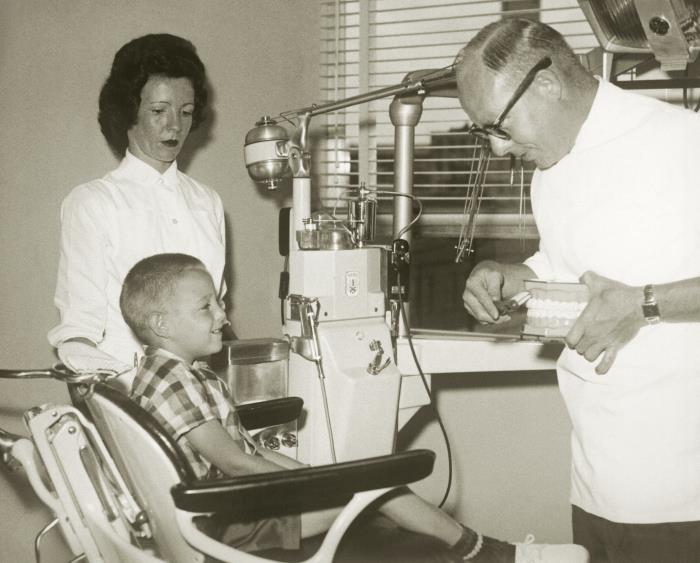
Image context: the cover photograph comes from CDC's Public Health Image Library. A dentist is teaching a child to brush in a clinical setting in 1963 while the child's mother watches. The image belongs here because brushing technique is learned socially and physically: a hand, a model, a mouth, a caregiver, and a routine that has to survive outside the dental chair.[5]
The first lesson is angle, not force
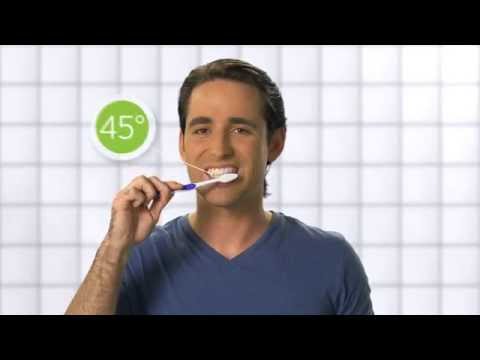
The video's core instruction is easy to underestimate: place the toothbrush at a 45-degree angle to the gums and use short, tooth-wide strokes.[1][2] That is not dental etiquette. It is the mechanical answer to where plaque causes trouble. NIDCR's oral-hygiene guidance tells readers to angle the bristles toward the gumline so they clean between the gums and teeth, then brush gently with small circular motions rather than scrubbing hard back and forth.[3]
The point is restraint. Many people intuitively treat brushing like cleaning a pan: more force should mean more cleanliness. The ADA and NIDCR instructions imply a different model. The brush should be directed, gentle, and systematic because the target is a soft biological film on enamel and near gum tissue, not a stain that can be defeated by aggression.[2][3] A harsh horizontal scrub can still miss the gumline while making the act feel satisfyingly energetic. The video corrects that by making angle and stroke size the first discipline.
This is also why a soft-bristled brush matters. ADA's toothbrush topic page says the consensus recommendation is to brush for two minutes twice a day with a soft-bristled toothbrush, and to replace toothbrushes every three to four months or sooner if bristles are visibly worn.[6] Worn bristles and excessive pressure both undermine the same premise: the bristles need to arrive where plaque is, with enough flexibility to clean rather than scrape.
The middle of the clip turns the mouth into a route
The video moves across outer surfaces, inner surfaces, and chewing surfaces.[1] ADA's written brushing page uses the same sequence and adds a small but important detail: to clean the inside surfaces of the front teeth, tilt the brush vertically and make several up-and-down strokes.[2] That vertical move is a reminder that the mouth is not one flat surface. The brush has to change orientation when the anatomy changes.
This is where the clip does its best public-health work. A person who brushes "everywhere" may actually mean "the easy places I can feel." The outer front teeth are visible and rewarding. The biting surfaces are obvious. The inner surfaces, back molars, gumline, and front-tooth interiors are easier to rush. The video counters that by making brushing a route through zones.[1][2] A route reduces the cognitive load of remembering every tooth. It also makes omissions easier to notice because the mouth has an order.
NIDCR's written guidance fills in the biological reason for that order. Plaque that is not removed can harden below the gumline and irritate the gums; red, swollen, or easily bleeding gums can be signs of gingivitis.[3] The article's inference from the video and written guidance is simple: the most important brushing is often the least glamorous brushing. It happens at margins, backs, and transitions where plaque can stay after a fast cosmetic pass.
Two minutes is a minimum dose, not a ceremonial number
The ADA video and written page both land on two minutes, twice a day.[1][2] CDC gives the same daily-care frame for adults, and adds the broader prevention setting: limit added sugars, drink fluoridated tap water where available, brush with fluoride toothpaste, and floss between teeth.[4] The number matters because brushing has to be long enough for a complete route, not because two minutes has mystical force by itself.
This is the practical reading. If the mouth has outer, inner, and chewing surfaces across upper and lower arches, a few seconds cannot plausibly cover the territory with care. Two minutes gives the route room to happen. It also slows the user enough to keep pressure from becoming the substitute for coverage. When time is too short, force often rises. When the route has time, technique can do the work.
Fluoride is the other quiet layer in the routine. ADA's brushing page explicitly calls for fluoride toothpaste, and NIDCR says fluoride protects teeth from decay by strengthening enamel, the tooth's hard outer surface.[2][3] That means brushing is doing two different kinds of work at once. The brush disrupts plaque mechanically; the toothpaste supplies a chemical defense for enamel. Treating the habit only as "scrubbing teeth clean" misses half the reason the routine is built the way it is.
What the video does not replace
The clip is a brushing demonstration, not a complete oral-health plan. CDC's adult guidance includes flossing between teeth to remove plaque, limiting added sugars, drinking fluoridated water, using mouthguards for higher-risk activities, and getting dental care when needed.[4] ADA's home-care topic page similarly places brushing alongside daily cleaning between teeth and dietary limits on sugary foods and drinks.[7] The video should therefore be read as the center of daily plaque control, not as permission to ignore the spaces a toothbrush cannot reach.
That boundary is important because the strongest public-health message is not "buy the perfect toothbrush." ADA notes that either manual or powered toothbrushes can be used effectively.[6] The article's main point is more durable: technique and consistency matter more than turning brushing into a technology race. A soft brush, fluoride toothpaste, the gumline angle, short strokes, all surfaces, two minutes, twice daily, and daily interdental cleaning form the core sequence.[2][3][4][6][7]
The ADA video succeeds because it makes that sequence feel ordinary enough to repeat. It does not dramatize disease or promise a bright-white transformation. It asks for a disciplined daily route through the mouth. That is the useful lesson for 2026: toothbrushing is not a cosmetic scrub that happens near the smile. It is a small, timed, evidence-backed way of disrupting plaque before plaque turns into inflammation, decay risk, or a problem that has to be solved later in a dental chair.[2][3][4]
Sources
- American Dental Association, "How to Brush Your Teeth," YouTube video, published October 3, 2014.
- American Dental Association MouthHealthy, "Brushing Your Teeth" - proper brushing technique, 45-degree gumline angle, short strokes, surfaces, and two-minute routine.
- National Institute of Dental and Craniofacial Research, "Oral Hygiene" - plaque, gingivitis, brushing tips, gumline angle, fluoride toothpaste, and cleaning between teeth.
- Centers for Disease Control and Prevention, "Oral Health Tips for Adults" - daily oral-health guidance on fluoride toothpaste, brushing twice daily, flossing, sugar limits, and mouthguards.
- Centers for Disease Control and Prevention Public Health Image Library, "ID#: 30042" - 1963 archival photograph of a dentist teaching a young patient proper toothbrushing technique.
- American Dental Association, "Toothbrushes" - soft-bristle, two-minute twice-daily consensus recommendation, replacement timing, and manual versus powered brush note.
- American Dental Association, "Home Oral Care" - ADA home-care recommendations for caries and gingivitis prevention, including brushing, interdental cleaning, diet, and personalized dental guidance.