
The National Institute on Aging's "Tips to Prevent Falls and Stay Independent as You Age" is most useful when watched as a prevention script, not as a warning montage.[1] The video does not treat a fall as a single unlucky event that arrives from nowhere. It treats falling as the visible end of a chain: changes in strength and balance, medicines that cause dizziness, vision that no longer gives reliable terrain cues, loose rugs and poor lighting, and the quiet habit of not telling anyone after a first fall or near miss.[1][2]
That framing matters because falls are common enough to become background noise and serious enough that they should not be normalized. CDC's current falls page says more than one out of four older people falls each year, less than half tell their doctor, and one fall doubles the chance of falling again.[2] Those facts make the video's tone feel carefully chosen. It is not trying to frighten older adults into retreat. It is trying to preserve independence by moving action upstream, before a broken hip, head injury, emergency department visit, or fear of walking turns a preventable risk into a smaller life.
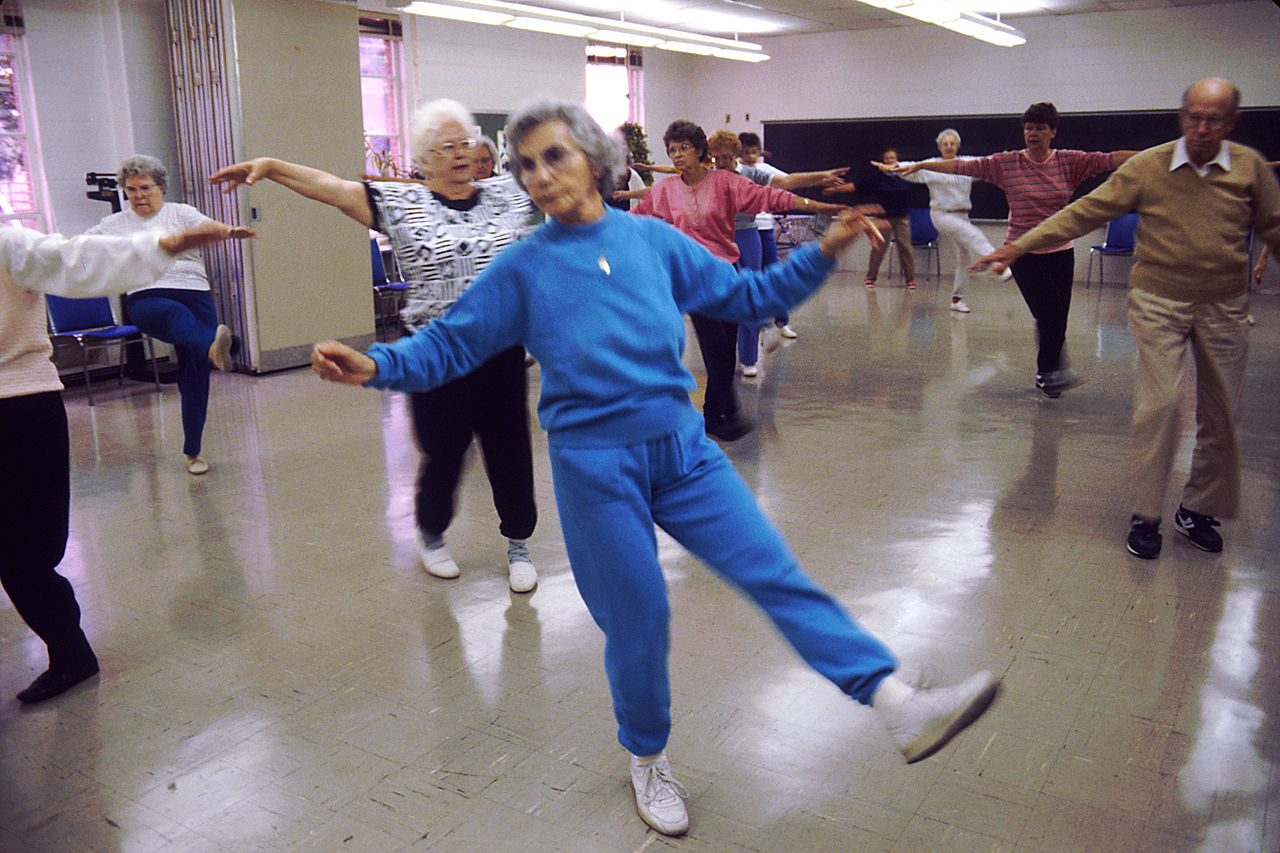
Image context: the cover photograph shows older adults exercising together at the Rockville Senior Center in October 1988.[6] It is not a diagram, chart, or generated visual. It belongs here because the video is not really about one perfect anti-fall trick. Its deeper message is that prevention is social and repetitive: bodies practice, rooms are modified, clinicians are told what happened, and ordinary movement stays inside daily life.
The video makes disclosure part of prevention
The most important move in the video is also the least cinematic: it makes talking about falls part of the safety system.[1] That matters because many older adults underreport falls. A person may feel embarrassed, may not be injured, may fear losing independence, or may treat a stumble as proof of ordinary aging rather than as a signal worth investigating. CDC's statistic that less than half of older adults who fall tell their doctor is therefore not a side note.[2] It identifies a broken feedback loop.
Once a fall is reported, the event can be interpreted. Was there dizziness on standing? Was a new medicine started? Is the problem foot pain, footwear, low vision, muscle weakness, neuropathy, clutter, a bathroom transition, or rushing in the dark? CDC's STEADI initiative exists for exactly this kind of conversion: it gives clinicians tools to screen, assess, and intervene for older adults who have fallen or are at risk.[4] The NIA video is public-facing, but its logic matches that clinical architecture. A fall that stays private remains a personal scare. A fall that enters care can become evidence.
That is also why "stay independent" is not sentimental wording. The video is trying to separate independence from secrecy.[1] Independence is not the ability to hide every stumble until injury forces disclosure. It is the ability to keep moving with better information, better supports, and fewer preventable hazards. In that sense, telling a clinician about a fall is not surrendering autonomy. It is how the next fall becomes less likely to dictate the terms.
Exercise is treated as risk engineering, not wellness decoration
The video also places movement near the center of fall prevention.[1] That choice is evidence-aligned. The 2024 USPSTF recommendation gives exercise interventions a B grade for community-dwelling adults age 65 or older who are at increased risk for falls.[3] Its implementation language is pragmatic: identify increased risk through fall history, physical functioning, or limited mobility, then refer older adults at increased risk to exercise interventions.[3]
The useful distinction is that fall-prevention exercise is not just "be more active" in a vague wellness sense. It targets the physical systems a stumble exploits: balance, gait, functional movement, strength, and the ability to recover when the body shifts unexpectedly. The Health.gov summary of the Cochrane review makes the same point in accessible terms, noting that exercises focused on balance, gait, and muscle strength can prevent falls among community-dwelling adults 65 and older.[5] The NIA video works because it translates that evidence into an ordinary habit rather than a research abstraction.
This is where the 1988 senior-center photograph is more than nostalgic.[6] A class setting makes fall prevention visible as practice. Standing, reaching, shifting weight, turning, stepping, and regaining alignment are not glamorous movements, but they are the mechanics of living in a real house, crossing a curb, rising from a chair, navigating a store aisle, or catching oneself after a foot lands badly. The point is not that every older adult needs aerobics specifically. The point is that balance and strength have to be rehearsed before the moment that tests them.
The home is part of the body-environment system
The video's home-safety emphasis is easy to underestimate because it sounds so familiar: remove trip hazards, improve lighting, use rails, keep frequently used things reachable.[1] But these are not cosmetic housekeeping notes. They are ways of changing the environment so that ordinary aging, fatigue, low light, urgency, or a brief loss of balance has less room to become an injury.
CDC's STEADI framework helps explain why the environment belongs beside strength, vision, and medications rather than after them.[4] A fall usually has more than one cause. Weakness may matter, but so may a throw rug. Poor vision may matter, but so may a dim hallway. A medication may increase dizziness, but the harm may occur at the bathroom threshold. Treating the home as part of the intervention keeps the article away from blaming the person for every stumble. Fall risk is distributed across body, routine, objects, lighting, timing, and care.
This is also why the video avoids promising that one change solves the problem.[1] Installing a grab bar does not replace exercise. Exercise does not replace medication review. New glasses do not remove every hazard from a hallway. The stronger claim is cumulative: each correction removes one failure point from the chain. A good fall-prevention plan is rarely dramatic. It is a stack of small decisions that make a bad step less likely to become a bad outcome.
The analysis has to keep the boundary clear
The video is general education, not an individualized diagnosis.[1] That boundary is important. An older adult with recurrent falls, fainting, chest pain, new weakness, confusion, head injury, severe dizziness, Parkinson disease, neuropathy, dementia, medication changes, alcohol use, or sudden vision change needs personal medical evaluation. The article should not turn a public video into a substitute for clinical assessment.
At the same time, the evidence does support action before a specialist crisis. CDC's falls facts make clear that the first reported fall matters because a previous fall predicts future risk.[2] USPSTF's recommendation makes clear that exercise interventions have enough preventive value to belong in routine care for at-risk community-dwelling older adults.[3] STEADI shows that clinicians can structure screening and intervention rather than treating fall prevention as a vague lifestyle category.[4]
The best reading of NIA's video is therefore practical and modest. It says: do not wait for a catastrophic fall to make balance, strength, vision, medicines, shoes, stairs, bathrooms, and lighting part of the health conversation.[1][2][3][4] Independence is not protected by pretending risk is absent. It is protected by making risk visible early enough to change the room, the routine, and the body before the next stumble arrives.
Sources
- National Institute on Aging, "Tips to Prevent Falls and Stay Independent as You Age," YouTube video.
- Centers for Disease Control and Prevention, "Facts About Falls" (Jan. 27, 2026) - current CDC statistics on fall frequency, underreporting, recurrence risk, and older-adult injury burden.
- U.S. Preventive Services Task Force, "Falls Prevention in Community-Dwelling Older Adults: Interventions" (2024 recommendation statement).
- Centers for Disease Control and Prevention, "STEADI - Older Adult Fall Prevention" - CDC clinician initiative for screening, assessing, and intervening on older-adult fall risk.
- Health.gov, "Exercise for preventing falls in older people living in the community" - evidence-based resource summary of the Cochrane review on balance, gait, and strength exercise.
- Wikimedia Commons, "File:Aerobics class.jpg" - National Cancer Institute photograph by Bill Branson, October 1988, used as the article image.