
As of 2026-04-22 UTC, the most useful way to watch Clinton County Health Department's short "Proper Tick Removal" video is as a correction to panic.[1] The clip is plain, almost deliberately unglamorous: use fine-tipped tweezers, get close to the skin, pull steadily, clean the site, and keep watching afterward. That simplicity is the point. Tick removal is one of those public-health tasks where folk methods multiply precisely because the real procedure looks too small to matter.
It does matter. CDC's current July 15, 2025 tick-bite guidance puts the first principle in direct language: if a tick is attached to the skin, remove it as soon as possible, because delaying removal to wait for a clinician can increase the risk of tickborne disease.[2] Mayo Clinic's first-aid page, updated March 15, 2024, uses the same basic mechanics: grasp close to the skin with fine-tipped forceps or tweezers, pull slowly and steadily upward, and avoid twisting, squeezing, petroleum jelly, nail polish, or heat.[3] The health communication challenge is not that the public lacks a complex algorithm. It is that people often substitute drama for technique.
The longer clock begins after the tick is gone. Lyme disease surveillance data explain why the removal step sits inside a broader public-health frame. CDC says more than 89,000 Lyme disease cases were reported in 2023, while separate estimates suggest about 476,000 people may be diagnosed and treated each year in the United States.[4] The 2020 AAN/ACR/IDSA Lyme guidelines then add the clinical boundary: prophylactic antibiotics are reserved for specific high-risk bites, and if used, the single-dose doxycycline window is within 72 hours after removal.[5] A person who removes a tick well has not finished the whole task. They have converted a chaotic moment into a cleaner record: where the bite happened, when the tick came off, what symptoms appear over the next several days to weeks, and whether the bite fits a high-risk category.
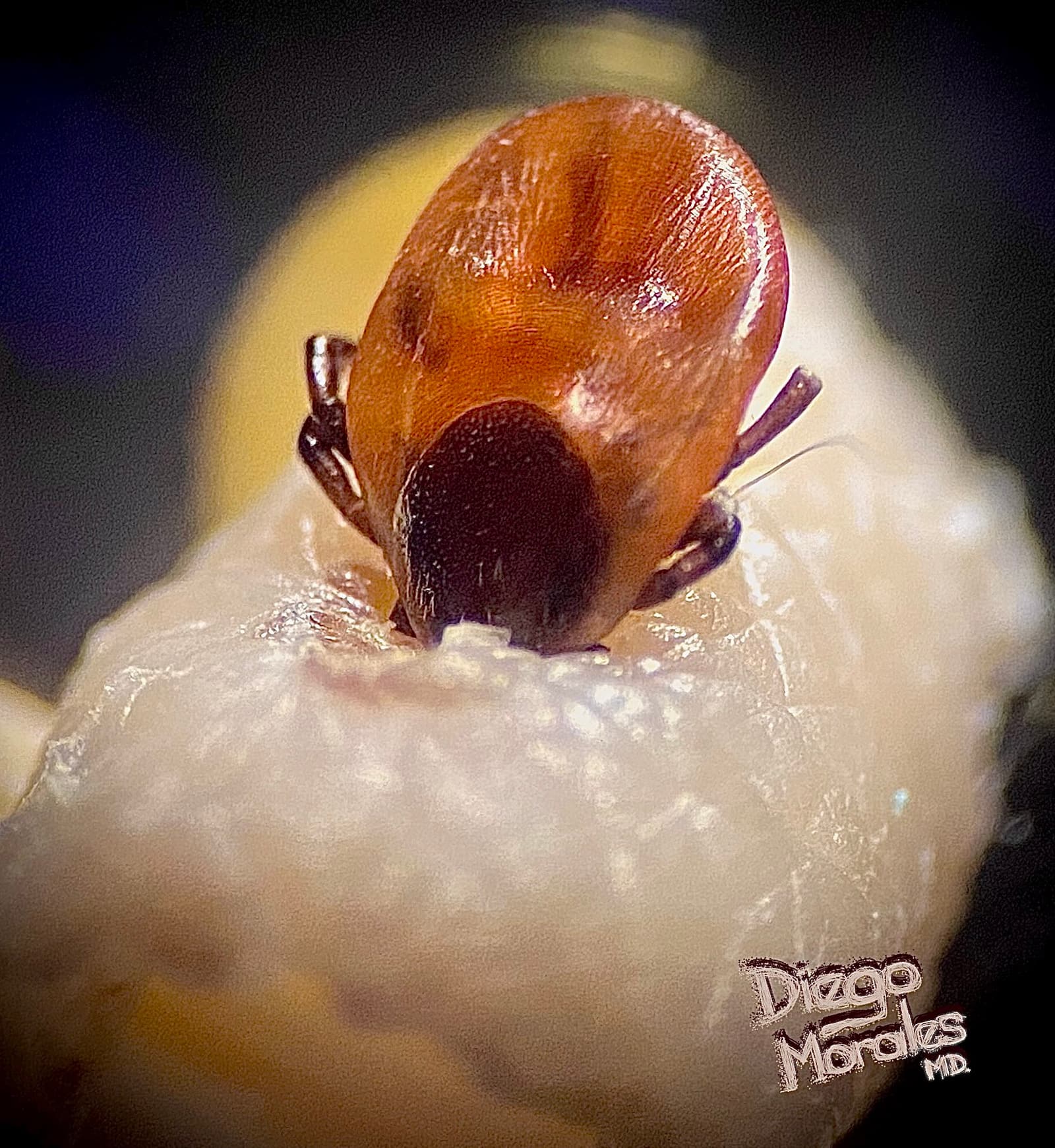
Image context: the cover photograph comes from Wikimedia Commons and shows an Ixodes deer tick embedded in skin tissue.[6] It is more useful than a diagram here because the article is about hand position and evidence scale. The tick is small, the attachment point is smaller, and the margin for squeezing the wrong part is exactly where the practical lesson lives.
At the start, the video treats the tool as a positioning device
The first lesson is not "have tweezers." It is where the tweezer tips go.[1] The video's value comes from the way it narrows attention to the attachment point instead of the visible body of the tick. CDC's written guidance is explicit: grasp the tick as close to the skin's surface as possible, using clean fine-tipped tweezers if available, and avoid squeezing the body.[2] Mayo Clinic says the same thing in first-aid language: use fine-tipped forceps or tweezers, get close to the skin, then lift with a slow, steady upward motion.[3]
That detail changes the whole procedure. Many bad removal methods are attempts to make the tick decide to leave: burn it, smother it, irritate it, twist it, or coat it. CDC's caution is sharper. Petroleum jelly, heat, nail polish, and other substances can agitate the tick and force infected fluid into the skin.[2] Mayo Clinic likewise warns against hot matches, nail polish, and petroleum jelly.[3] The good method works in the opposite direction. It does not negotiate with the tick. It mechanically controls the closest safe point.
This is why the clip's plainness works.[1] It refuses to make tick removal feel like pest control theater. The task is closer to splinter removal than to an exorcism: stabilize the tool, grip near the skin, pull evenly, then stop adding unnecessary maneuvers.
The pull is steady because the main risk is breaking the event into a messier one
Around the demonstration, the important verb is "pull," not "yank."[1] CDC says to pull away from the skin with steady, even pressure and not to twist or jerk, because mouthparts can break off and remain in the skin.[2] That instruction often gets misunderstood. A retained mouthpart is not a reason to panic or dig aggressively. CDC says the body will naturally push remaining mouthparts out over time as the skin heals; if they cannot be removed easily with tweezers, leave them alone.[2]
That guidance is useful because it keeps the public from turning one small procedure into a larger wound. The same logic governs disposal and cleaning. CDC recommends placing a live tick in a sealed container, wrapping it tightly in tape, flushing it, or putting it in alcohol, then cleaning the bite area and hands with soap and water, rubbing alcohol, or hand sanitizer.[2] The sequence is practical: remove, contain, clean, document.
Mayo Clinic adds a second reason to stay disciplined. Tick bites are often painless and minor at first, but some ticks spread illnesses including Lyme disease and Rocky Mountain spotted fever.[3] That means the removal event has two meanings. It is a first-aid action in the moment and a time stamp for later medical judgment.
After removal, the record matters more than the tick test
One of CDC's strongest post-removal instructions is also the least cinematic: do a careful tick check for other ticks and monitor for rash or fever in the following days to weeks.[2] The agency's follow-up language asks people who develop rash or fever to tell a clinician about the recent tick bite, when it occurred, and where they most likely acquired it.[2] Those details sound ordinary, but they are the difference between a vague story and a clinically useful exposure history.
CDC's surveillance page explains the scale behind that caution. Reported Lyme disease cases are only one measure; claims-based estimates point to far more people diagnosed and treated annually than reported case counts alone show.[4] That gap should not make people catastrophize every bite. It should make them precise. Write down the date. Note the location. Take a photo if helpful. Watch for a spreading rash, fever, chills, fatigue, muscle or joint aches, facial weakness, irregular heartbeat, or arthritis-type symptoms in the appropriate time frame.[2][3][4]
The IDSA guideline helps set the boundary on antibiotics. Prophylaxis is not framed as a universal response to every tick bite. It is recommended only for high-risk Ixodes bites in highly endemic areas when attachment was long enough and treatment can start within 72 hours of removal.[5] That boundary is essential public-health hygiene. Too little concern turns real infections into delayed care. Too much reflex treatment turns every outdoor weekend into an antibiotic event. The middle path is documentation plus criteria.
What the video gets right by staying narrow
The Clinton County Health Department video works because it does not try to be the entire tickborne-disease curriculum.[1] It teaches the first move. The written sources supply the surrounding frame: remove promptly, avoid irritant tricks, clean the site, keep a useful record, and escalate based on symptoms and risk criteria rather than fear alone.[2][3][5]
That is the lesson worth carrying into tick season. A tick bite is not solved by folklore and not made safer by theatrical force. It is handled by a small procedural discipline followed by a longer observational discipline. Tweezers close to skin. Steady traction. Clean hands. Date, place, and symptom watch. In a public-health sense, the removal is the short part. The memory of what happened is the longer tool.
Sources
- Clinton County Health Department, "Proper Tick Removal," YouTube video.
- Centers for Disease Control and Prevention, "What to Do After a Tick Bite" (July 15, 2025) - CDC tick-removal steps, disposal, cleaning, follow-up, and caution against irritant methods.
- Mayo Clinic, "Tick bites: First aid" (March 15, 2024) - first-aid removal technique, warnings against folk methods, and emergency/symptom boundaries.
- Centers for Disease Control and Prevention, "Lyme Disease Surveillance and Data" - reported 2023 cases and annual diagnosis-and-treatment estimates.
- AAN/ACR/IDSA, "2020 Guidelines for the Prevention, Diagnosis and Treatment of Lyme Disease" - high-risk tick-bite criteria and the 72-hour prophylaxis window.
- Wikimedia Commons, "File: Tick-Skin (51838764781).jpg" - medical photograph of an Ixodes deer tick embedded in skin tissue used as the article image.