Seat belts are easy to shrink into a moral instruction: buckle up, be responsible, follow the law. That framing is true enough for a roadside sign, but too thin for public health. A seat belt works because it turns a violent, very short event into a managed energy problem. It couples the body to the vehicle at stronger load paths, slows the body's forward motion over a slightly longer interval, limits contact with hard interior surfaces, keeps the occupant inside the survival space, and holds the person where an air bag can help rather than harm.[1][2]
That is why the belt belongs in health history rather than only in traffic law. It is a device, a standard, a habit, a policing choice, a design interface, and a population intervention at once. CDC now describes seat belt use as the most effective way for adults and properly sized older children to prevent crash injury or death, with serious crash-related injuries and deaths reduced by about half.[1] The mechanism behind that sentence is mechanical, but the route from mechanism to lives saved runs through institutions.
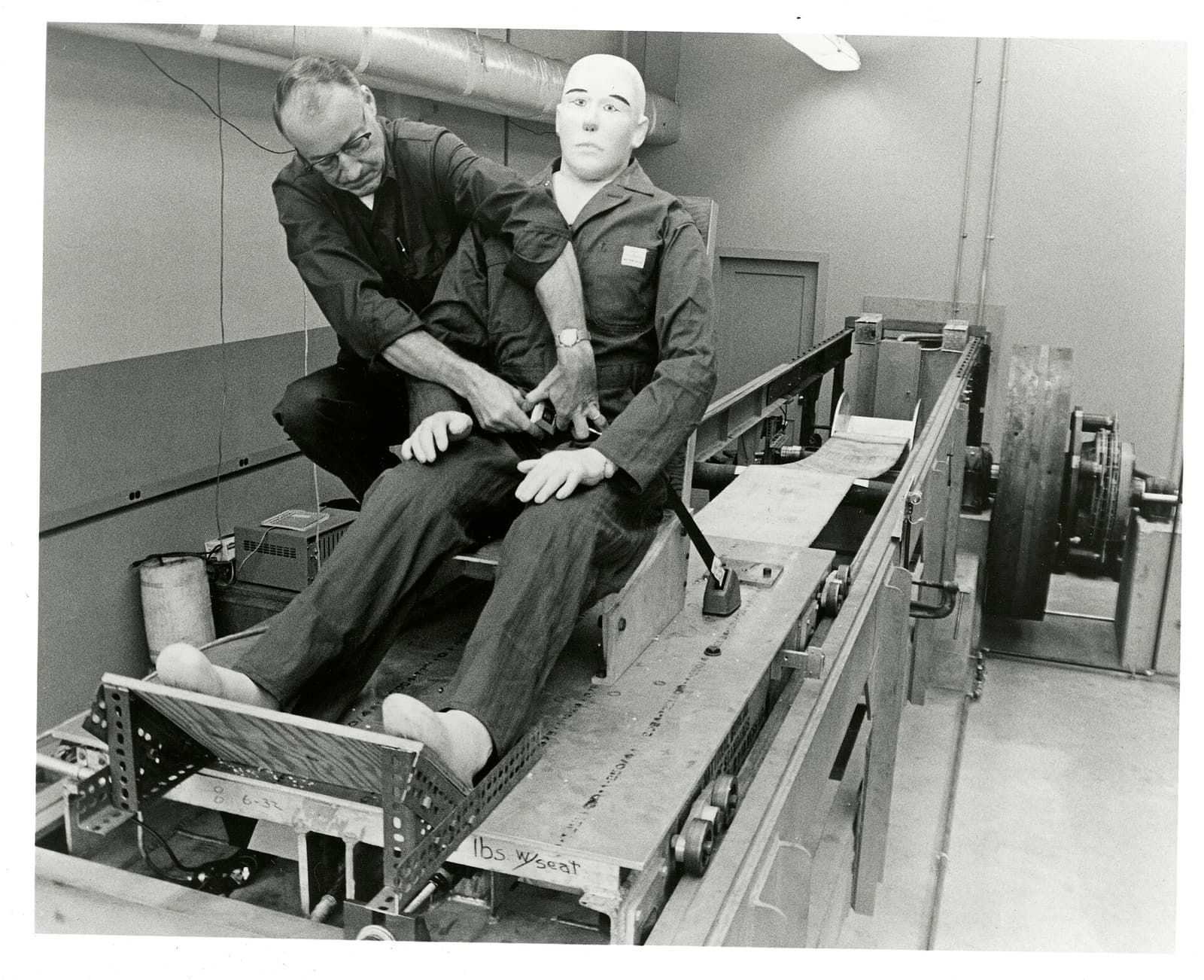
Image context: the cover image is a real 1967 National Bureau of Standards photograph of a crash-test dummy restrained in a seat-belt testing apparatus. It fits this article because the subject is not generic road safety. The subject is how a restraint system has to prove itself against bodies, anchorages, force, and failure modes before it can become ordinary public-health infrastructure.[7]
The first collision is outside the body; the second is inside the car
In a crash, the vehicle stops before the unrestrained body has finished moving. Without restraint, the person keeps traveling until a windshield, dashboard, steering wheel, door frame, pavement, or another occupant supplies the stop. The injury problem is therefore a sequence problem. The vehicle collision happens first; then the body collides with the vehicle interior or leaves the vehicle altogether.
The belt changes that sequence. A lap-and-shoulder belt spreads force across the pelvis and chest rather than letting the head, face, neck, or abdomen take the whole event. It also keeps the torso from jackknifing freely into the steering wheel or dash. NHTSA's countermeasures guide gives the effect size in plain terms: used lap-and-shoulder belts reduce fatal-injury risk for front-seat passenger-car occupants by 45% and moderate-to-critical injury by 50%; for light-truck occupants, the corresponding estimates are 60% and 65%.[2]
Those numbers are not magic properties of webbing. They come from geometry, timing, and fit. The shoulder belt needs to cross the shoulder and chest; the lap belt needs to sit low over the hips; slack and poor positioning reduce the system's ability to route force through stronger structures. Children add another boundary: until the belt fits their body, an appropriate child restraint or booster is part of the same mechanism, not an optional accessory.[1][2]
Ejection is the failure mode the belt prevents most bluntly
The cleanest public-health value of a belt is that it keeps the occupant in the vehicle. Ejection turns a crash from an interior injury problem into an uncontrolled impact with pavement, roadside objects, or the vehicle itself. Even when the passenger compartment stays survivable, an unbelted person can leave that survival space before the vehicle has stopped moving.
This is why the seat belt and the air bag are paired systems. CDC's public guidance is careful on that point: air bags add protection, but they do not substitute for seat belts.[1] An air bag deploys into a designed zone for a short instant. The belt helps keep the body in that zone and reduces the forward velocity the bag has to manage. Read backwards, the message is just as important. An unbelted occupant can be badly positioned when the air bag deploys, and a rear-seat passenger without a belt can become a moving load that injures people in front.
The device therefore works as a restraint system, not as a charm. It is most powerful when used on every trip, in every seating position, with the body fitted to the restraint rather than twisted around it.[1][2]
Standards made the belt available before laws made use normal
The United States did not move from invention to habit in one step. Federal vehicle standards first made restraint hardware a built-in expectation. NHTSA's review of vehicle safety technologies traces the early regulatory sequence: the original Federal Motor Vehicle Safety Standard No. 208 had a January 1, 1968 effective date and required lap belts at each designated passenger-car seating position, with shoulder-belt provisions for outboard front seats under the original static-test logic.[3] The same review describes later amendments that pushed toward shoulder belts, retractors, warnings, and integral three-point lap-shoulder belts.[3]
That hardware story matters because it separates two public-health tasks. First, the car had to contain a usable restraint. Second, people had to use it. The second task lagged. CDC's MV PICCS summary notes that seat belt use was only 11% to 14% in the late 1970s and early 1980s before occupant-use laws, even though vehicles already had belts.[4] A technology sitting unused in the cabin is not yet a population intervention.
New York supplied the first major use-law turn in 1984, and CDC's summary says nationwide use increased dramatically as laws went into effect and were enforced; the largest increase came from 1984 to 1987, when 29 states implemented seat belt laws.[4] The old objection that seat belts were merely a private choice became less persuasive once the public costs of trauma, emergency response, disability, and preventable death were counted in the same frame.
Enforcement changes the denominator
Seat belt policy has always lived in the gap between individual behavior and population risk. A belt works one body at a time, but laws change the denominator: more trips become restrained trips. That is why the difference between primary and secondary enforcement matters. Under primary enforcement, an officer can stop a vehicle for a seat belt violation alone. Under secondary enforcement, the belt violation is ticketed only after another stop has already occurred.[1][4]
CDC's 2026 facts page reports higher observed use in states with primary enforcement than in states with secondary enforcement or no adult belt law: 92% versus 90% in 2022.[1] The difference looks small at a glance, but the denominator is huge. In a national system where millions of vehicle trips happen daily, a few percentage points can decide whether many crashes include a restrained body or an unrestrained one.
The 1985 CDC report on state legislative activity shows how quickly the policy question sharpened. It recorded that New York's mandatory-use law, effective January 1, 1985, was followed by an increase in observed use from 16% before the law to 57% four months later, with fatalities down 19% despite a modest mileage increase.[5] That single-state snapshot did not settle every causal question, but it showed the adoption mechanism public-health officials cared about: law plus visibility could move use much faster than education alone.
The Community Preventive Services Task Force later treated mandatory-use laws as an evidence-review question, not just a legal preference. Its archived CDC Stacks record describes the recommendation as based on systematic reviews of effectiveness and economic impact.[6] That is the appropriate level of analysis for seat belts. The outcome is not only whether a belt can restrain a dummy in a test. The outcome is whether a society can make restraint ordinary enough that the test result reaches real crashes.
The mechanism has boundaries
Seat belts reduce risk; they do not abolish crash physics. High-speed impacts, side intrusion, rollover forces, heavy trucks, incompatible vehicle masses, alcohol, speeding, fatigue, distraction, road design, and emergency-response time all remain part of injury risk. A belt is one layer in a traffic-injury system.
The boundary is especially important for children. NHTSA's countermeasures guide separates adult belts from child restraints and booster seats because anatomy and fit change the mechanism.[2] A belt that sits across a small child's abdomen or neck can shift force into dangerous places. The public-health lesson is not "one strap solves all bodies." It is that restraint has to match body size, seating position, vehicle design, and crash mode.
There is also a social boundary. Seat belt use can look like the simplest possible prevention behavior, yet the history shows that availability, reminders, law design, enforcement intensity, social norming, and vehicle warnings all had to stack together. CDC estimates that seat belts saved almost 15,000 lives in 2017.[1] That figure is not the product of a slogan. It is the product of a mature restraint ecosystem: standards put belts in vehicles, evidence proved the mechanism, laws changed use, enforcement reinforced the norm, and everyday repetition made the act feel automatic.
The health lesson inside the buckle
Seat belts are one of the clearest examples of injury prevention as ordinary infrastructure. They do not require a hospital bed, a prescription, or a clinician at the moment of use. Their health effect begins before the crash, in a cabin ritual that takes seconds. Yet that tiny ritual rests on decades of design, crash testing, federal standards, state laws, epidemiology, enforcement campaigns, and family habits.
The mechanism is simple only at the surface. Underneath it sits a full public-health chain: measure a common cause of death, design a protective technology, require it in the environment, persuade and compel use, track adoption, and keep improving the parts of the system that fail. The buckle is the visible gesture. The system is what makes the gesture matter.
Sources
- Centers for Disease Control and Prevention, "Facts About Seat Belt Use" (January 27, 2026; current CDC summary of seat belt effectiveness, lives saved, primary-enforcement comparison, and crash-death burden).
- National Highway Traffic Safety Administration, Countermeasures That Work: Seat Belts and Child Restraints (effectiveness estimates for lap-and-shoulder belts, light trucks, and child restraints).
- National Highway Traffic Safety Administration, Lives Saved by Vehicle Safety Technologies and Associated Federal Motor Vehicle Safety Standards, 1960 to 2012 (DOT HS 812 069; regulatory history of FMVSS 208, 209, and 210).
- Centers for Disease Control and Prevention, "MV PICCS Intervention: Primary Enforcement of Seat Belt Laws" (history of low pre-law belt use, New York's 1984 law, 1984-1987 state adoption, and primary-enforcement evidence context).
- Centers for Disease Control and Prevention, "State Legislative Activities Concerning the Use of Seat Belts -- United States, 1985" (MMWR; early post-law observations from New York and other state activity).
- Community Preventive Services Task Force / CDC Stacks, "Motor Vehicle-Related Injury Prevention: Use of Safety Belts, Laws Mandating Use" (2000; systematic-review basis for mandatory-use law recommendations).
- Wikimedia Commons, "File:Seatbelt testing apparatus1.jpg" (1967 National Bureau of Standards / NIST archival photograph used as the article image source).