The Back to Sleep campaign is easy to remember as a slogan, but its public-health force came from a mechanism. A fragile epidemiologic finding had to become a nightly routine: put the infant down on the back, every sleep, across parents, grandparents, babysitters, nurseries, clinics, and child care settings. The campaign mattered because it converted SIDS prevention from a specialist debate into a repeated household act supported by clinician advice, public images, crib design cues, and later safe-sleep environment rules.[1][3][4]
The historical sequence is short but loaded. By 1991, studies in Australia, New Zealand, and the United Kingdom had linked stomach sleeping with SIDS risk; in 1992, the American Academy of Pediatrics recommended that U.S. infants be placed on their backs or sides for sleep; in 1994, NICHD and partners launched the national Back to Sleep campaign; in 1996, AAP sharpened the recommendation toward the back position alone.[1][2] The campaign was later expanded and renamed Safe to Sleep in 2012, because the problem was no longer only sleep position. The sleep environment itself had become part of the prevention system.[1]
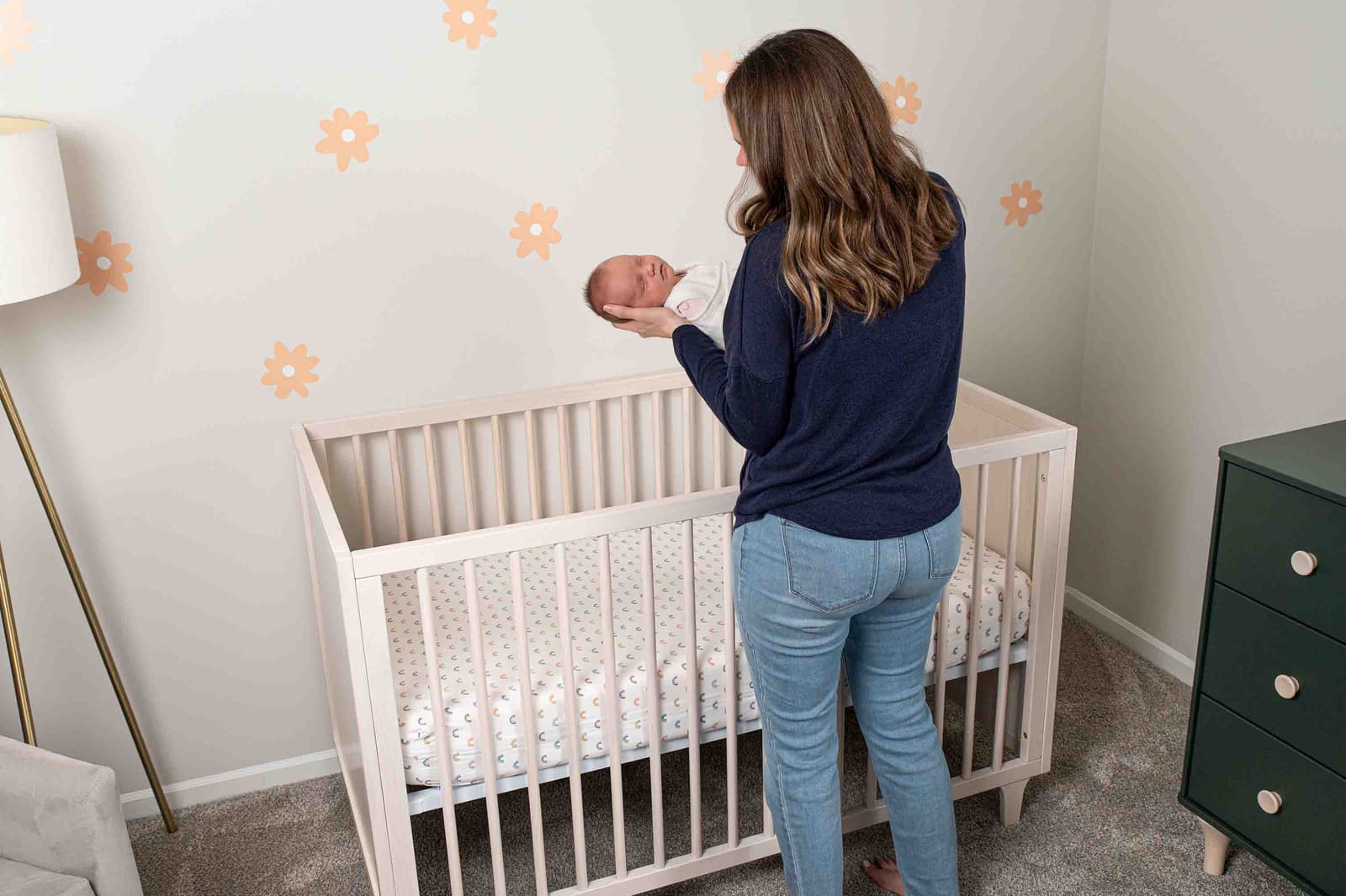
Image context: the cover image comes from the American Academy of Pediatrics Safe Sleep Image Gallery. It is a real educational photograph, not an illustration or chart. Its value is that it shows the message as a practiced scene: a caregiver, a separate crib, a firm flat mattress, no pillows, no loose blanket, and a baby being placed to sleep rather than simply watched after the fact.[7]
The risk finding had to become a default
SIDS is a diagnosis of exclusion, and the category has always required caution. CDC's 1996 MMWR defined it as a sudden death under age 1 that remains unexplained after a complete investigation, including autopsy, death-scene review, and clinical history.[2] That diagnostic boundary matters because it keeps the article from pretending that one sleep position explains every sudden infant death. It does not. What changed in the early 1990s was narrower: prone sleep became a modifiable risk factor that could be addressed before any single infant entered danger.[2][6]
The data signal was strong enough to change policy. CDC reported that the U.S. SIDS rate fell 30% during 1992-1995, concurrent with a drop in prone sleeping prevalence from 78% in 1992 to 43% in 1994.[2] That does not prove that sleep position was the only force at work. CDC also noted changes in smoking during pregnancy, diagnosis, death-scene investigation, and other risk factors.[2] But the temporal fit explains why the campaign became a public-health landmark: a behavior measurable at the crib was moving in the same direction as mortality.
The mechanism was behavioral, not just biological
The biological question around SIDS remains complex, but the prevention mechanism was operationally simple. A supine sleep position reduces exposure to risk pathways associated with prone or side sleep, and it creates a clear instruction that can be repeated without a medical device, prescription, or appointment. The message had to survive tired nights, family advice, old nursery habits, fear of choking, and the intuition that a baby might seem more comfortable on the stomach.[3][4]
That is why the word "every" became important. Current Safe to Sleep guidance says babies should be placed on their backs for naps and at night, including babies born preterm and those with reflux, until they are 1 year old.[4] It also draws a high-risk boundary around inconsistency: when a baby who usually sleeps on the back is placed on the stomach or side, even for a nap, SIDS risk can increase by up to 45 times.[4] The campaign therefore was not only telling families which position was best. It was trying to remove exception-making from the routine.
The public-health design problem was delivery. A recommendation heard once at discharge can fade. A recommendation repeated by pediatricians, modeled by hospital nurseries, printed on campaign materials, reinforced by product imagery, and echoed by grandparents is more likely to become a default. Back to Sleep worked as a system because it made one small action socially legible.
The crib became part of the intervention
The early slogan focused on sleep position because that was the urgent behavioral correction. Over time, the safe-sleep frame widened. AAP now summarizes the prevention bundle as placing infants on their backs, in their own sleep space, on a firm and flat mattress with a fitted sheet, while keeping blankets, pillows, stuffed toys, bumpers, and other soft items out of the sleep area.[3] Safe to Sleep similarly emphasizes a firm, flat, level surface and warns against couches, sofas, sitting devices, and inclined sleep surfaces as routine sleep spaces.[4]
This widening is not mission drift. It is mechanism completion. A baby on the back in a cluttered, soft, adult sleep environment is not the same intervention as a baby on the back in an empty crib. The sleep-position rule reduces one class of risk; the sleep-surface and sleep-space rules reduce others, including suffocation, entrapment, wedging, and airway compromise.[3][4][5]
The image discipline matters here. Unsafe infant-sleep photos can quietly teach the wrong scene: pillows, adult beds, blankets, toys, swings, couches, or babies sleeping on the stomach. AAP's image gallery exists because public health does not travel only through text. It travels through the model picture that caregivers and editors repeatedly see.[7]
The plateau is part of the story
Back to Sleep is often remembered through the steep 1990s decline. The harder contemporary fact is that the problem did not end. CDC reported about 3,700 sudden unexpected infant deaths in the United States in 2022, including 1,529 deaths classified as SIDS, 1,131 from unknown causes, and 1,040 from accidental suffocation and strangulation in bed.[5] AAP notes that sleep-related infant death rates declined significantly in the 1990s after back-sleep recommendations, but later plateaued, with Black and American Indian/Alaska Native infants dying at more than double the rate of white infants.[3]
That plateau changes how the original campaign should be remembered. The victory was real, but it was not self-sustaining. The system has to keep transmitting the rule across new caregivers, product markets, housing constraints, cultural practices, exhaustion, and misinformation. The same mechanism that made the 1990s campaign successful also explains why present-day safe-sleep work is hard: prevention depends on ordinary scenes being rebuilt thousands of times a day.
The diagnostic issue also remains. The NCBI Bookshelf review of SIDS and sudden unexpected infant deaths emphasizes that temporal trends are shaped by both real changes in risk and shifts in classification.[6] That does not erase the campaign's effect. It keeps the conclusion disciplined. Back sleeping did not solve every unexplained infant death. It moved a modifiable risk factor at scale, and that movement lined up with a large decline in SIDS.
What the campaign really taught
The enduring lesson of Back to Sleep is not that a slogan saves lives by itself. The lesson is that a slogan can become the front end of a prevention system when the underlying action is specific, observable, repeatable, and backed by institutions. The campaign had those properties. The target behavior was visible. The timing was frequent. The message could be taught before discharge, repeated at well-child visits, shown in photographs, and checked by any caregiver at the crib.
That is also why the modern version must be broader than the old phrase. Safe sleep now means position, surface, space, and consistency. It means starting every sleep on the back, then surrounding that act with an environment that does not undercut it.[3][4] Back to Sleep worked because it made prevention small enough to do every night. Safe to Sleep persists because the small act still needs a room, a script, and a culture around it.
Sources
- Eunice Kennedy Shriver National Institute of Child Health and Human Development, "Campaign History" - timeline of Back to Sleep's 1994 launch, the 1992 AAP recommendation, the 1996 back-only refinement, and the 2012 Safe to Sleep expansion.
- Centers for Disease Control and Prevention, "Sudden Infant Death Syndrome -- United States, 1983-1994" (MMWR, 1996) - historical mortality, sleep-position, and diagnosis context for the early campaign period.
- American Academy of Pediatrics, "Safe Sleep" - current AAP summary of safe-sleep recommendations, the 1990s decline, plateau, and persistent disparities.
- Safe to Sleep, "Ways to Reduce Baby's Risk" - current public guidance on back sleeping, sleep surfaces, sleep spaces, and the up-to-45-times risk statement for inconsistent prone or side placement.
- Centers for Disease Control and Prevention, "Data and Statistics for SUID and SIDS" (Sept. 17, 2024) - 2022 U.S. SUID, SIDS, unknown-cause, and accidental suffocation/strangulation counts.
- National Center for Biotechnology Information Bookshelf, "The Epidemiology of Sudden Infant Death Syndrome and Sudden Unexpected Infant Deaths: Diagnostic Shift and other Temporal Changes" - review of SIDS/SUID trends and classification issues.
- American Academy of Pediatrics, "Safe Sleep Image Gallery: Crib" - photographic source collection used for the cover image.