The rusty-nail story is useful only until it becomes too simple. It correctly teaches that a deep puncture wound can matter. It goes wrong when rust itself becomes the villain. Tetanus is caused by toxin produced after Clostridium tetani spores enter broken skin and germinate in conditions where the organism can grow. CDC's current public guidance points people toward puncture wounds, dirt, soil, feces, saliva, dead tissue, and vaccination status; WHO likewise describes spores in soil, ash, feces, skin surfaces, and rusty tools.[1][5]
The better question is therefore not "was the object rusty?" It is "did this wound create the conditions for tetanus, and does the person have enough vaccine-derived protection?" That shift matters because tetanus is rare in high-coverage countries, but not harmless. CDC's 2026 surveillance summary counted 402 U.S. cases and 37 associated deaths during 2009-2023; among cases with known vital status, the case-fatality rate was 12.4%.[4] A familiar myth can make a serious prevention system look like folklore.
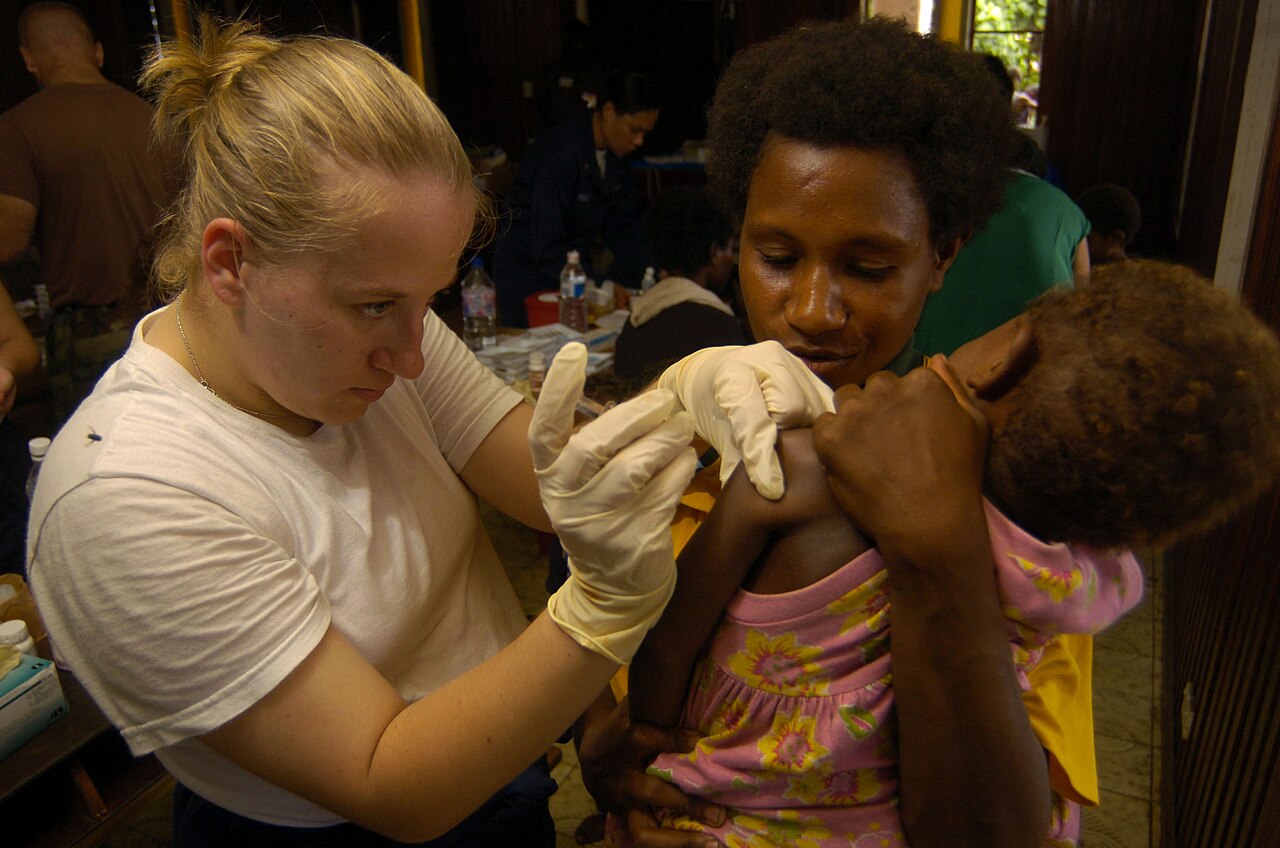
Image context: the cover image shows a real tetanus vaccination encounter rather than a symbolic rusty nail. It fits because the article's argument is about prevention infrastructure: vaccination, booster memory, wound assessment, and access to care.[6]
Timeline anchors
- 1947: tetanus became nationally notifiable in the United States; since then, reported U.S. cases have declined by more than 95% and deaths by more than 99%, a decline CDC ties to routine childhood immunization and later booster policy.[4]
- Late 1940s and 1960s: tetanus vaccine entered routine childhood immunization, and decennial booster dosing later became part of protection for all ages.[4]
- 1989: the World Health Assembly launched the global neonatal tetanus elimination goal, defining elimination as less than one neonatal tetanus case per 1,000 live births in every district.[5]
- 2009-2023: U.S. surveillance still found cases concentrated around missed vaccination, delayed wound prevention, and older-adult vulnerability rather than around one dramatic object.[4]
Myth: rust is the cause
Rust is a visual shortcut, not the mechanism. A rusty nail can be dangerous because it is often sharp, dirty, and capable of making a puncture wound. The rust does not manufacture tetanus toxin. The organism's spores are the problem, and those spores are environmentally tough. WHO says they can survive for years and are found widely in the environment, including soil and feces as well as on surfaces such as rusty tools.[5]
CDC's wound guidance makes the same point operationally. Dirty or major wounds include penetrating or puncture wounds, wounds containing dirt, soil, feces, or saliva, and wounds with devitalized tissue such as burns, crush injuries, frostbite, or necrotic tissue.[2] That list is more useful than the rusty-nail myth because it separates the visual clue from the biologic risk. A clean-looking puncture can still deserve attention; a dramatic-looking rusty object is not the whole diagnostic story.
The low-oxygen part is important. CDC's surveillance summary explains that once spores are inside the body in anaerobic conditions, they can germinate and produce tetanospasmin, the toxin responsible for the serious neurologic effects.[4] That is why dead tissue, deep wounds, and contaminated punctures matter. They are not scary because they look dirty in a cartoon sense. They are dangerous because they can create a local environment where spores move from dormant contamination to toxin production.
Myth: the shot after a wound is the whole rescue
The phrase "tetanus shot" can hide two different ideas. Routine tetanus-containing vaccines train immunity before exposure, which is why CDC's Pink Book treats tetanus as vaccine-preventable even though the organism remains common in the environment.[3] Tetanus immune globulin, or TIG, provides temporary antitoxin in selected higher-risk situations. CDC's clinician guidance says TIG can directly bind and neutralize circulating toxin, but cannot neutralize toxin already bound to nerve endings.[2] That boundary is the toxin clock. Once the toxin has bound, prevention has already missed its easiest window.
This also explains why wound care is not just cleanup theater. CDC tells clinicians to clean wounds, remove dirt or foreign material, and remove or debride necrotic material.[2] The same guidance warns that antibiotics should not be used just to prevent tetanus after a wound, while infected wounds should still be treated appropriately.[2] The prevention stack is specific: wound cleaning, vaccination-status assessment, vaccine when indicated, and TIG when indicated. It is not a generic "give antibiotics and hope" pathway.
Diagnosis has its own limit. CDC's surveillance summary states that tetanus is a clinical syndrome and that no diagnostic tests can support or rule out the diagnosis.[4] That makes prevention unusually important. The system cannot wait for a reassuring lab result after spasms begin. It has to use wound type, vaccine history, symptom pattern, and clinical judgment before the event hardens into a neurologic emergency.
Myth: childhood shots or past tetanus settle the matter forever
Tetanus does not behave like measles infection, where natural infection typically leaves lasting immunity. WHO is explicit that people who recover from tetanus do not have natural immunity and can be infected again.[5] Protection has to come from tetanus-toxoid-containing vaccines and, depending on the setting, boosters.
That is why CDC's wound guidance uses both wound type and vaccine timing. For clean and minor wounds, people who completed the primary series are recommended vaccination if their last tetanus vaccine was 10 or more years ago. For dirty or major wounds, that threshold tightens to 5 or more years.[2] The details matter because the practical question is not "has this person ever heard of a tetanus shot?" It is whether the primary series was completed and whether enough time has passed for booster protection to matter.
The U.S. surveillance record shows why that distinction is not bureaucratic excess. Among people with tetanus and known vaccination history during 2009-2023, CDC reported that 43.9% had no documented tetanus-toxoid-containing vaccine doses. Among those with at least one documented dose, 58.8% had received the most recent dose at least 10 years before onset. Nearly 95% of reported patients with known hospitalization status were hospitalized, and 65.0% of hospitalized patients with known ICU status required intensive care.[4] Those numbers make tetanus look less like a freak accident and more like a preventable failure of immune memory plus wound-response timing.
The global record adds another layer. WHO reports that neonatal tetanus deaths fell by 97% from 1988 to 2018 as tetanus-toxoid-containing immunization scaled up, but it still counted about 25,000 neonatal deaths in 2018 and noted that 11 countries had not achieved maternal and neonatal tetanus elimination as of July 2023.[5] That is the same mechanism at a different scale: vaccination and clean care convert a lethal environmental hazard into a controlled risk, but the control has to be maintained.
The rusty nail remains a useful warning sign if it leads to the right behavior. It fails when it narrows attention to rust rather than wound conditions, booster status, and timely medical assessment. Tetanus prevention is not a superstition about old metal. It is a toxin-clock problem, and the clock is easiest to beat before the toxin has a chance to bind.
Sources
- Centers for Disease Control and Prevention, "About Tetanus" - current public guidance on symptoms, risk factors, wound concerns, and vaccination prevention.
- Centers for Disease Control and Prevention, "Clinical Guidance for Wound Management to Prevent Tetanus" - wound categories, 5-year and 10-year vaccine thresholds, TIG indications, and wound-care guidance.
- Centers for Disease Control and Prevention, Pink Book, Chapter 21: Tetanus - vaccine-preventable-disease background and immunization reference chapter.
- Hughes MM, Amin AB, Rubis AB, "Tetanus Surveillance - United States, 2009-2023," MMWR Surveillance Summaries 75(SS-1), 2026.
- World Health Organization, "Tetanus" fact sheet (July 12, 2024) - global mechanism, neonatal tetanus, immunization schedule, and elimination context.
- Wikimedia Commons, "File:US Navy 050515-N-1485H-001 Hospitalman Mary Lewis...administers a tetanus shot to a child and her mother.jpg" - real U.S. Navy photograph used as the article image source.