
As of 2026-06-28 UTC, Brown University's short fentanyl test-strip video is still worth watching because it gives a visual shape to a difficult harm-reduction idea: the strip is not a permission slip, a purity certificate, or proof that a drug is safe. It is a signal. Its value is that it can interrupt an invisible risk before use, when there is still time to change the surrounding plan.[1][2]
That distinction matters because fentanyl is often discussed in either alarmist or overly technical language. CDC's public guidance is more practical. Fentanyl is a potent synthetic opioid that may be present in powders, counterfeit pills, and other drugs; a person cannot reliably identify it by sight, taste, or smell; and test strips can help detect its presence while still leaving important uncertainty.[3] The useful lesson is therefore not "a test strip solves overdose risk." The useful lesson is "a test result creates a decision point."
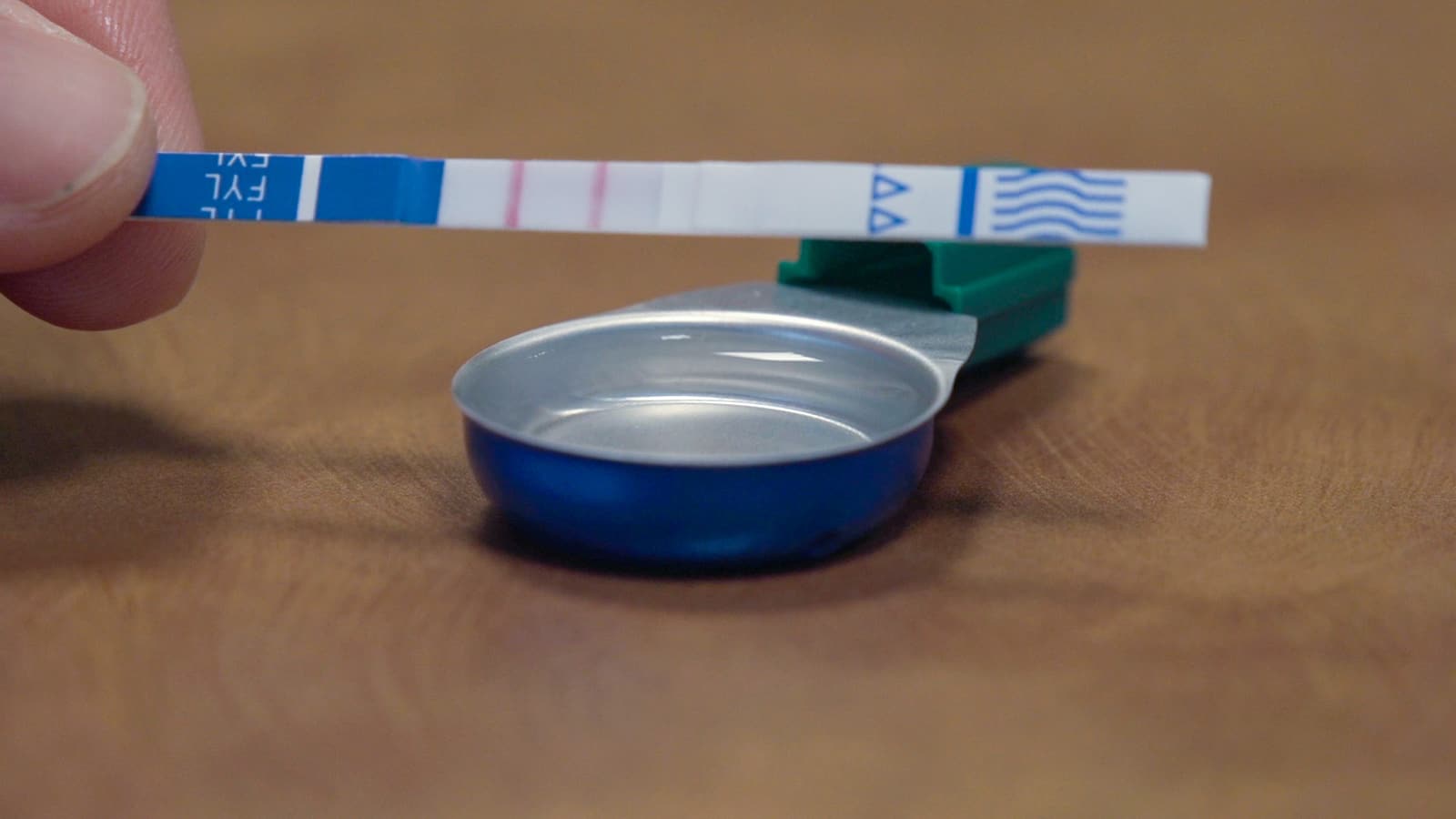
The Brown video makes that decision point physical: a small strip, a sample, a result, and then a pause before anyone assumes they know what is in front of them.[1] The photograph used for this article comes from Brown's 2019 report on the same research program, which followed young adults in Rhode Island who were given strips and interviewed about how they used them.[2][6] The image is a real photograph, not a diagram or generated visual, and it belongs here because drug-checking policy is easiest to misunderstand when the object itself disappears from view.
Watch the result as a question, not an answer
The first thing to notice in the video is how small the device is compared with the claims often made around it.[1] A fentanyl test strip can be useful precisely because it is simple enough to be distributed, carried, and used outside a laboratory. But that simplicity also makes the boundaries easy to miss. CDC frames strips as a tool for detecting fentanyl in different forms of drugs, while warning that a negative result does not guarantee safety and that fentanyl may not be distributed evenly through a sample.[3]
That is the core annotation to carry through the video. A positive result should be treated as meaningful warning. A negative result should be treated as incomplete information, not reassurance. The New York State Department of Health AIDS Institute guideline, hosted by NCBI Bookshelf, puts test strips inside a larger harm-reduction stack: when possible, test drugs with fentanyl and xylazine test strips or other drug-checking systems; avoid using alone; start with a small amount; carry naloxone; and connect people to local or online resources for strips and instructions.[4] The strip is one layer, not the whole plan.
This is why the video is more useful as an annotated object than as a standalone instruction. It shows the viewer that drug checking can happen quickly and privately, but the written clinical guidance explains what the viewer should not infer. The result does not measure dose. It does not detect every possible contaminant. It does not remove the need for naloxone, someone nearby, emergency response, or local harm-reduction advice.[3][4]
The behavior around the strip is the intervention
Brown's research program is helpful because it asked what people did after testing, not just whether they liked the technology. In the 2017 Rhode Island pilot described in the 2019 qualitative paper, 81 participants returned for follow-up and 62 reported using at least one strip.[6] Participants described using the information to change behavior: discarding a supply, using with someone else present, keeping naloxone nearby, or sharing strips with people they believed were at risk.[2][6]
Those details matter more than the device's novelty. A strip that produces information but does not change the setting is weaker than one that triggers a safer-use conversation, a naloxone check, a decision not to use alone, or a choice to use a smaller initial amount. The video compresses that logic into a public-facing demonstration.[1] The Brown and clinical sources unpack why the demonstration belongs in a wider safety system rather than in a gadget story.[2][4][6]
This also helps avoid a common bad argument: that fentanyl test strips matter only if they can make drug use safe. No serious harm-reduction reading requires that claim. Seat belts do not make crashes safe; smoke alarms do not make fires safe; naloxone does not make opioid use safe. They reduce particular failure modes. Fentanyl test strips are best understood the same way. They can reveal one class of hidden risk early enough for a person or outreach worker to change the plan, while leaving other risks intact.
What newer evidence adds
The strongest recent support is still careful, not absolute. A 2025 JAMA Network Open cohort study used data from Kentucky, New York, and Ohio, following people who use drugs after baseline reporting in a larger community intervention context.[5] The study included 732 participants; 414, or 56.6%, reported baseline fentanyl test-strip use. Over follow-up, baseline strip users reported more overdose risk-reduction behaviors than nonusers, including behaviors such as having naloxone, asking someone to check on them while using, testing drug strength, and discarding drugs that seemed bad or unexpected.[5]
That finding should be read with discipline. The study is observational, so it does not prove that handing out strips alone causes better outcomes in every setting. People who use strips may already be more connected to harm-reduction services or more likely to use several safety practices at once. But that limitation does not make the finding trivial. It actually matches the best interpretation of the video: the strip works as part of a behavior cluster. It is a low-friction way to make risk discussable before use, especially when paired with outreach, naloxone, drug-checking education, and nonjudgmental access points.[4][5]
The timeline is important here. The Brown pilot began in 2017, the qualitative report appeared in 2019, and the 2025 multisite cohort added a larger observational layer after the fentanyl-dominated drug supply had become even more entrenched.[2][5][6] Across those years, the basic public-health lesson stayed stable. Drug checking is not about certainty. It is about moving uncertainty earlier, before the most dangerous moment.
The video's real lesson
The best way to watch Brown's video is to notice the pause it creates.[1] Before the strip, a person may have only rumor, appearance, seller trust, or past experience. After the strip, the person has a signal that can change the next action. That signal may be positive, negative, confusing, or mismatched with what local drug-checking programs are seeing. Any of those outcomes is still better handled inside a support system than alone.
This is where clinicians, public-health workers, and readers should resist turning the clip into either a miracle story or a moral argument. The evidence does not say that a strip neutralizes fentanyl. It says that strips can be acceptable, usable, and associated with concrete overdose risk-reduction behaviors.[5][6] CDC and clinical guidance then add the boundary: test results should sit beside naloxone access, not using alone, smaller test amounts, local instructions, and attention to other adulterants such as xylazine where relevant.[3][4]
The video is short because the object is short on purpose. A test strip is designed for a moment when a long lecture may not happen. The article's job is to lengthen that moment enough to make the interpretation honest. A fentanyl test strip is a signal, not a safety certificate. Used well, the signal can buy time for safer choices. Used poorly, it can be mistaken for certainty. The difference is the layer of guidance, supplies, and human support wrapped around the strip.
Sources
- Brown University, "Fentanyl test strips prove useful in preventing overdoses," YouTube video.
- Brown University, "Firsthand accounts indicate fentanyl test strips are effective in reducing overdose risk" (Jan. 18, 2019) - report and source page for the article image by Stephen Crocker/Brown University.
- Centers for Disease Control and Prevention, "Fentanyl Facts" (redirected from CDC's Test for Fentanyl resource; last modified Apr. 28, 2026) - public guidance on fentanyl, test-strip use, and limitations.
- New York State Department of Health AIDS Institute, "Substance Use Harm Reduction in Medical Care," NCBI Bookshelf guideline, updated Jan. 24, 2025.
- Vickers-Smith RA, Gelberg KH, Childerhose JE, et al., "Fentanyl Test Strip Use and Overdose Risk Reduction Behaviors Among People Who Use Drugs," JAMA Network Open 8(5), e2511011 (May 13, 2025).
- Goldman JE, Waye KM, Periera KA, Krieger MS, Yedinak JL, Marshall BDL, "Perspectives on rapid fentanyl test strips as a harm reduction practice among young adults who use drugs: a qualitative study," Harm Reduction Journal 16, 3 (Jan. 8, 2019).