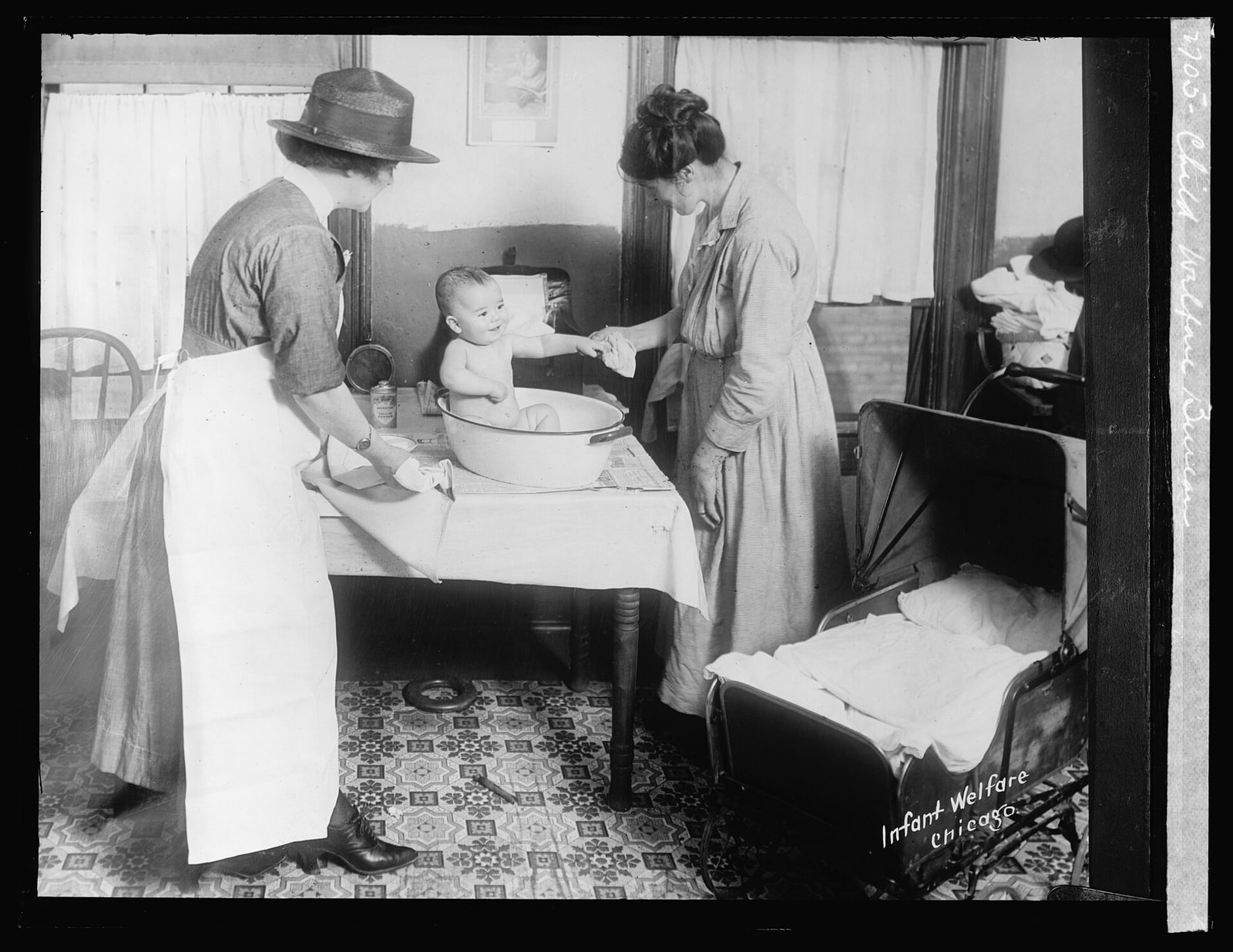
The baby in the photograph is sitting in a washbasin, smiling at the woman who holds one hand. A second attendant stands close with a towel. Taken at a Chicago child-welfare clinic between 1918 and 1928, the photograph documents an ordinary moment of organized infant care.[7] It cannot show what the attendants measured or believed. That evidentiary limit is useful here, because this story turns on the distance between seeing an event and knowing what caused it.
For centuries, however, one of infancy's most visible milestones had carried an impossible explanatory burden. A tooth appeared while a child drooled, cried, developed diarrhea, convulsed, or died; the sequence was written down as causation. In 1842, “teething” was recorded for 4.8% of deaths among London infants younger than one and 7.3% among children aged one to three.[2] As late as 1905, the Registrar-General for England and Wales counted 2,343 deaths certified as due to teething alone.[1]
The myth is not that tooth eruption is sensationless. Tender gums, chewing, drooling, irritability, and small shifts in temperature can accompany it. The myth is that eruption explains severe systemic illness. That distinction matters because the old diagnosis did two kinds of damage: it could stop the search for the disease actually making a child sick, and it licensed remedies whose risks were more real than the supposed disease.
Myth: the tooth was causing the crisis
London's early modern Bills of Mortality did not work like modern death certificates. John Rendle-Short's 1955 history describes how parish “searchers”—sworn local women rather than physicians—viewed bodies, asked questions, and reported a cause to the parish clerk. In the Bills for 1629–1660, “teeth and worms” became one of the largest recorded categories of childhood death outside the neonatal labels.[1]
That category joined a medical tradition reaching back to antiquity. Fever, diarrhea, convulsions, swollen gums, and restlessness were repeatedly grouped under dentition. If the tooth was thought to be trapped, cutting the gum seemed logical. By 1742, surgeon Joseph Hurlock was advocating early and repeated gum lancing even though deaths continued in his own case histories.[1]
The causal story was contested long before laboratory medicine could settle it. William Cadogan argued in 1748 that healthy children could cut teeth without dangerous symptoms. George Armstrong sharpened the objection in the 18th century: children who died while they were “about teeth,” he observed, were routinely said to have died from teething.[1] His point was not that the deaths were imaginary. It was that the label had converted coincidence into mechanism.
Evidence: the label was a diagnostic container
No archive can retrospectively assign a modern diagnosis to every child listed under “teeth.” The historical sources instead support a bounded interpretation: the category plausibly held many different illnesses whose timing overlapped with tooth eruption. Diarrheal infection, meningitis and other causes of convulsions, nutritional disease, and genuine local gum discomfort are candidates—not diagnoses that can now be proved for individual deaths.[1][2]
Three forces made the container unusually durable.
First was age coincidence. Primary teeth begin appearing during a period when infants also encounter changing foods, wider environments, and many infections. An eruption is easy to see; a pathogen is not. Second was diagnostic scarcity. Without microbiology, reliable temperature tracking, or consistent medical certification, the visible event could stand in for an invisible cause. Third was administrative reinforcement. Once “teething” appeared in mortality tables, the table itself made the category look established. A repeated label acquired the authority of a repeated finding even when every entry rested on the same weak causal inference.
That third step is an inference from the record, not a claim the sources directly measure. But it explains an otherwise strange persistence: critics could attack the diagnosis for generations while the count generated by the diagnosis continued to make it seem numerically substantial.
Prospective observation finally asks a different question. Instead of starting with a sick child and looking backward for an erupting tooth, it follows healthy infants day by day and checks whether specific symptoms cluster around recorded eruptions. In a 2000 Pediatrics cohort, researchers enrolled 125 children; parents of 111 supplied at least some daily symptom data, producing 19,422 child-days of observations around 475 tooth eruptions.[5]
The study found a narrow eight-day window—from four days before emergence through three days after—in which biting, drooling, gum rubbing, irritability, wakefulness, reduced appetite for solids, and mild temperature elevation appeared somewhat more often. Yet no symptom occurred in more than 35% of teething infants, no symptom was more than 20 percentage points more common during teething days, and temperatures above 102°F were not significantly associated with tooth emergence. No participant had a life-threatening illness.[5]
This design does not prove that every child experiences eruption identically. The cohort consisted of healthy children in one clinic-based setting; parents, not clinicians, recorded symptoms and felt daily for teeth breaking through the gum; and 14 enrolled families supplied no diary data. Its strength is narrower: it measures timing instead of assuming it. The resulting picture is one of modest, inconsistent local and behavioral effects—not a systemic disease capable of explaining a death register.
The remedy could become the disease
Once teething was imagined as a dangerous internal crisis, forceful treatment could be sold as rescue. Gum lancing turned a causal theory into a wound. “Soothing” preparations turned it into a market.
Wellcome Collection's pharmacy history shows how 19th-century children's products wrapped potent ingredients in domestic reassurance. Rival Steedman's and Stedman's teething powders both contained calomel, or mercurous chloride. Other infant remedies used opiates and alcohol, suppressing distress without treating whatever caused it.[3] The products did not merely follow the teething myth; they strengthened it. A frightening diagnosis created demand for a powerful remedy, and a sedated child could make the remedy appear to have confirmed the diagnosis.
Mercury created a particularly cruel loop. Calomel exposure was later connected to acrodynia, or “pink disease.” A medical history by L. E. Davis notes that 585 children in England and Wales were recorded as dying from pink disease between 1939 and 1948, and that the condition still accounted for more than 3% of admissions to London children's wards around 1950.[4] Illness produced by a teething treatment could therefore be folded back into the broad distress that had justified treatment in the first place.
The evidence boundary matters here too. Not every old teething remedy contained mercury, not every exposed child developed acrodynia, and not every historical “teething” death was treatment injury. The stronger conclusion is systemic: a false causal label lowers the threshold for interventions aimed at the label, and those interventions require their own evidence of benefit and harm.
What the correction should preserve
Correcting the myth does not require dismissing a caregiver's observation that a child is uncomfortable. It requires keeping symptom scale proportional to evidence. The FDA describes ordinary teething as a normal process that may involve tender gums, drooling, an urge to chew, mild irritability, and a low-grade temperature. It also warns that topical benzocaine or lidocaine offers little or no teething benefit while carrying serious risks, and that teething jewelry can cause choking or strangulation.[6]
The enduring lesson is diagnostic, not nostalgic. A visible tooth is evidence that a tooth is erupting. It is not a sufficient explanation for high fever, marked diarrhea, vomiting, or a child who appears seriously unwell.[5][6] Concerning symptoms need assessment on their own terms rather than being closed inside the word “teething.”
The old death registers preserve real loss but unreliable causality. Reading them well means refusing two easy reactions: laughing at past medicine, or treating every historical category as if it mapped cleanly onto a modern disease. “Teething” became deadly on paper because observation, explanation, and treatment had collapsed into one label. The scientific advance was not simply learning that teeth do not kill. It was learning to separate what happens at the same time from what causes what—and to test the remedy just as hard as the diagnosis.
Sources
- John Rendle-Short, “The History of Teething in Infancy,” Proceedings of the Royal Society of Medicine 48, no. 2 (1955) — historical medical arguments, Bills of Mortality, gum lancing, and the 1905 certification count.
- H. L. Gibbons and C. K. Hebdon, “Teething as a Cause of Death: A Historical Review,” Western Journal of Medicine 155, no. 6 (1991) — 19th-century mortality attribution and the category's later decline.
- Briony Hudson, “The Poor Child's Nurse,” Wellcome Collection (2017) — opiates, alcohol, calomel-containing teething powders, and the marketing of children's remedies.
- L. E. Davis, “Unregulated Potions Still Cause Mercury Poisoning,” Western Journal of Medicine 173, no. 1 (2000) — calomel, acrodynia, and recorded pink-disease mortality.
- M. L. Macknin et al., “Symptoms Associated with Infant Teething: A Prospective Study,” Pediatrics 105, no. 4 (2000) — 125-child cohort, daily symptom timing, and severity boundaries.
- U.S. Food and Drug Administration, “Safely Soothing Teething Pain in Infants and Children” (content current June 26, 2024) — ordinary symptoms and safety warnings for topical drugs and jewelry.
- Library of Congress, “Child Welfare Bureau: Infant Welfare, Chicago” (photographed between 1918 and 1928), via Wikimedia Commons — archival image record and provenance.