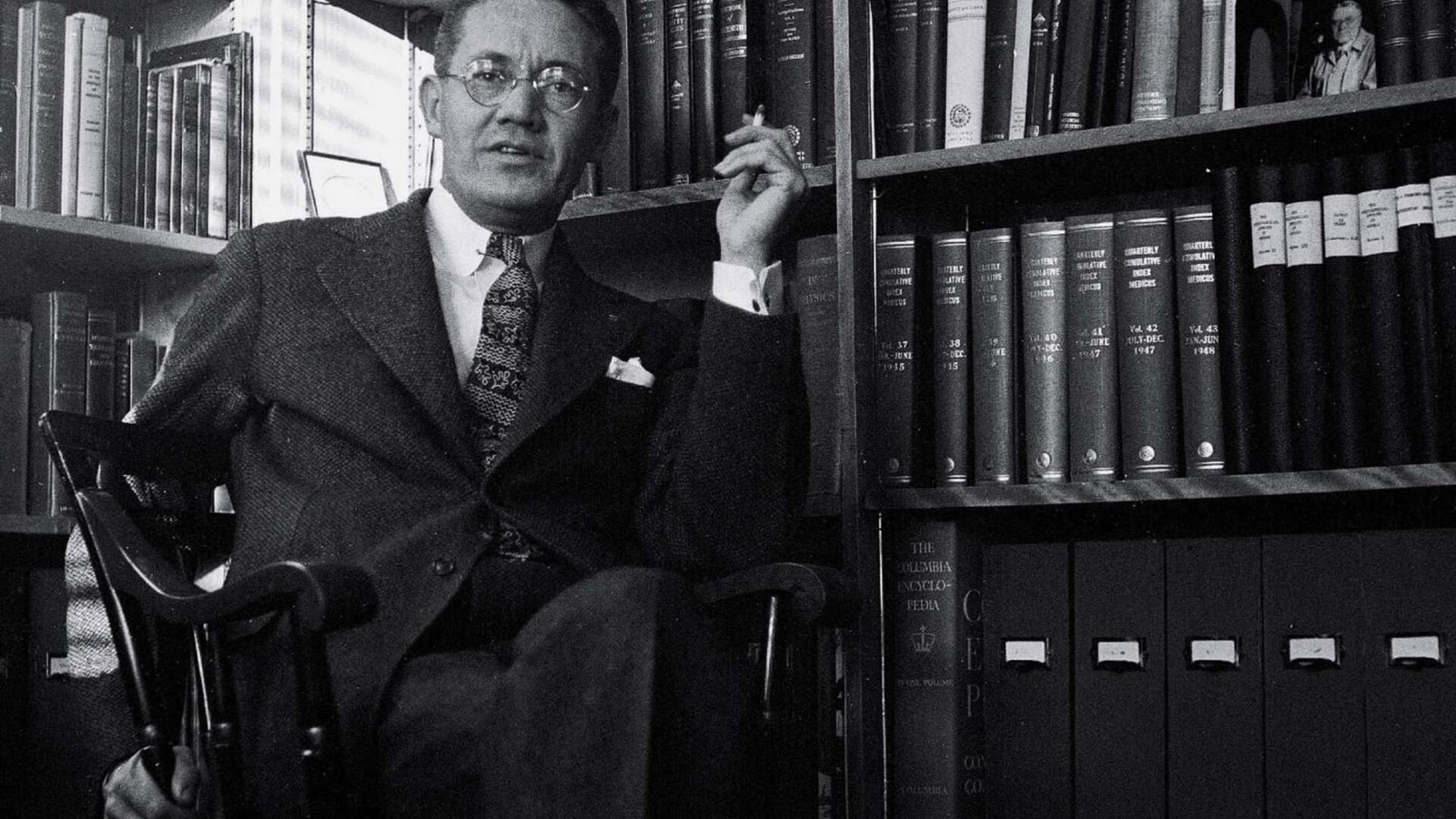
Henry K. Beecher sits in front of bound medical journals, one hand raised as if he has paused in the middle of an argument. The photograph was taken in 1950, eighteen years before the Harvard anesthesiologist chaired a committee asked to decide when a patient with a beating heart could nevertheless be declared dead.[2][6]
The committee's four-page report is remembered as a definition. Read closely, it is more revealing as a procedure. It takes an unsettled boundary—profound coma sustained by a machine—and turns it into a sequence of observations, exclusions, repetition, declaration, and separation from organ retrieval. Its achievement was not to make death philosophically simple. It was to make a new judgment reproducible enough for a hospital to act on it.[1]
That distinction still matters. The paper's historical test details are not current clinical instructions. Modern determination of brain death, also called death by neurologic criteria, is governed by far more detailed professional standards and must be performed by qualified clinicians.[5] The value of returning to August 5, 1968 is to see how the first influential U.S. protocol assembled the problem—and where its reasoning stopped.
A problem the ventilator made visible
The report arrived after a decade in which medicine had learned to sustain breathing and circulation through catastrophic brain injury. In 1957, Pope Pius XII had addressed anesthesiologists on prolonged resuscitation and left the medical determination of death to physicians; the Harvard paper cited that address as its only numbered reference.[1] In 1959, French neurologists Pierre Mollaret and Maurice Goulon described coma dépassé, a condition beyond ordinary coma, without simply settling that the patient was dead. By 1967, transplantation and intensive care had made the unresolved boundary impossible to treat as a rare semantic puzzle.[2][3]
Beecher's committee was formally constituted in January 1968; its discussions and drafting gathered pace that spring. Neurologist Eelco Wijdicks later examined the original files and interviewed three surviving members. His reconstruction gives neurologists Robert Schwab and Raymond Adams major roles in shaping the clinical criteria and describes a committee intent on simplicity and diagnostic accuracy.[2] Historian Mita Giacomini, reading committee records alongside transplant debates and contemporary medicine, reaches a less frictionless conclusion: technology did not dictate one inevitable definition, and professional and transplantation interests helped shape the policy choice.[3]
Those interpretations disagree about emphasis, but the published report itself makes one point indisputable. It did not begin with a theory of personhood. It began with two practical pressures. Supportive care could leave a patient's heart beating after irreversible brain damage, creating burdens for patients, families, hospitals, and scarce beds. Older definitions could also create controversy when organs were obtained for transplantation. The declared purpose was to make irreversible coma a “new criterion for death.”[1]
The opening therefore mixes diagnosis with consequences. That does not prove the criteria were medically unsound or devised merely to procure organs. It does show that utility was not a hidden accusation invented by later critics. The committee placed it on page one.
The report's real invention was an order of operations
The paper then pivots from pressure to examination. It says that a permanently nonfunctioning organ is “for all practical purposes dead,” and it asks how a physician could identify a permanently nonfunctioning brain.[1] The answer is built in layers.
First came complete unreceptivity and unresponsiveness: no response even to intense stimulation. Second came no spontaneous movement or breathing. Third came absent reflexes, including fixed pupils, no eye movement or blink, and no corneal or pharyngeal response. A flat electroencephalogram, or EEG, supplied confirmatory evidence when available rather than replacing the clinical examination.[1]
The numbers show how much the committee wanted a protocol rather than an impression. The 1968 text called for at least one hour of observation, described a three-minute ventilator-disconnection procedure—an obsolete, drastically abbreviated precursor of modern apnea testing—recommended 10 to 20 minutes of EEG recording, and required the full set of tests to be repeated at least 24 hours later with no change. It also excluded severe hypothermia below 90°F (32.2°C) and central-nervous-system depressants such as barbiturates, because either could mimic the state under examination.[1]
Those historical instructions must not be lifted into present practice. Compared with the brief 1968 passage, the modern apnea test has far more comprehensive prerequisites, oxygenation provisions, physiologic targets, monitoring, and abort conditions.[5] But as a document, the old sequence reveals the committee's central problem: irreversibility could not be inferred from stillness alone.
The report itself confronted two major mimics: drug effects and severe cold. Modern standards scrutinize a wider set of metabolic derangements and other potentially confounding or reversible conditions.[1][5] A machine can hide the ordinary respiratory sign by moving air on the patient's behalf. Electrical noise can masquerade as brain activity, while an apparently flat tracing can be an artifact of equipment or technique. The report therefore paired positive observations of absent function with negative work: exclude named mimics, check the apparatus, wait, and repeat. Its most durable idea is not any single 1968 threshold. It is that a declaration this final requires a standardized attempt to disprove it.
Death had to be declared before the machine was stopped
The report's next move is easy to miss because it sits under “Other Procedures.” The committee insisted on an exact sequence: physicians were to declare death before stopping the respirator, not wait for the heart and circulation to cease afterward.[1]
That order did conceptual and legal work. If ventilation were stopped first, the act could look like the cause of death under the older cardiopulmonary definition. If death had already been determined through the new neurologic criteria, switching off the machine ended artificial support of a person the physicians had declared dead. The report was not merely adding another test. It was moving the recognized moment of death to the other side of a clinical decision.
The committee also built a primitive conflict-of-interest firewall. The physician in charge was to consult at least one other physician involved in the case. The doctors declaring death were not to participate in later organ retrieval, avoiding even the appearance that a transplant interest had influenced the judgment. Families and nurses were to be informed, but the report said the family should not be made responsible for deciding whether death had occurred.[1]
That arrangement contains both foresight and the paternalism of its period. Separating determination from procurement protects trust by keeping the transplant interest outside the declaration itself. Yet calling the judgment “solely a medical issue” gave physicians extraordinary authority over a boundary with moral, religious, and legal meaning. The family appears as someone to inform, not a participant whose understanding or objection alters the process.[1]
Two readings survive because the report does two jobs
The strongest charitable reading treats the Harvard paper as clinical standardization under pressure. Wijdicks's archival study found that neurologists did substantive work on the criteria and portrayed the committee as swift, accuracy-oriented, and not captured by a special interest.[2] On this view, mechanical support had broken the usefulness of heartbeat alone in a narrow class of cases. The committee responded with observable signs, safeguards against reversible mimics, repetition, and consultation.
The strongest critical reading treats the paper as policy made in medical language. Giacomini argues that ventilators, EEGs, and transplantation did not mechanically yield one definition; institutions still chose what counted as decisive evidence and who would control the decision.[3] The published text supports part of that critique. Its practical rationales concern beds, burdens, legal protection, and organs, while the step from a nonfunctioning brain to a dead human being receives only a few sentences.[1]
These readings are not clean opposites. A protocol can be clinically careful and institutionally interested at the same time. The report can protect against a false declaration while also expanding medical authority. It can prevent transplant clinicians from judging their own donors while still treating transplantation as one reason the new definition is needed.
The unresolved issue is not whether the committee listed signs. It plainly did. The tests were intended to support the committee's judgment that the functions examined would not return. Whether they established that prognosis adequately—and whether the loss was identical to the death of the person—remained further medical, philosophical, and legal questions. The report made its answer actionable before it made the argument complete.
What later standards kept—and what they discarded
The law did not follow the report's prediction that legislation would probably be unnecessary. The 1980 Uniform Determination of Death Act supplied a model with two routes: irreversible cessation of circulatory and respiratory function, or irreversible cessation of all functions of the entire brain, including the brainstem. It also delegated the diagnostic details to accepted medical standards rather than freezing a 1968 checklist into statute.[4]
That delegation allowed the protocol to evolve. The 2023 U.S. pediatric and adult consensus guideline retains the recognizable core: a known catastrophic and permanent brain injury, coma, absent brainstem reflexes, and inability to breathe in response to an adequate physiologic stimulus. It begins from the presumption that the patient does not meet the criteria and requires clinicians to disprove that presumption through a standardized assessment.[5]
At the same time, the modern guideline exposes how historical the Harvard checklist has become. It does not treat a flat EEG as the report did. EEG records activity in the cerebral hemispheres but cannot establish absent brainstem function, so the 2023 guideline says it should not be used as an ancillary test for this determination. Ancillary testing is reserved for cases in which the clinical examination or apnea test cannot be completed or interpreted, and the recommended tests focus on cerebral perfusion.[5]
Nor does modern practice simply copy the report's universal 24-hour repeat rule or its brief ventilator-disconnection method. Observation periods, number of examinations, prerequisites, and testing procedures now depend on age, injury mechanism, confounders, and safety. The document that made the judgment repeatable was not itself the last word on how to repeat it.
Read the portrait as a committee document
Beecher's 1950 portrait is useful because it refuses the visual shorthand of a glowing brain scan or a symbolic heartbeat line. It shows a physician inside an institution: shelves of accumulated literature, a desk just outside the frame, and a person positioned to turn knowledge into authority.[6]
The 1968 report did the same thing in prose. It gathered clinical signs, machine limits, legal risk, transplant ethics, and hospital pressure, then placed them in an order a physician could execute. That was its power. It gave medicine a way to act when ventilation had separated a beating heart from the possibility of consciousness and spontaneous breath.
Its limitation is equally clear. Repetition can strengthen a diagnosis; it cannot, by itself, settle what society means by death. The Harvard committee made a new boundary operational. The half-century since has been the continuing work of testing the medicine, revising the procedure, and arguing about the claim underneath it.
Sources
- Ad Hoc Committee of the Harvard Medical School to Examine the Definition of Brain Death, “A Definition of Irreversible Coma,” JAMA 205, no. 6 (August 5, 1968), 337–340 — full-text scan of the original report, hosted by Manchester University.
- Eelco F. M. Wijdicks, “The Neurologist and Harvard Criteria for Brain Death,” Neurology 61 (2003), 970–976 — study of original committee files and interviews with three surviving members.
- Mita Giacomini, “A Change of Heart and a Change of Mind? Technology and the Redefinition of Death in 1968,” Social Science & Medicine 44 (1997), 1465–1482 — PubMed record for an archival analysis of technological, transplant, and professional forces around the committee.
- National Conference of Commissioners on Uniform State Laws, Uniform Determination of Death Act (1980) — official model-act text and commentary establishing dual cardiopulmonary and neurologic standards.
- David M. Greer et al., “Pediatric and Adult Brain Death/Death by Neurologic Criteria Consensus Guideline,” Neurology 101 (2023) — current clinical comparison for prerequisites, examination, apnea testing, ancillary tests, and EEG's limits.
- Jack El-Hai, “Brief Life of a Late-Blooming Ethicist: Henry Knowles Beecher, 1904–1976,” Harvard Magazine (2017) — source and provenance for Yale Joel's 1950 archival portrait of Beecher.