Expanded newborn screening can look like a story about political ambition: states decided to screen for more diseases, laboratories bought better machines, and the panel grew. The sharper mechanism runs through the specimen.[1][2] For decades, newborn screening was constrained by how much information one heel-prick blood spot could yield. Tandem mass spectrometry changed that in the 1990s by reading multiple amino acids and acylcarnitines from the same dried blood spot in one short run.[1][2] Once that happened, the bottleneck moved. The central question was no longer how to get enough blood for one more assay. It was how to decide which disorders belonged on the panel, how to manage false positives and follow-up, and how to keep state-by-state variation from turning birthplace into destiny.[2][4]
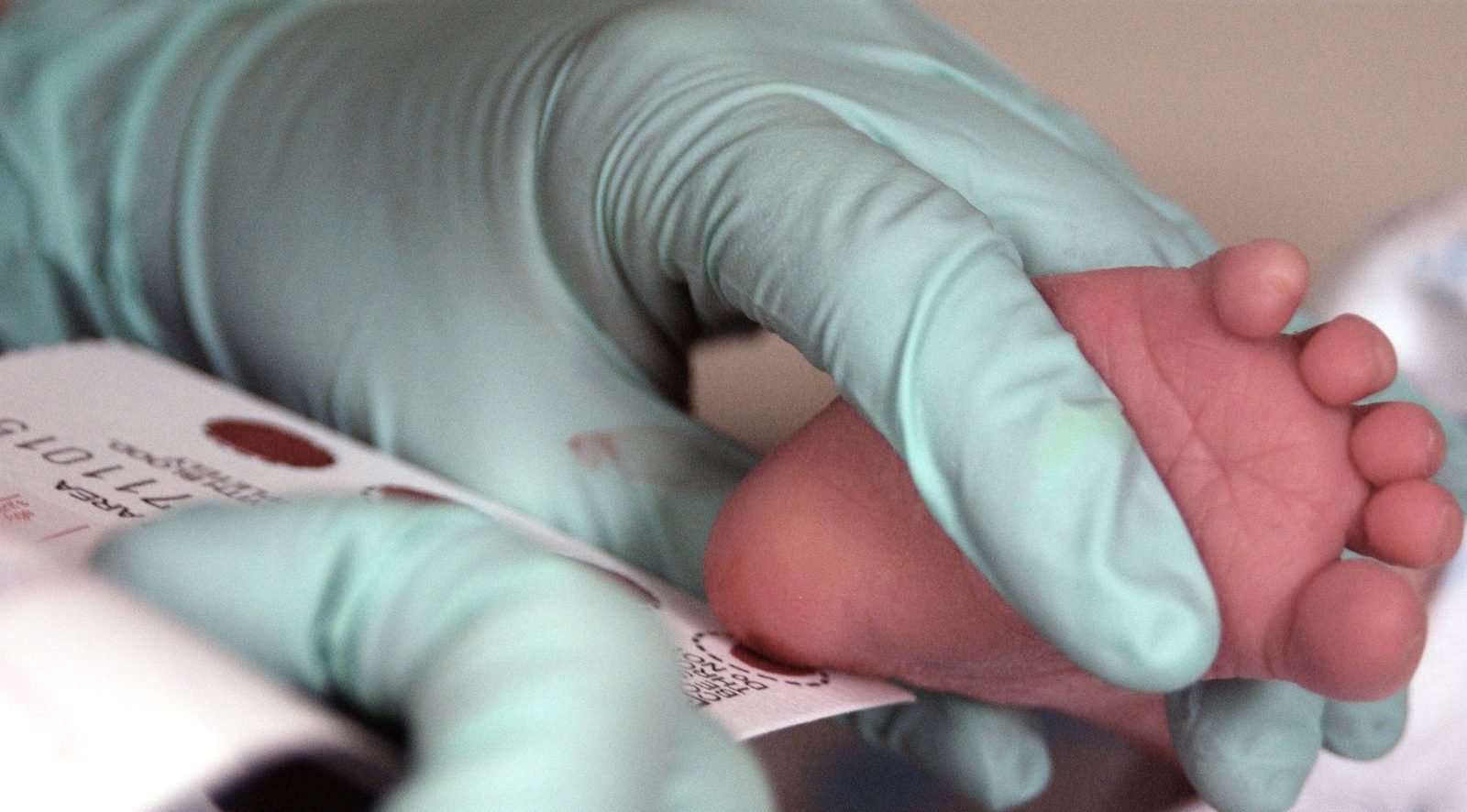
Image context: the cover photograph shows heel-prick blood collection for PKU screening.[6] That is the right documentary image here because the visible act at the bedside stayed almost the same before and after tandem mass spectrometry. The deeper change happened downstream, when one dried blood spot ceased to be a narrow single-condition specimen and became a multiplex laboratory object.
Timeline anchors
- 1960s: newborn screening begins with PKU and a small dried-blood-spot workflow built around one condition with a proven dietary intervention.[2][4]
- 1990s: tandem mass spectrometry enters population-based newborn screening and makes it possible to detect more metabolic disorders from the same routinely collected dried blood spot.[1][2]
- 1997: North Carolina launches the first universal U.S. statewide tandem mass spectrometry newborn-screening pilot.[3]
- April 1999: North Carolina's public laboratory brings the MS/MS analyses in-house after the pilot phase.[3]
- 2002-2005: HRSA asks ACMG to propose national guidance; the review examines 81 conditions and places 29 in the original core panel.[4]
- By April 2011: all U.S. states are testing for at least 26 disorders, reflecting how far the panel logic has spread.[4]
1. Before MS/MS, screening scale was limited by assay geometry
The first generation of newborn screening worked because the Guthrie card made blood transportable. The second constraint was analytical. Screening programs could only do as much as their chemistry allowed with a tiny amount of dried blood.[2] The NCBI history is explicit: for decades, the number of conditions that could be screened was limited by the amount of blood available for testing.[2] In practical terms, that meant newborn screening grew by adding more disease-specific methods one by one, each with its own workload, thresholds, and confirmatory path.
That older geometry favored a short list. It worked best for conditions like PKU, where there was a recognizable marker, a manageable assay, and a treatment path clear enough to justify universal capture.[2][4] It did not naturally scale into a broad metabolic panel, because every additional disorder threatened to consume more specimen, more bench time, or more interpretive labor than state programs could absorb.
2. Tandem mass spectrometry changed the unit of reading from one test to one pattern
This is the core mechanism. CDC's 2001 report says tandem mass spectrometry substantially increased the number of metabolic disorders detectable from dried blood-spot specimens and did so by analyzing multiple markers in a single process.[1] The report is concrete about how the machine changed screening logic: MS/MS can reliably analyze approximately 20 metabolites in about 2 minutes and provide a comprehensive assessment from a single blood-spot specimen.[1]
That mattered because the laboratory was no longer asking one narrow question per run. It was reading a metabolite pattern. Amino acid disorders, fatty acid oxidation disorders, and organic acid disorders could now enter the same analytical workflow.[1] The article's strongest claim sits here: expanded newborn screening was not simply an administrative decision to "screen for more." It was a measurement shift that collapsed multiple disease pathways into one specimen-reading event.[1][2]
The health stakes were large enough to justify the shift. CDC's report estimated that a full panel of acylcarnitines and amino acids would identify MS/MS-detectable disorders at rates around 1:4,000-1:5,000.[1] It also singled out MCAD deficiency, with an incidence around 1:10,000-1:20,000 newborns and reported mortality of 20%-25% among infants and children in the first three years when the disorder went unrecognized.[1] Once a single run could expose that kind of otherwise silent risk, the pressure to expand screening became structural.
3. The first statewide lesson was that multiplex detection only works when follow-up is designed just as carefully
North Carolina is useful because it shows what had to be built around the machine. According to the program's published experience, North Carolina became the first U.S. state to initiate universal MS/MS newborn screening through a statewide pilot in 1997, then moved the analyses in-house in April 1999.[3] Between 28 July 1997 and 28 July 2005, the program screened 944,078 infants and confirmed 219 diagnoses, an overall incidence of 1:4,300.[3]
Those numbers show why tandem mass spectrometry could not be treated as a plug-in gadget. The North Carolina paper says the program depended on a comprehensive follow-up protocol integrating the public health laboratory with academic metabolic centers.[3] That phrase should be read literally. A multiplex instrument creates a multiplex responsibility: borderline results, diagnostic elevations, confirmatory testing, family contact, and specialist referral have to move quickly enough that presymptomatic detection still buys time.[3]
The same paper gives one operational measure of that discipline. For infants requiring confirmatory testing, the positive predictive value in 2003 and 2004 was 53%.[3] That is not a trivial footnote. It tells us that expanded screening is inseparable from threshold design and downstream triage. A panel that detects more conditions also creates more chances to worry families, miss milder disease, or overcall borderline biology. The machine expands what can be seen; the program has to decide how that visibility is governed.
4. Once some states expanded and others did not, technology turned into a federalism problem
The NCBI history and NICHD overview agree on the next phase.[2][4] Tandem mass spectrometry entered public programs unevenly, and that unevenness exposed how decentralized newborn screening had always been. NICHD's summary is especially useful because it gives the range plainly: in 2002, some states screened for as few as 4 conditions while others screened for as many as 50.[4] By 2003, the majority of U.S. states still screened for only 6 disorders.[4]
This is where the mechanism left the instrument bench and entered governance. Once one dried blood spot could support many more analytes, the old state-by-state autonomy became harder to defend as mere local variation.[2][4] The same baby with the same hidden disorder could be flagged in one state and missed in another because the panel, cutoffs, and follow-up expectations differed by jurisdiction. The technology widened what was possible; federalism widened the inequality in who actually received it.[2]
5. The RUSP was an answer to panel inflation, not just a celebration of technical progress
NICHD describes the federal response in a sequence that matters.[4] HRSA asked the American College of Medical Genetics in 2002 to develop newborn-screening guidelines. The ACMG reviewed 81 conditions and placed 29 in a core screening panel, creating the original Recommended Uniform Screening Panel.[4] Another 25 were placed at a secondary level because treatment or disease understanding remained weaker.[4]
That is a more disciplined story than "technology found more diseases, so the list got longer." The RUSP was a filtering device. It tried to separate what could be measured from what should be screened universally.[4] In other words, tandem mass spectrometry created panel capacity; the RUSP tried to keep panel growth tied to evidence, timing, test performance, and benefit from early intervention.[2][4]
NICHD's later benchmark shows what this standardization did in practice. By April 2011, all states were testing for at least 26 disorders.[4] The United States did not become perfectly uniform, but the era of radical panel divergence began to narrow.
6. The modern system still depends on quality assurance because multiplex screening multiplies failure modes too
The final mechanism is contemporary. CDC's newborn-screening laboratory pages show that the work did not stop once the panel expanded.[5] CDC now provides quality-control dried blood spot materials, trains state staff in molecular and biochemical mass spectrometry methods, and supports laboratories so results remain timely and accurate.[5] The 2024 CDC feature story adds the scale: the program makes about 1 million dried blood spots per year and ships reference cards to laboratories across the United States and 88 countries.[5]
That current infrastructure is the real afterlife of tandem mass spectrometry. Multiplex screening saves blood and broadens detection, but it also creates more analytes, more cutoffs, more software dependencies, and more places for the program to drift. Quality assurance is therefore not an administrative afterthought. It is what keeps panel medicine from decaying into panel noise.[5]
Two interpretations
Interpretation A: tandem mass spectrometry made expansion basically inevitable
This view has real support. Once one dried blood spot could yield about 20 metabolite signals in roughly 2 minutes, a larger panel became technically and economically attractive.[1] The disease burden was also significant enough that programs had strong incentives to adopt the technology.[1][3]
Interpretation B: the decisive shift was not the machine alone, but the governance built around it
This interpretation is stronger. North Carolina's experience, the early state variation, and the later RUSP process all show that detection capacity by itself did not settle who should be screened, how positive results should be managed, or how uniform the public-health promise should become.[2][3][4] The decisive historical shift was technological and institutional at the same time.
What would change this assessment? Evidence showing that state programs converged naturally, with minimal federal guidance and little need for formal follow-up design, would strengthen Interpretation A. The historical sequence points the other way. Expansion generated enough variability and enough downstream burden that standard-setting and quality assurance became central parts of the screening system.[2][4][5]
Best reading
Tandem mass spectrometry changed newborn screening by changing the information density of one dried blood spot. That is the laboratory hinge. The public-health hinge came a step later, when states had to decide how to govern the new abundance of detectable risk.[1][2][4] Expanded screening therefore belongs to two histories at once: a history of better instruments, and a history of learning that better instruments force harder decisions about panels, thresholds, follow-up, and uniformity.
Sources
- Centers for Disease Control and Prevention, Using Tandem Mass Spectrometry for Metabolic Disease Screening Among Newborns (MMWR Recommendations and Reports, 2001).
- National Academies of Sciences, Engineering, and Medicine, Introduction in Newborn Screening in the United States (2024) - history of PKU screening, the 1990s MS/MS expansion, and the federalism problem in state panel variation.
- Frazier DM, et al. The tandem mass spectrometry newborn screening experience in North Carolina: 1997-2005 (Journal of Inherited Metabolic Disease, 2006; PubMed abstract).
- NICHD, Brief History of Newborn Screening - 2002 state variation, ACMG review of 81 conditions, the original 29-condition RUSP core panel, and later national convergence.
- Centers for Disease Control and Prevention, CDC Provides Quality Assurance for Newborn Screening (2024) - current dried-blood-spot quality assurance scale, laboratory workflow, and international distribution.
- Wikimedia Commons, File: Phenylketonuria testing.jpg - source page for the heel-prick screening photograph used as the article image.