The history of Haemophilus influenzae type b, or Hib, is easy to flatten into a simple before-and-after vaccine story. The sharper comparison runs through age. Before effective vaccination, Hib was the leading cause of bacterial meningitis and other invasive bacterial disease in U.S. children younger than 5 years, and about two-thirds of cases occurred in children younger than 18 months.[1] That age pattern is the whole problem. A vaccine that works late can still miss the center of the burden.
That is why the first Hib vaccine and the later conjugate vaccines should not be treated as one continuous success. The pure polysaccharide shot licensed in 1985 and the first conjugate vaccine licensed in 1987 did not solve the same bottleneck.[1][2] The earlier product offered proof that the capsule could be turned into a vaccine target. The conjugate era changed the deeper public-health equation by making that target immunogenic enough in infancy to matter where the disease was most concentrated.[1][4]
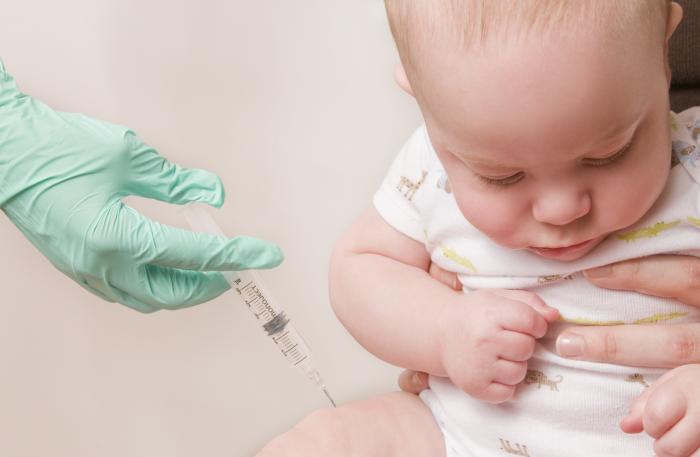
Image context: the cover uses a CDC Public Health Image Library photograph of a child receiving vaccination during a routine clinical visit.[6] It fits this article because the biggest historical shift in Hib control was not a dramatic new rescue inside the hospital. It was the movement of prevention into ordinary infant scheduling, where severe meningitis would increasingly fail to appear.
Timeline anchors for the comparison
- Early 1980s: the United States was seeing about 20,000 cases of severe Hib disease each year in children younger than 5, with about 1,000 deaths.[1][2][3]
- 1985: the first U.S. Hib vaccine, a pure polysaccharide product, was licensed.[1][2]
- 1987: the first Hib conjugate vaccine was licensed in the United States.[1][2]
- 1991: a Navajo infant trial reported 95% efficacy before age 18 months for an Hib conjugate vaccine and found that protection began after the first dose.[4]
- 1996-1997: CDC reported that invasive Hib incidence among children younger than 5 had declined 99%, from 34 to 0.4 per 100,000.[5]
- 1997: CDC's National Immunization Survey found three-dose Hib coverage of 61% by age 7 months and 93% by age 24 months.[5]
- 2019: CHOP's vaccine summary recorded only 18 Hib cases in U.S. children age 5 and younger.[3]
1. The older vaccine met an age wall
The pre-vaccine Hib burden was not evenly distributed across childhood. CDC's Pink Book states that approximately one in 200 children younger than 5 developed invasive Hib disease in the pre-vaccine era, and that roughly two-thirds of all cases fell in children younger than 18 months.[1] In practical terms, the disease was loaded into the same early window in which many polysaccharide antigens are immunologically weak.
That is what makes the 1985 pure-polysaccharide vaccine historically important and historically limited at the same time.[1][2] It showed that the type b capsule, especially its polyribosylribitol phosphate, or PRP, surface, could anchor a preventive strategy. But it arrived against a disease whose center of gravity was infancy.[1] A vaccine that does not produce reliable early-life protection may still work as a biologic and still fail as population control.
The comparison becomes much clearer once the CDC explanation of conjugation is laid beside the timeline. Pink Book says conjugation chemically bonds the polysaccharide to a more effective protein carrier and changes the antigen from T-independent to T-dependent, greatly improving immunogenicity, especially in young children.[1] That one sentence explains why the 1985 shot could not be the end of the story. The real Hib bottleneck was not merely identifying the capsule. It was making the capsule legible to infant immune systems.
2. Conjugation changed the question from late protection to early scheduling
Once the capsule was coupled to a carrier protein, the vaccine stopped being a narrow chemistry trick and became a workable infant program. Pink Book notes that conjugate vaccines permit booster responses, maturation toward class-specific IgG predominance, and carrier-related immune help.[1] Those are not laboratory ornaments. They are exactly the properties a public-health program needs when it must protect babies before the second year of life.
The 1991 Navajo infant trial captures the turning point better than any retrospective slogan. In that study, infants received an Hib conjugate vaccine linked to meningococcal outer-membrane protein complex starting between 42 and 90 days of age.[4] Before age 18 months, there was 1 systemic Hib infection in 2,588 vaccinated infants versus 22 in 2,602 placebo recipients, a point estimate of 95% efficacy.[4] The paper's most revealing line is even narrower: between the first and second doses, there were no Hib infections in the vaccine group and eight in the placebo group, leading the authors to conclude that protection began after the first dose.[4]
That is the historical hinge. The pure-polysaccharide vaccine belonged to a world where age remained an obstacle. The conjugate vaccine belonged to a world where the schedule could finally move into infancy. Once early doses could protect children still inside the main meningitis window, Hib prevention stopped waiting for childhood to mature first.[1][4]
3. The ward changed because the carriage system changed too
The impact of conjugate vaccination was larger than individual protection alone. CDC's 1997 surveillance report states that invasive Hib incidence in children younger than 5 had fallen 99%, from 34 to 0.4 per 100,000.[5] That scale of decline is hard to explain through bedside treatment or modest clinical improvement. It marks a transmission and exposure shift.
CDC's own reading of coverage and community protection makes that visible. In the same report, the agency noted three-dose Hib coverage of 61% by 7 months and 93% by 24 months, then added that high coverage levels help protect susceptible children in the community through herd immunity, meaning less frequent exposure to pharyngeal carriers of the organism.[5] In other words, the conjugate era altered the ecology around unprotected children as well as the immune status of vaccinated ones.
That is why the comparison should not be reduced to one vaccine being chemically superior in the abstract. The later products were superior because they operated on three levels at once. They protected infants early, they supported boosting through repeat doses, and they changed the amount of Hib circulating around young children who had not yet completed the schedule.[1][5] The hospital ward felt different because the nursery and clinic waiting room had already changed the pool of exposure upstream.
4. The best comparison is between two public-health logics
History of Vaccines puts the scale of the pre-vaccine problem starkly: about 20,000 U.S. children younger than 5 developed severe Hib disease annually, and about 1,000 died.[2] CHOP's current vaccine page then gives the modern contrast: only 18 Hib cases were reported in U.S. children age 5 and younger in 2019.[3] Those two numbers are not simply evidence that one product outperformed another in a lab. They show that the entire public-health logic of pediatric bacterial meningitis was rearranged.
The first logic accepted that the capsule could be targeted but still left the highest-risk age band only partly addressed. The second logic used conjugation to move meaningful protection into the first months of life, where the disease had been most concentrated, and then reinforced that protection through scheduled doses and reduced community carriage.[1][4][5] The comparison is therefore not "old vaccine versus new vaccine" in a consumer sense. It is "older-child biologic proof versus infant-capable population control."
That distinction is worth preserving in 2026 because Hib's historical lesson is larger than one pathogen. Some infectious diseases are not defeated when medicine first identifies a usable antigen. They are defeated when the immunology, the age distribution of risk, and the delivery schedule finally line up. Hib conjugate vaccines mattered because they created that alignment.
Sources
- Centers for Disease Control and Prevention, Pink Book, Chapter 8: Haemophilus influenzae - pre-vaccine burden, age distribution, 1985/1987 vaccine timeline, and the immunologic consequences of conjugation.
- History of Vaccines, "Hib (Haemophilus influenzae type b)" - pre-vaccine U.S. case and death burden, and the 1985 to 1987 transition from the first vaccine to the improved conjugate era.
- Children's Hospital of Philadelphia Vaccine Education Center, "Haemophilus influenzae type b (Hib): The Disease & Vaccines" - current case contrast and concise explanation of why the conjugate vaccine changed disease control.
- Santosham M, et al., "The efficacy in Navajo infants of a conjugate vaccine consisting of Haemophilus influenzae type b polysaccharide and Neisseria meningitidis outer-membrane protein complex" (New England Journal of Medicine, 1991; PubMed abstract) - infant trial showing 95% efficacy before 18 months and protection beginning after the first dose.
- Centers for Disease Control and Prevention, "Progress Toward Elimination of Haemophilus influenzae Type b Disease Among Infants and Children - United States, 1987-1997" (MMWR, 1998) - 99% incidence decline, coverage, and herd-immunity framing through reduced exposure to pharyngeal carriers.
- CDC Public Health Image Library, image ID 13528 - source page for the routine childhood vaccination photograph used as the article image.