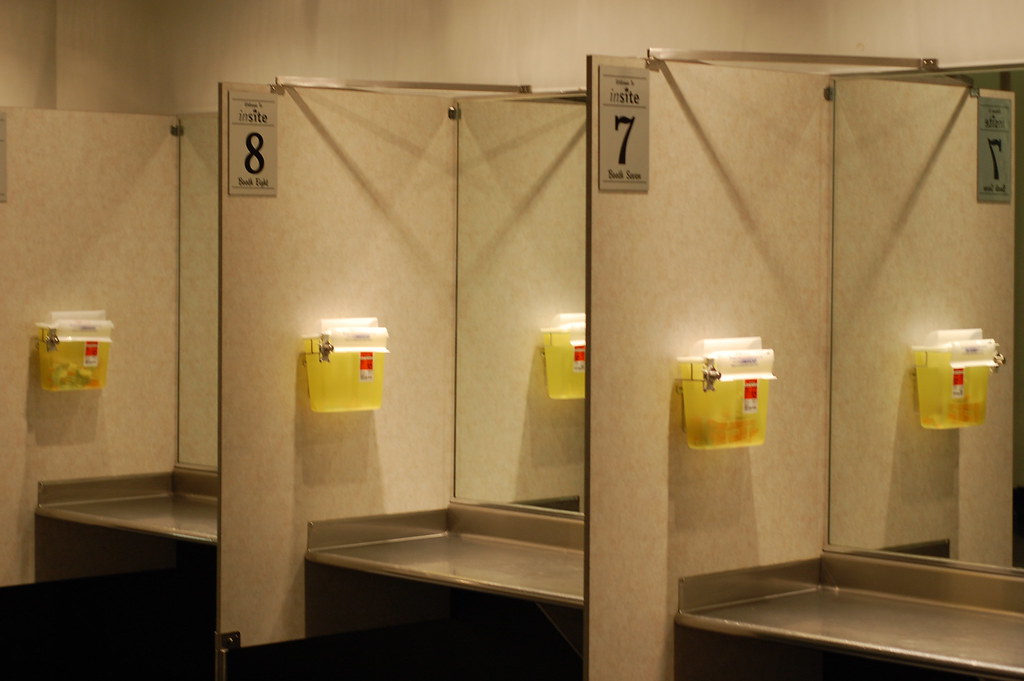
The booths in the photograph look deliberately ordinary: numbered stations, stainless-steel counters, wall-mounted sharps bins. Their ordinariness is the achievement. Inside Vancouver's Insite, an act exposed to criminal sanction almost everywhere else in the city is placed inside a health-care sequence—check in, use a pre-obtained drug under observation, receive an overdose response if necessary, then encounter wound care, counselling, or a route into treatment.[3][7]
Sydney made a similar room ordinary first. Its Medically Supervised Injecting Centre opened in Kings Cross on May 6, 2001; Insite opened in Vancouver's Downtown Eastside in September 2003. Neither service supplied drugs, made an unpredictable illicit supply safe, or ended addiction. Each did something narrower: it moved some injections from hurried, isolated places into a staffed setting where an overdose could be seen and treated immediately.[1][3]
The two cities reached that room by different legal routes. New South Wales wrote one time-limited trial into statute and attached evaluation to it. Vancouver began with a discretionary exemption from federal drug law, then had to defend that exemption all the way to Canada's Supreme Court. Read together, the histories show that evidence did more than judge the services after they opened. Evidence was part of the legal machinery that allowed them to exist.
The same clinical boundary, two constitutional maps
The core design was a boundary rather than a permission slip for drug use in general. Clients brought their own substances. Staff did not inject them or guarantee their contents. The protected space was limited to a licensed service with protocols, trained personnel, sterile equipment, observation, emergency response, and connections to other care. Outside that boundary, the ordinary drug laws remained.
That boundary mattered clinically because overdose is a race against unobserved time. A person using alone can lose consciousness without anyone noticing; a person using in an alley may inject quickly to avoid police attention. In a supervised room, a worker can recognize deteriorating breathing, give oxygen or naloxone, and summon higher-level care. The room also creates repeated contact with people whom conventional services often reach poorly. In Sydney's first evaluation, roughly one in four visits included another health service, while referrals extended to drug treatment, primary care, and social welfare.[1]
But the boundary mattered politically for a different reason. It made a controversial proposal testable. Legislators and judges did not have to decide whether to approve “harm reduction” in the abstract. They could ask what happened at one named address, under one regulatory scheme, to clients and to the surrounding neighborhood.
Sydney: legislate the experiment
Sydney's route grew out of a visible heroin crisis and a compromised policing environment. The 1997 Wood Royal Commission into the New South Wales Police Service had encountered informal “shooting galleries” while investigating corruption and recommended considering a sanctioned, supervised alternative. After the May 1999 NSW Drug Summit, Parliament passed legislation enabling a single medically supervised injecting centre for an 18-month trial.[1]
The trial language did two jobs. It lowered the political threshold for opening: lawmakers were authorizing a bounded experiment, not announcing a permanent settlement. It also made continuation dependent on a record. The NSW Department of Health commissioned an independent evaluation before the centre received its first client, with questions covering feasibility, overdose, blood-borne-virus risk, referrals, public injecting, discarded equipment, crime, community attitudes, and cost.[1]
During the initial 18 months, 3,810 people registered and made 56,861 visits. Staff managed 409 overdose-related incidents, including 329 involving heroin, and issued 1,385 referrals to 577 clients. No overdose at the centre became a death. These figures establish direct outputs: high-risk events were brought within reach of clinical response, and repeated contact produced opportunities for other care.[1]
The evaluation was unusually candid about what it could not establish. A sharp reduction in heroin availability began across New South Wales around January 2001, four months before the centre opened. Against that moving background, the evaluators found no detectable centre-specific reduction in community overdose deaths or ambulance attendances during the first trial. They estimated that on-site intervention probably prevented deaths, but the estimate depended on assumptions about how overdoses would have ended elsewhere.[1]
Later data supplied a stronger neighborhood signal. A study of 20,409 ambulance attendances compared 36 months before the centre opened with 60 months after. Opioid-overdose call-outs fell more in the centre's immediate vicinity than in the rest of New South Wales, with the clearest difference during opening hours.[2] Even here, the design was ecological, not randomized: it could identify a place-and-time association, not hold policing, drug supply, treatment access, and neighborhood change perfectly still.
Sydney's long trial survived repeated extensions. On October 21, 2010, the lower house approved legislation to make the centre permanent.[8] The important sequence was not trial, instant proof, permanence. It was trial, measurement under confounding conditions, further measurement, political reassessment, then permanence.
Vancouver: exempt the experiment, then litigate the evidence
Vancouver faced a different division of power. Health-service delivery belonged principally to the province, while possession remained prohibited by Canada's federal Controlled Drugs and Substances Act. Insite therefore opened only after the federal health minister granted a conditional section 56 exemption, effective September 12, 2003, for medical and scientific purposes.[3]
That architecture made the service legally vulnerable. The first exemption lasted three years; shorter extensions followed while the federal government requested more research. When the minister effectively refused a further extension, litigation turned Insite's evaluation record into constitutional evidence.
On September 30, 2011, the Supreme Court of Canada held that refusing the exemption threatened clients' life and security interests in a way that was arbitrary and grossly disproportionate on the factual record. The Court ordered the minister to grant an exemption. It did not invalidate Canada's possession law, create a general right to possess drugs, or give any self-described consumption room automatic protection. Its ruling was specific to a regulated service shown to reduce risk without a discernible negative effect on public safety; future decisions still had to consider local need, regulation, resources, crime evidence, and community views.[3]
The Vancouver evidence carried a striking spatial finding. A 2011 Lancet study compared overdose mortality before and after Insite opened. Within a pre-specified 500-metre radius, the fatal-overdose rate fell from 253.8 to 165.1 deaths per 100,000 person-years, a 35.0% decline; in the rest of Vancouver, it fell 9.3%. The authors reported a statistically significant difference between those trends.[4]
That result is an association around one facility, not proof that the facility alone produced every avoided death. The study used coroner records and a before-and-after geographic comparison, not random assignment. People can move, police practices can change, and an illicit market can change composition. Still, the finding joined evidence about on-site overdose management, safer injecting behavior, treatment contact, and local public order to form the record before policymakers and courts.[3][4]
Evidence became part of the infrastructure
Sydney's statute and Vancouver's exemption looked temporary for different reasons, but both converted precarity into a research design. The address was fixed. The service model was specified. Visits, adverse events, referrals, neighborhood indicators, and possible harms could be counted. The legal exception created the observation point; the observations then helped defend the exception.
This feedback loop also shaped the research field. A 2021 systematic review found 22 effectiveness studies, 16 of them focused on the single Vancouver facility. Across the included literature, supervised injection facilities were generally associated with less overdose morbidity or mortality, safer injecting, better access to treatment, and no increase—or reductions—in crime and public nuisance. The reviewers did not pool the studies because their comparisons and outcomes were too heterogeneous, and they warned that evidence concentrated in Vancouver and Sydney might not travel cleanly to other settings.[5]
The distinction between scale levels is essential. The evidence is most direct for what happens inside a staffed room: an overdose is observed, an intervention occurs, a death does or does not follow. It is less direct for the neighborhood, where before-and-after studies must separate the site from simultaneous changes. It is hardest at the city or population level, where a facility may supervise only a small fraction of total consumption while drug potency, housing, treatment capacity, and the number and hours of sites all change. A 2025 review of population-level mortality studies found the recent evidence limited and methodologically mixed; on-site reversals should not be inflated into a claim that one room can bend an entire toxic-drug death curve.[6]
That limit does not erase the intervention. It locates it. A supervised injection service is an emergency-response setting, a hygienic environment, and a low-threshold door into care. It is not a regulated drug supply, housing policy, universal treatment access, or a citywide overdose strategy by itself.
Sydney and Vancouver therefore offer neither a miracle story nor a simple cautionary tale. Sydney shows how a legislature can use a trial to make a forbidden service observable, then keep revising its judgment as the record grows. Vancouver shows how a carefully documented service can turn ministerial discretion into a rights question when withdrawal would expose clients to a demonstrated risk.
The quiet room in the photograph exists because law and clinical practice were fitted tightly enough to one another to hold. Its deepest historical lesson is procedural: protect a bounded space, observe honestly at the scale the data can support, preserve null findings and confounders, and do not ask one intervention to stand in for the rest of a health system.
Sources
- MSIC Evaluation Committee, Final Report of the Evaluation of the Sydney Medically Supervised Injecting Centre (2003) — enabling law, trial design, service use, overdoses, referrals, outcome limits, and the heroin-shortage confounder.
- Allison M. Salmon et al., “The Impact of a Supervised Injecting Facility on Ambulance Call-Outs in Sydney, Australia,” Addiction 105, no. 4 (2010) — ecological before-and-after analysis of 20,409 ambulance attendances.
- Supreme Court of Canada, Canada (Attorney General) v. PHS Community Services Society, 2011 SCC 44 — Insite's exemption history, operating boundary, constitutional analysis, and remedy.
- Brandon D. L. Marshall et al., “Reduction in Overdose Mortality after the Opening of North America's First Medically Supervised Safer Injecting Facility,” The Lancet 377 (2011) — the 500-metre before-and-after mortality analysis.
- Timothy W. Levengood et al., “Supervised Injection Facilities as Harm Reduction: A Systematic Review,” American Journal of Preventive Medicine 61, no. 5 (2021) — synthesis of 22 effectiveness studies and evidence limitations.
- Geneviève Gariépy et al., “Supervised Consumption Sites and Population-Level Overdose Mortality: A Systematic Review of Recent Evidence, 2016–2024,” Health Promotion and Chronic Disease Prevention in Canada 45, no. 9 (2025; 2026 corrigendum) — limits of inference at population scale.
- Jonathan Dickinson, “Insite — Vancouver's Supervised Injection Site” (photographed October 23, 2009), Flickr — documentary photograph of the facility's numbered injection booths.
- ABC News, “Lower House Approves Drug Injecting Room” (October 21, 2010) — the parliamentary vote to make Sydney's trial facility permanent.