The WHO Surgical Safety Checklist looks modest on paper: a short sequence of prompts, names, confirmations, and anticipated risks. Its deeper mechanism is stronger than that. It turns three fragile transitions in an operation into shared stops: before anesthesia, before incision, and before the patient leaves the room.[1][2]
That matters because surgical harm often begins in gaps between competent people. The surgeon knows the plan. The anesthetist knows the airway and blood risk. The nursing team knows instruments, sterility, antibiotics, counts, and equipment readiness. The checklist's causal claim is that safety improves when those separate knowledge streams are forced into the same spoken moment before the next irreversible step.[1][5]
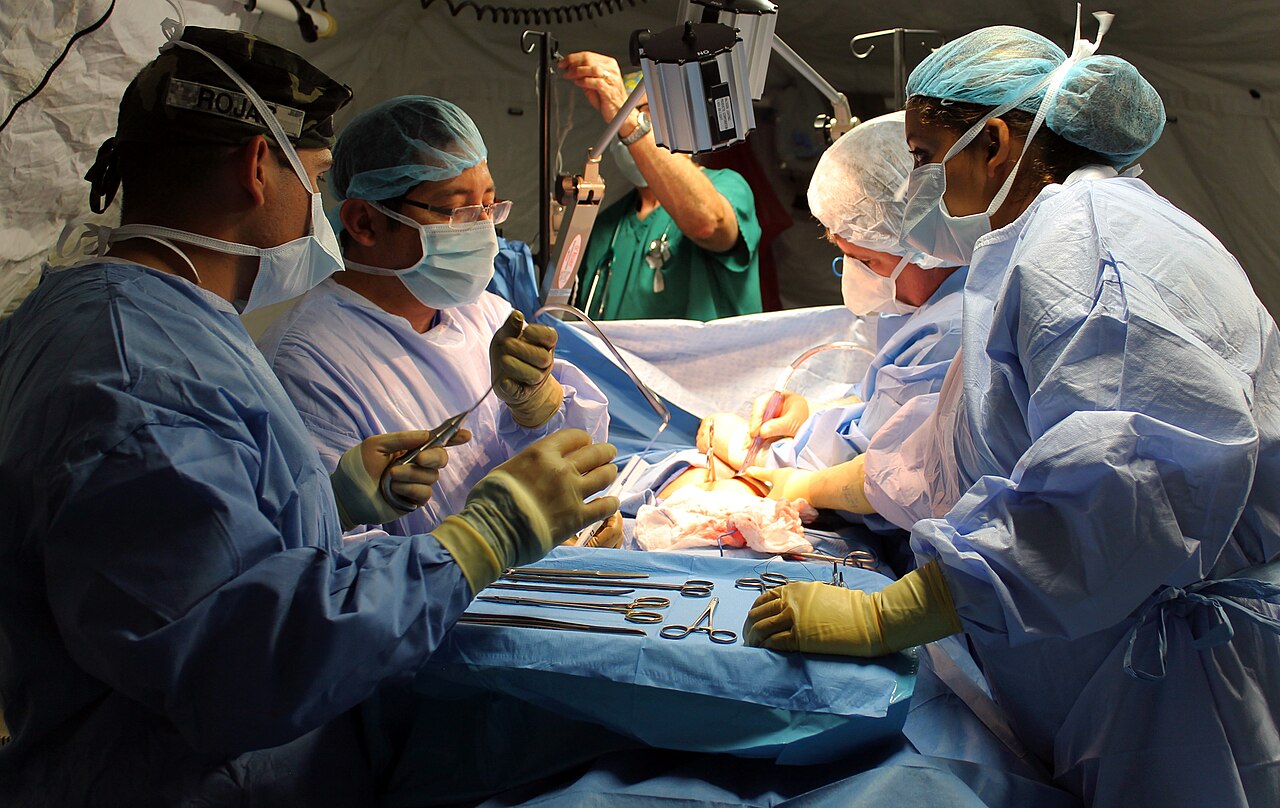
Image context: the cover photograph shows a Joint Task Force-Bravo mobile surgical team operating during a medical readiness exercise in Puerto Cortes, Honduras, on February 25, 2014. It fits the article because the checklist is not a poster or a form first. It is a way of making a crowded clinical room behave like one coordinated system.[8]
Timeline anchors before the mechanism
- 2002: the World Health Assembly adopted WHA55.18, urging stronger health-care safety systems and giving WHO a mandate to set norms for patient safety.[7]
- October 2004: WHO Patient Safety launched as an international alliance, turning patient safety into a global policy program rather than a hospital-by-hospital concern.[7]
- 2007: WHO Patient Safety launched the Second Global Patient Safety Challenge, Safe Surgery Saves Lives, with surgical safety as the explicit campaign object.[7]
- January 2009: the multinational checklist study appeared in The New England Journal of Medicine, reporting lower complications and deaths after checklist implementation in eight hospitals.[2]
- April 2009: WHO published the Guidelines for Safe Surgery and the implementation manual for the 19-item checklist.[1][7]
- 2009-2010: a stepped-wedge randomized trial in two Norwegian hospitals tested sequential checklist rollout across surgical clusters.[3]
- 2008-2010: Ontario hospitals implemented surgical checklists under a provincial program; the later population study found no statistically significant reduction in mortality or complications, sharpening the distinction between checklist design and checklist implementation.[4]
1. The problem is coordination under irreversible tempo
Surgery is not only a technical procedure. It is a timed handoff system where several professional groups hold different pieces of the same patient's risk. The WHO manual locates the checklist at three transition points: Sign In before induction of anesthesia, Time Out before skin incision, and Sign Out before the patient leaves the operating room.[1] Those moments are chosen because they sit just before the cost of a missing fact rises.
Before anesthesia, the team still has time to confirm identity, procedure, site, consent, airway risk, allergy status, blood-loss risk, and pulse-oximetry readiness.[1] Before incision, the operation is about to become physically committed, so the whole team pauses for verbal confirmation of patient, procedure, site, antibiotic prophylaxis, imaging, anticipated critical events, and equipment concerns.[1][2] Before exit, the case is no longer unfolding but the next risks are being handed forward: specimen labeling, instrument and sponge counts, equipment problems, and recovery concerns.[1]
That sequence is the core mechanism. The checklist does not make a surgeon more skilled with a scalpel or an anesthetist more skilled with a difficult airway. It creates a predictable social interruption in which each discipline must surface the information only it can see. In a hierarchy-heavy room, that interruption has clinical value. It gives the nurse a sanctioned opening to question a missing antibiotic dose, gives anesthesia a place to name airway or blood concerns, and gives the surgeon a forced audience for the plan's dangerous steps.[1][5]
The causal chain therefore runs through behavior before it reaches outcomes: shared attention, spoken confirmation, expectation-setting, earlier detection of missing steps, and fewer assumptions that someone else has already handled the risk.[1][5]
2. Why the 2009 result looked so dramatic
The first large public proof came from the Safe Surgery Saves Lives Study Group. Haynes and colleagues implemented a 19-item checklist in eight hospitals across diverse resource settings. The headline result was large: the rate of death fell from 1.5% before the checklist to 0.8% afterward, while inpatient complications fell from 11.0% to 7.0%.[2]
Those numbers should be read through the mechanism rather than as checklist magic. The study sites did not merely hang a form on a wall. They trained local teams, introduced a common structure, and emphasized specific process failures that were common enough to matter: antibiotic timing, anesthesia safety checks, pulse oximetry, anticipated blood loss, and final counts.[1][2]
The global context also made surgery safety unusually consequential. Weiser and colleagues estimated that 234.2 million major surgical procedures were performed worldwide each year, with very uneven access across countries by health expenditure.[6] At that scale, even modest reductions in avoidable complications become a public-health issue rather than a narrow operating-room preference.
The 2009 result persuaded people because it matched a plausible failure model. The checklist did not require a new drug, device, or surgical technique. It targeted known weak points in the surgical system: omitted prophylaxis, wrong-site risk, missing equipment, unspoken blood-loss expectations, specimen confusion, and recovery handoff gaps.[1][2][5]
3. The three stops do different work
The checklist is often discussed as one intervention, but each phase has a different job.
Sign In is mostly about making anesthesia and baseline identity risk explicit before the patient loses protective autonomy. This is the moment for identity, procedure, consent, site marking, airway and aspiration risk, allergy status, blood-loss concern, and monitoring readiness.[1] The patient can still be part of confirmation when feasible. The team can still slow the case before sedation narrows options.
Time Out is the operating room's synchronization point. The team members introduce themselves by name and role, confirm patient and procedure, state anticipated critical events, verify antibiotics and imaging, and make the plan audible.[1] This is where the checklist becomes more than memory support. Names and roles lower the cost of speaking up. Shared prediction turns hidden concern into public information.
Sign Out protects the transition after the technical climax. Counts, specimens, equipment problems, and postoperative concerns move into the open before attention disperses.[1] A retained sponge, mislabeled specimen, broken instrument, or vague recovery plan can harm a patient after the operation appears finished. The final stop exists because exit is also a risk point.
Seen this way, the checklist is a rhythm imposed on a complex room. It reduces the chance that a team will treat the operation as one continuous flow when the safer design is staged: enter, commit, hand forward.[1][5]
4. The evidence says implementation is part of the intervention
Later evidence made the story more useful by complicating it. Haugen and colleagues ran a stepped-wedge cluster randomized trial in two Norwegian hospitals, comparing 2,212 control procedures with 2,263 checklist procedures during 2009-2010. Complication rates fell from 19.9% to 11.5%, an absolute reduction of 8.4 percentage points, and mean length of stay fell by 0.8 days. Overall mortality decreased from 1.6% to 1.0%, though that overall reduction was not statistically significant.[3]
That trial supported the idea that a real checklist rollout can improve morbidity, especially when implementation changes clinical behavior rather than documentation alone.[3]
Ontario's 2014 population study is the necessary counterweight. Urbach and colleagues examined checklist introduction across Ontario hospitals and found that adjusted death risk changed from 0.71% before implementation to 0.65% afterward, with no statistically significant reduction; adjusted complication risk also did not significantly improve.[4] A weak reading treats that as a contradiction. A stronger reading treats it as the mechanism becoming visible. A checklist can be present without making the room stop together.
Treadwell, Lucas, and Tsou's systematic review reached a similar boundary. Across 33 studies, surgical checklists were associated with better detection of safety hazards, fewer complications, and improved communication, but the authors emphasized that implementation depended on local champions, staff feedback, adaptation to workflow, and avoiding redundant paperwork.[5] In other words, the paper object is not the intervention by itself. The intervention is the paper plus the social permission, training, timing, and local ownership that make people actually use the pause.
That boundary is especially important for hospital leaders. Mandating checklist completion is easier than changing operating-room speech. The clinical mechanism requires the second task.
5. The checklist's real target is the silent assumption
The most dangerous assumption in a high-performing operating room is often that someone else knows. Someone else checked the antibiotic. Someone else confirmed laterality. Someone else noticed the imaging mismatch. Someone else told recovery about the airway issue. The checklist interrupts that assumption with a small ritual of public speech.[1][5]
That is also why a checklist can feel awkward when it first enters a room. It asks experts to say obvious things aloud. Yet the obviousness is the point. A safety-critical fact that stays inside one person's head cannot protect the team. Once spoken, it becomes shared material: contestable, correctable, and available to the next person who needs it.
The best version of the WHO checklist is therefore not a bureaucratic test of whether a box was ticked. It is a disciplined conversion of private knowledge into team knowledge at the three moments when delay still has value.[1]
The mechanism is modest, but the stakes are large. Modern surgery combines skill, speed, anesthesia, devices, sterile fields, pathology specimens, recovery units, and handoffs. A short checklist cannot make all of that simple. It can give the room a few protected seconds to become one room before the next step begins.
Sources
- WHO Patient Safety and World Health Organization, Implementation Manual WHO Surgical Safety Checklist 2009: Safe Surgery Saves Lives (sign-in, time-out, sign-out structure and implementation guidance).
- Haynes AB, Weiser TG, Berry WR, et al., "A Surgical Safety Checklist to Reduce Morbidity and Mortality in a Global Population" (New England Journal of Medicine, 2009; original eight-hospital checklist outcome study).
- Haugen AS, Softeland E, Almeland SK, et al., "Effect of the World Health Organization Checklist on Patient Outcomes: A Stepped Wedge Cluster Randomized Controlled Trial" (Annals of Surgery, 2015; Norwegian randomized rollout evidence).
- Urbach DR, Govindarajan A, Saskin R, Wilton AS, Baxter NN, "Introduction of Surgical Safety Checklists in Ontario, Canada" (New England Journal of Medicine, 2014; population-level counterweight on implementation limits).
- Treadwell JR, Lucas S, Tsou AY, "Surgical Checklists: A Systematic Review of Impacts and Implementation" (BMJ Quality & Safety, 2014; evidence synthesis and implementation factors).
- Weiser TG, Regenbogen SE, Thompson KD, et al., "An Estimation of the Global Volume of Surgery: A Modelling Strategy Based on Available Data" (Lancet, 2008; estimate of global surgical volume and access imbalance).
- World Health Organization, WHO Guidelines for Safe Surgery: Safe Surgery Saves Lives (April 3, 2009; patient-safety program context and surgical safety as a global health concern).
- Wikimedia Commons, "Joint Task Force-Bravo mobile surgical team during a medical readiness training exercise, Puerto Cortes, Honduras - 20140225.jpg" (real operating-room photograph used as the article image).