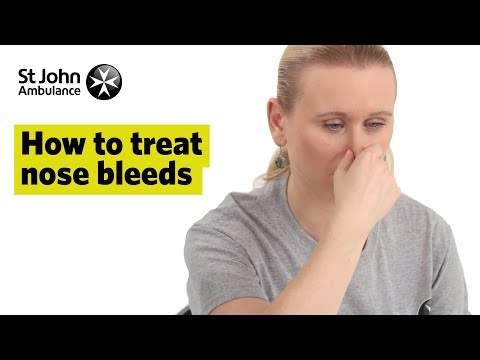
As of 2026-04-20 UTC, the most useful way to watch St John Ambulance's "How to Treat Nose Bleeds" video is to treat it as a correction to a household reflex.[1] Nosebleeds are common enough that nearly everyone has inherited a small ritual for them: tip the head back, wad tissue into the nostril, check every few seconds, move around while waiting for the bleeding to quit. The video strips that folklore down to a narrower first-aid sequence. Sit down. Lean forward. Pinch the soft part of the nose. Hold the pressure long enough for it to mean something.[1][2]
That simplicity is the point. A nosebleed is dramatic because blood is visible on the face, but most first-aid decisions in the first few minutes are mechanical rather than mysterious. St John Ambulance's written page, last reviewed on 28 April 2025, says the common mechanism is rupture of small blood vessels inside the nostrils and lists triggers such as a blow to the nose, sneezing, picking or blowing the nose, high blood pressure, and anti-clotting medicine.[2] Mayo Clinic gives the same public-facing frame: most nosebleeds are annoying rather than medically serious, but some cross into emergency territory by volume, duration, faintness, or injury context.[3] The video works because it teaches the ordinary case without hiding the escalation boundary.
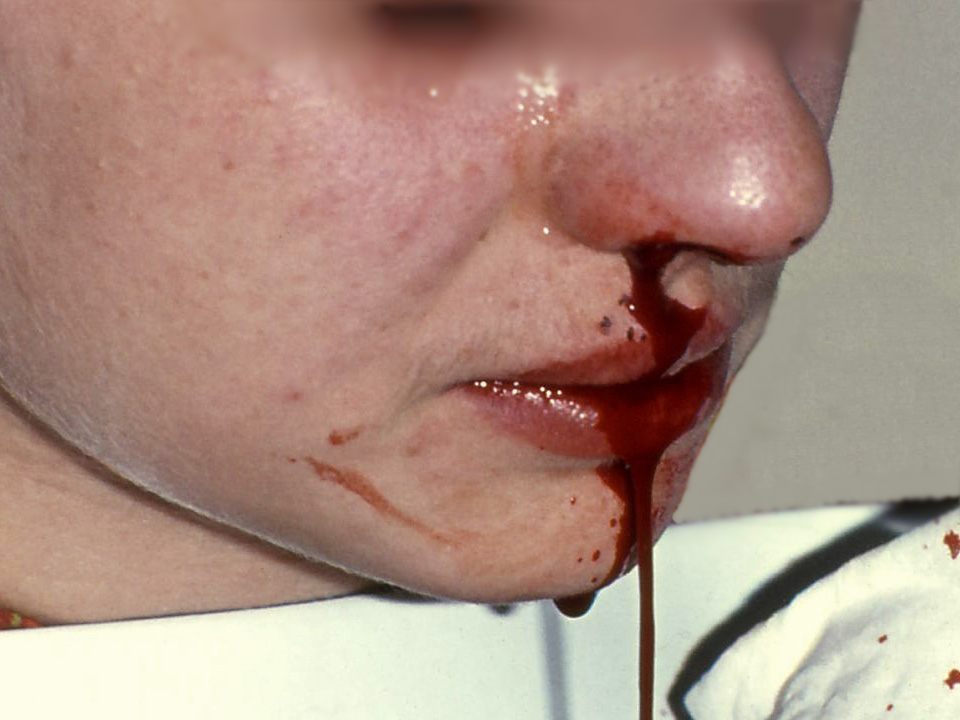
The 2007 photograph used here is deliberately plain. It is not a training diagram and it does not make the event look tidy.[5] That matters because nosebleeds often become hard to manage socially before they become medically complex. Blood on the face makes people rush. The instructional value of the St John clip is that it slows the scene down without making it passive. It turns attention away from the red surface and back toward controllable structure: position, pressure, mouth breathing, and the clock.[1][2][3]
Forward lean changes the airway problem
The first useful detail in the video is posture.[1] The person is seated and tipped forward, not reclined with the head thrown back. That choice can look counterintuitive to people who want the blood to disappear from view. But first aid is not theater. The goal is not to hide blood from the shirt or the floor; it is to keep blood draining out of the nose rather than down the throat.
St John Ambulance states this boundary directly: leaning the head back can let blood trickle toward the throat and block the airway.[2] healthdirect Australia adds a related practical point: the person should lean forward and pinch below the bony part of the nose for about 10 minutes.[4] Mayo Clinic gives the same reason in a different register, noting that blood going down the throat can cause choking or stomach upset.[3] Three sources converge on the same instruction because the old "head back" habit solves the wrong problem. It protects appearances while creating a swallowing and airway problem.
That is why the video's opening is more than a posture cue. It changes the mental model of the event. A nosebleed is not controlled by making blood vanish from the front of the face. It is controlled by creating a stable position in which pressure can work and drainage goes somewhere safer.[1][2][4]
The pinch has to be low, soft, and patient
The next key moment is hand placement.[1] The clip focuses pressure on the soft part of the nose, below the bony bridge. This is where many home responses drift. People press too high on the hard bridge, dab at the nostril opening, or keep inserting tissue as if plugging the visible outlet were the same thing as compressing the bleeding vessel.
The written guidance is consistent. St John Ambulance says to pinch the soft part of the nose and breathe through the mouth, releasing pressure after 10 minutes and repeating for two further 10-minute periods if needed.[2] healthdirect advises leaning forward and firmly pinching the nose below the bony part for 10 minutes.[4] Mayo Clinic sets the pressure window at 10 to 15 minutes, explaining that pinching puts pressure on the blood vessels and helps stop the flow.[3]
Those numbers are not decorative. They are the engineering of the response. Direct pressure needs uninterrupted time because clotting is not instant. The most common first-aid failure is often not ignorance of the pinch; it is impatience with the pinch. People release every minute to see whether the blood has stopped, and each check can disturb the forming clot. The video, read beside the written sources, makes the public skill more exact: pinch the right tissue, hold it continuously, and let the clock do its work.[1][2][3][4]
This is also where the article's central claim sits. Nosebleed first aid is a pressure problem before it is a cleaning problem. Tissue helps catch blood. Water helps clean the face later. Ice may add comfort or local cooling. None of those details replace steady compression on the soft part of the nose.[2][3][4]
The escalation rule keeps calm from becoming neglect
A short video can make a problem look simple. Responsible annotation has to add the boundary where simple first aid stops being enough. St John Ambulance says to call 999 or 112 if the bleeding is severe or lasts more than 30 minutes.[2] Mayo Clinic's emergency list includes more than expected blood, bleeding longer than 30 minutes, faintness or lightheadedness, or bleeding after a fall or accident.[3] healthdirect similarly separates ordinary home care from cases needing medical advice, including frequent nosebleeds, bleeding after injury, and heavier-risk situations such as blood-thinning medicines.[4]
The important distinction is that escalation does not contradict the calm sequence. It depends on it. If a helper has not held proper pressure for a real interval, the scene never reaches a meaningful decision point. A clock gives first aid its evidence. After 10 minutes, the helper can reassess. After repeat pressure and persistent heavy bleeding, the problem has moved into a different category.[2][3][4]
This is the video's quiet strength. It does not dramatize the rare outcome. It teaches the ordinary action so the rare outcome becomes easier to recognize. The person helping is not asked to diagnose anterior versus posterior epistaxis or to judge clotting physiology. The public script is narrower: lean forward, pinch correctly, keep time, repeat if instructed, and escalate when the bleeding is severe, prolonged, injury-related, or accompanied by symptoms that change the risk.[1][2][3][4]
After the bleeding stops, the clot still needs protection
The video concentrates on stopping the active bleed, but the written sources add the aftercare that makes the first-aid sequence hold.[1] St John Ambulance advises rest and avoiding exertion or nose blowing after the bleeding stops so the clots are not disturbed.[2] Mayo Clinic gives the same practical warning: avoid picking or blowing the nose and avoid bending below the heart or heavy lifting for many hours.[3] healthdirect also gives prevention and medical-advice boundaries for recurrent, injury-linked, or higher-risk events.[4]
That aftercare matters because people often treat the end of visible bleeding as the end of the episode. In practice, the fragile point is the next stretch of ordinary behavior: blowing the nose to clear it, bending over, rushing back into activity, or repeatedly checking the nostril. The clot is doing quiet work. The best public first-aid advice protects that work by making the person less busy for a while.
Viewed as health communication, the St John video succeeds because it does not try to turn a nosebleed into a grand emergency. It does something more useful. It takes a familiar event and removes the familiar mistakes. The forward lean protects the throat and airway. The low soft-nose pinch applies pressure where pressure matters. The 10-minute clock disciplines the helper's impatience. The escalation rule keeps the calm sequence honest. For a minor emergency, that is enough structure to change the outcome in the room.
Sources
- St John Ambulance, "How to Treat Nose Bleeds - First Aid Training - St John Ambulance," YouTube video.
- St John Ambulance, "Nosebleed First Aid," clinically reviewed page, last reviewed 28 April 2025.
- Mayo Clinic, "Nosebleeds: First aid," public guidance on posture, pressure timing, aftercare, and emergency thresholds.
- healthdirect Australia, "Nosebleed," self-care sequence, causes, prevention, and medical-advice thresholds.
- Wikimedia Commons, "File: Epistaxis1.jpg," 2007 photograph by Welleschik.