The famous line from the 1964 Surgeon General smoking report is that cigarette smoking causes lung cancer in men.[1][2] That line deserves its place in public memory, but a close reading shows that the report's deeper achievement sits one layer below the headline. It created a public-health way of saying "cause" that was cautious enough to look scientifically disciplined, broad enough to absorb observational evidence, and firm enough to justify action by the federal government.[1][3]
That matters because the report was not written in an experimental world. No committee could randomize millions of people to decades of cigarettes and wait for verdicts. The question was whether converging epidemiology, pathology, animal work, clinical observation, and mortality patterns could support a causal judgment without laboratory proof in humans.[3][4] The 1964 report answers yes, but it does so with unusual care. It says statistical methods alone do not establish causality, then explains that causal significance has to be judged from multiple criteria together, with no single test carrying the whole burden.[3] That is the report's real craft.
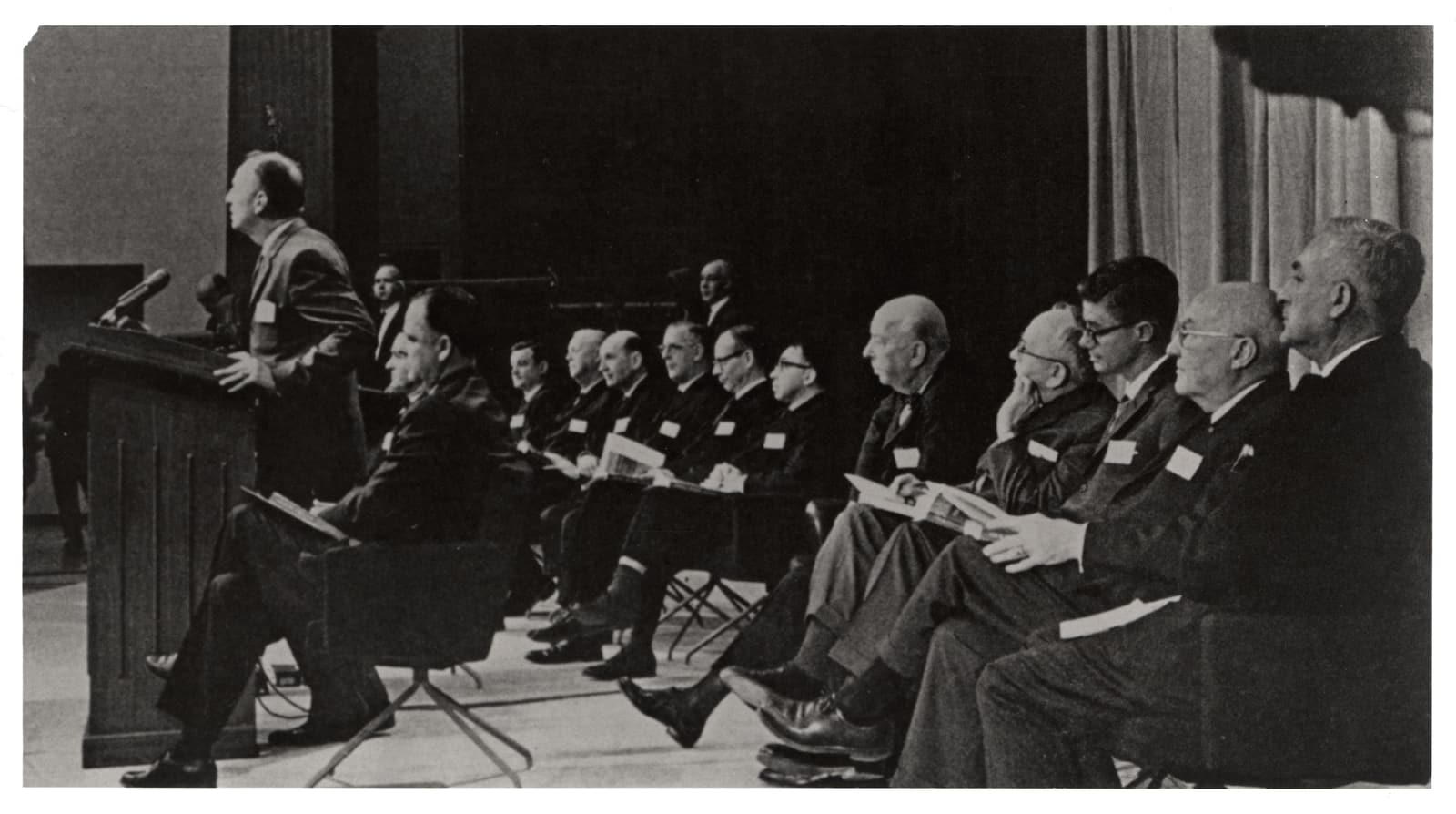
Image context: the cover uses a real 1964 National Library of Medicine press-conference photograph of Surgeon General Luther Terry releasing the report. It fits this essay because the article is about how a committee document became a public-health event: evidence synthesized in private, then presented in language strong enough to survive cameras, headlines, Congress, and industry attack.[6]
Timeline anchors before interpretation
- 1957: Surgeon General Leroy Burney publicly states the U.S. Public Health Service position that cigarette smoking has a causal relationship with lung cancer, showing that the evidence dispute had already moved past mere suspicion before Terry's committee began work.[5]
- 1962: Luther Terry convenes an independent Advisory Committee of scientists who had not publicly taken a position on whether smoking caused lung cancer, in order to review the full record and provide an evidence base for action.[4]
- 1962-1964: according to GovInfo's 60th-anniversary summary, the committee met on the NIH campus with more than 150 consultants and reviewed more than 7,000 articles on smoking and disease.[2][5]
- January 11, 1964: the report is released and states that cigarette smoking is a cause of lung cancer and laryngeal cancer in men, a probable cause of lung cancer in women, and the most important cause of chronic bronchitis.[1][5]
- 1965: Congress passes the Federal Cigarette Labeling and Advertising Act, beginning the first federal warning-label regime for cigarette packages.[1][7]
- 1969-1970: Congress passes the Public Health Cigarette Smoking Act, leading to the television and radio cigarette advertising ban that took effect after September 30, 1970.[1][2][8]
1. The report was designed to look independent before it tried to look decisive
One underread feature of the 1964 report is that the committee's composition is part of the argument.[4] The advisory group was not presented as a regular in-house agency memo. It was a panel of outside scientists chosen in part because they had not publicly committed themselves on the smoking-causation question before the review began.[4] That design did not guarantee neutrality in some perfect philosophical sense, but it did something politically and scientifically useful. It made the report harder to dismiss as a predetermined moral campaign by the Public Health Service.
That choice matters more than it first appears. Smoking in the early 1960s was not a minor or marginal exposure. It was a mass-market habit backed by advertising, cultural prestige, and a powerful industry with every incentive to describe epidemiologic evidence as merely statistical or merely suggestive.[4] If Terry had released a short bureaucratic memo saying that the science was now settled, the resistance would have been immediate and easy. The committee format changed the posture. It signaled that the government was not simply asserting a preference. It was submitting a cumulative scientific judgment.
The report's later authority depends on this opening move. Read closely, the document keeps returning to synthesis rather than revelation.[3] It does not claim that one experiment, one pathology slide, or one cohort table solved the problem. It claims that when different forms of evidence point in the same direction, and when rival explanations weaken under comparison, the responsible judgment can cross from association into causation.[3][4]
2. The key sentence is not only that smoking is dangerous, but how the report defines "cause"
The strongest pages in the report are the ones that explain what causal language can mean in public health.[3] The committee openly admits that statistical association does not mechanically prove a causal relationship. Instead of treating that as a stopping point, it treats it as the reason judgment is necessary. The report defines cause in ordinary but disciplined terms, as a meaningful and effect-producing relationship between an agent and disease in the host.[3][4]
This may look modest now, but it was a decisive move. In infectious-disease history, causation often carried the prestige of one pathogen, one disease, one experimental chain. Cigarette smoking did not fit that template cleanly. The exposure was voluntary, prolonged, dose-graded, commercially promoted, and tied to diseases with long latency.[3][4] The report's solution was to say, in effect, that public-health causation does not require the same evidentiary shape as laboratory causation.
That point still matters because the report's language is neither casual nor maximalist. It does not say that any association with a low p-value should be called causal. It says the opposite: the judgment goes beyond probability and depends on multiple criteria considered together.[3] In practice, that meant consistency across studies, coherence with pathology and animal work, dose-response patterns, temporal sequence, and the weakness of competing explanations.[3][4] The report made those criteria legible enough that later Surgeon General reports could reuse the same logic in more refined form.[4]
3. Its conservative wording is exactly what made it actionable
A superficial reading of the report can make the conclusions look uneven. Why "cause" for lung cancer in men, "probable cause" for lung cancer in women, and "most important cause" for chronic bronchitis?[1][5] The answer is not indecision. It is evidentiary calibration.
The committee matched strength of language to strength of record. By 1964, the male lung-cancer evidence base was large, repeated, and mutually reinforcing.[3][4] For women, smoking patterns and the available epidemiologic history were different, so the report stopped at "probable cause" rather than pretending symmetry where the record was still thinner.[1][5] For chronic bronchitis, the committee used language that emphasized comparative contribution rather than a single all-or-nothing disease trigger.[1]
That conservatism gave the report durability. It meant the document could not be easily caricatured as overclaiming across every endpoint at the same intensity. A report that is too sweeping invites institutional retreat. A report that grades its conclusions by evidentiary weight becomes harder to break. The later history described by CDC shows exactly that pattern: the 1964 report did not end the smoking fight, but it changed the terms on which the fight could be carried on.[1]
This is why the report still reads as a live lesson in evidence writing. Strong public-health documents often survive because they do less than activists want rhetorically and more than institutions can ignore practically. The 1964 report speaks in that register.
4. The sentence that changed the policy clock is "appropriate remedial action"
The most consequential phrase in the report may be shorter than the causal conclusions themselves. After laying out the evidence, the committee states that cigarette smoking is a health hazard of sufficient importance in the United States to warrant "appropriate remedial action."[2][3] That phrase is easy to glide past because it sounds administrative. In fact, it is the hinge between scientific judgment and state response.
The report could have stopped at classification. It did not. Once it declared the hazard large enough to justify action, Congress, federal agencies, broadcasters, schools, and voluntary health organizations had a new reference point.[1][2] CDC's historical summary makes this sequence explicit: the report is followed by warning labels in 1965, the broadcast advertising ban framework in 1969, and a continuing federal reporting system on smoking and health.[1]
That helps explain why the report was such a powerful public artifact. The crucial move was not "smoking is bad," which many people already suspected. The crucial move was "the evidence has matured enough that inaction now requires its own defense." That is a different kind of sentence. It changes burden, not just opinion.
The strongest two interpretations
Interpretation A: the report mainly mattered because it said, in one headline, that cigarettes cause cancer
This interpretation has a true core. The report's categorical conclusions were nationally legible in a way that journal articles and specialist reviews were not.[1][2] A sentence that the federal government can put before cameras has a reach that even famous epidemiology papers do not.
Interpretation B: the report mattered more because it wrote a reusable causality grammar for public health and connected that grammar to action
This interpretation fits the primary source more fully. The committee explains how causal judgment can be made from converging evidence, calibrates language to the record, and then explicitly links that judgment to remedial action.[2][3][4]
Current assessment: Interpretation B is stronger. The report's lasting force lies less in one dramatic sentence than in the method and tone that made the sentence institutionally durable.
What would change the assessment: evidence that the report's committee design and causal criteria were mostly decorative, and that policy change would have proceeded on the same timetable without them, would strengthen Interpretation A. The historical sequence described by CDC and GovInfo points the other way.[1][2]
Why this close reading still matters
The 1964 report remains useful because it shows how public health writes under conditions where direct experimentation is impossible, latency is long, and commercial opposition is strong.[3][4] Its solution was not to lower standards. It was to articulate a standard appropriate to population evidence and then to speak with calibrated confidence.
That is the document's deeper legacy. It taught public health how to say that an exposure causes disease without pretending the question looked like laboratory toxicology or bedside diagnosis. It also taught institutions how to move from evidence accumulation to policy obligation without waiting for impossible certainty. In that sense, the report did more than condemn cigarettes. It built a language in which preventable mass harm could be named and governed.[1][3][4]
Sources
- CDC, "A History of the Surgeon General's Reports on Smoking and Health" - official historical summary of the 1964 report's conclusions and the 1965/1969 policy sequence.
- GovInfo, "Anniversary of the Surgeon General's First Report on Smoking and Health" - government summary of the 1962-1964 committee process, 150+ consultants, and later timeline.
- U.S. Department of Health, Education, and Welfare, Smoking and Health: Report of the Advisory Committee to the Surgeon General of the Public Health Service (1964 PDF) - primary report text containing the causality criteria and the call for "appropriate remedial action."
- NCBI Bookshelf, "Producing the Surgeon General's Report From 1964-2014: Process and Purpose" - official retrospective explaining the committee's design and the report's causality framework.
- National Library of Medicine, "The 1964 Report on Smoking and Health" - historical overview of the report's release and significance within the Surgeon General series.
- National Library of Medicine Profiles in Science, "U.S. Surgeon General Luther Terry addressing press conference at the release of the 1964 Report on Smoking and Health" - source page for the archival photograph used as the article image.
- GovInfo, Federal Cigarette Labeling and Advertising Act (current compiled text PDF) - official federal source for the 1965 warning-label statute.
- GovInfo, Public Health Cigarette Smoking Act of 1969 and Background Information for Hearings on Bills Relating to "Small Cigars" (hearing print PDF including the act text) - federal source for the 1969 broadcast-advertising ban legislation.