Rubella is easy to underestimate because in most children and adults it is a light disease: a short rash illness, often so mild that people may not even notice it.[2][4][5] The historical trouble begins somewhere else. Rubella became one of the twentieth century's most consequential vaccine targets because a mild infection in one body could become permanent injury in another body still forming. Congenital rubella syndrome, or CRS, made public health look sideways. The key patient was often not the child or young adult carrying the virus, but the fetus exposed during early pregnancy.[2][4][5]
That sideways logic produced an unusual strategic problem. Once live attenuated rubella vaccines were licensed in the United States in 1969, public health could not solve pregnancy risk by simply vaccinating pregnant people at the moment of danger. The vaccine was not advised during pregnancy because of theoretical fetal risk and because the worst damage from infection had already occurred very early in gestation, often before pregnancy was fully recognized.[4][6] So the first durable answer had to be indirect: cut circulation in children, build population immunity around future pregnancies, and later tighten the remaining gap by identifying susceptible women of childbearing age.[2][3][6]
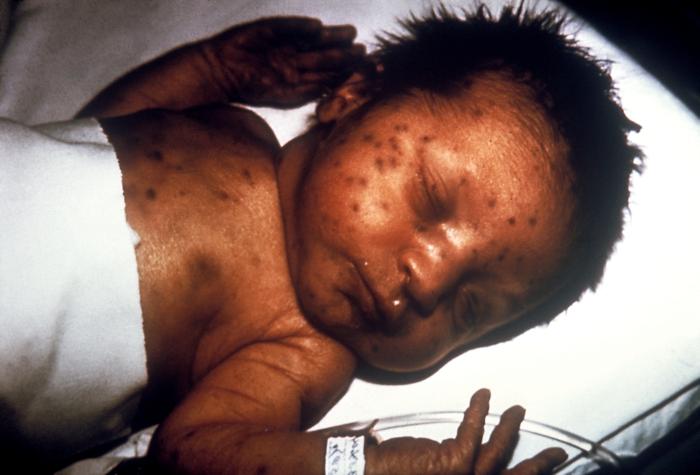
Image context: the cover uses a real CDC archival photograph of an infant with congenital rubella. It belongs here because the event reconstructed below turns on outcome visibility. Rubella looked clinically modest in many infected children. CRS made its fetal cost visible in the nursery, the eye clinic, and the cardiology ward.[7]
Timeline anchors
- 1940: Australia experiences a major rubella epidemic that sets the immediate background for Norman Gregg's observations the following year.[1]
- 1941: Gregg reports 78 infants with congenital cataracts and other anomalies, most born to mothers who had rubella early in pregnancy.[1]
- 1964-1965: the last major U.S. rubella epidemic produces an estimated 12.5 million cases, 11,000 pregnancy losses, 2,100 neonatal deaths, and 20,000 infants born with CRS.[2][6]
- 1969: live attenuated rubella vaccines are licensed in the United States, and a national vaccination program begins.[2][3][6]
- 1978: U.S. policy expands attention toward susceptible postpubertal females and other adult groups after outbreaks persist among adolescents and young adults.[3][6]
- 2004: CDC concludes that endemic rubella transmission is no longer present in the United States.[2][6]
1. Gregg's 1941 clue changed the unit of attention
The first hinge in the story is not a vaccine trial. It is a pattern-recognition event. After the 1940 Australian epidemic, Sydney ophthalmologist Norman Gregg began seeing an unusual run of infants with congenital cataracts, many of them also small for age or carrying heart and other abnormalities.[1] He surveyed colleagues in other Australian states, assembled 78 such cases, and published the observation in 1941.[1]
That move mattered because it shifted the unit of explanation. Before Gregg, rubella sat mostly inside the ordinary infectious-disease frame: a contagious but generally mild exanthem of children and young adults.[1][5] Gregg's case series forced clinicians to read the infection across pregnancy. The disease did not end with the mother. It crossed a developmental threshold and reappeared months later as a cluster of congenital defects.[1][5]
NHMRC's historical summary is useful because it preserves how disruptive this was. In the 1940s, congenital malformations were still widely treated as inherited problems, and many researchers did not yet accept that a viral infection could injure the developing fetus in this way.[1] Gregg's observation therefore did more than add one more complication to rubella. It helped make teratogenic infection clinically imaginable.
This first stage of the event reconstruction is important because it explains why rubella never fit neatly into the same public-health box as measles or mumps. The problem was not only outbreak burden in the infected child. The problem was vertical timing. A disease that looked light in the community could still be catastrophic if it crossed pregnancy during a short developmental window.[4][5]
2. The 1964-1965 epidemic turned a clinical warning into a national emergency
Gregg's clue was strong, but the next decisive push came from scale. During the 1964-1965 epidemic in the United States, rubella stopped being a specialist warning and became a national systems problem. CDC's current rubella program history gives the standard burden estimate: 12.5 million infections, 11,000 pregnant women who lost their babies, 2,100 newborn deaths, and 20,000 infants born with CRS.[2] The 2005 MMWR elimination report adds that the same epidemic also produced about 2,000 cases of encephalitis and carried an estimated U.S. economic cost of $1.5 billion.[6]
Those numbers matter for more than shock. They changed what counted as prevention. Once the fetal burden became visible at that scale, rubella could no longer be treated as a low-stakes childhood rash whose complications were mostly occasional and individual. Public health now had to protect pregnancies that had not yet declared themselves as such. That is a harder target than a school outbreak because the risk window opens in early gestation and closes before most response systems can work in real time.[4][5]
WHO's surveillance standard explains the biological severity in the clearest compact form. From just before conception through the first 8-10 weeks of gestation, maternal rubella infection can lead to multiple fetal abnormalities in up to 90% of cases and can also result in miscarriage or stillbirth.[5] CDC's pregnancy guidance frames the same point for current practice: the most severe damage occurs early, especially in the first 12 weeks.[4] Once those boundaries are in view, the later vaccination strategy makes sense. Rubella control was never only about lowering symptomatic cases. It was about getting ahead of a short fetal-risk clock.
This is why the 1964-1965 epidemic belongs at the center of the reconstruction. It converted a known danger into a scale problem that ordinary case management could not solve. Obstetric counseling after exposure mattered, but by the time exposure was recognized the decisive developmental interval might already have passed.[4][5] Prevention had to move upstream.
3. The first vaccine answer had to be indirect
In 1969, live attenuated rubella vaccines were licensed in the United States.[2][3][6] That was the technical breakthrough, but the strategic design is the more interesting part. The immediate national program targeted children roughly from age one through puberty, not pregnant women.[3][6] School campaigns were used to raise coverage quickly.[6]
That choice can look counterintuitive if the gravest harm fell on fetuses. Why start with schoolchildren? Because the public-health objective was to interrupt the transmission routes that carried virus toward future pregnancies, while avoiding use of a live attenuated vaccine during pregnancy itself.[4][6] CDC's elimination history states this directly: vaccination of women of childbearing age was not initially advised because data were insufficient to assess fetal risk if a live attenuated vaccine were given to someone unknowingly pregnant, and a registry was set up to track pregnancy outcomes after inadvertent exposure.[6]
So rubella control in the vaccine era began with a relay. Children were the main transmission reservoir before vaccine availability, with incidence highest among those under 9 years of age.[3][6] Vaccinating them was the fastest way to lower circulation in the population that future pregnant women lived inside. The first strategy therefore was not mistaken about who mattered most. It was built precisely around who mattered most. It simply had to reach that target indirectly.[2][3][6]
The early results show why the strategy held. According to the MMWR elimination report, an estimated 80 million doses of live attenuated rubella vaccine were distributed in the United States during 1969-1977, and reported rubella cases fell 78%, from 57,686 in 1969 to 12,491 in 1976.[6] Reported CRS cases also declined, from 68 in 1970 to 23 in 1976.[6] That sequence is the operational proof of the child-first logic. Lower community transmission translated into fewer fetal injuries.
4. The adult gap changed the strategy again
The first program worked, but not completely. As rubella incidence fell in children, the remaining epidemiology shifted upward in age. CDC's surveillance manual and elimination history both note later outbreaks among older adolescents and young adults, including students, military populations, and hospital workers.[3][6] In other words, the campaign succeeded well enough to change the problem it still had to solve.
That shift mattered because adult infection sits closer to pregnancy. In 1978, policy attention expanded toward susceptible postpubertal females and other adult groups at risk of sustaining transmission.[3][6] This was not a reversal of the earlier child-first design. It was its second stage. Once the reservoir in children had been cut down, the remaining task was to close immunity gaps in the age groups most likely to carry the virus into pregnancy or into settings where pregnant people might be exposed.[3][6]
Current CDC pregnancy guidance still carries the logic forward. People should be immune before pregnancy, and pregnant people who are not immune should wait until after delivery to receive MMR vaccine.[4] That advice can look like a simple safety warning. Historically it is the surviving trace of the whole rubella strategy. Because infection harms the fetus early and vaccine is not given during pregnancy, the safe zone has to be built beforehand.[4][5]
The long result was dramatic. CDC now treats 2004 as the year rubella was eliminated from the United States, meaning continuous endemic transmission was no longer present.[2] On the current CDC summary, fewer than 10 rubella cases are reported in the United States in a typical recent year, and since 2012 most reported cases have been linked to exposure outside the country.[2] That endpoint was not achieved by waiting for pregnancy and responding at bedside speed. It was achieved by changing the background through vaccination.
What this reconstruction clarifies
Rubella is often filed under routine immunization history, and by 2026 that can make the older danger feel abstract. The event reconstruction restores the harder sequence. First, Gregg's 1941 observation made fetal injury visible inside a disease that otherwise looked mild.[1] Second, the 1964-1965 epidemic made that fetal risk impossible to treat as rare background.[2][6] Third, the 1969 vaccine did not simply erase the problem at the point of pregnancy, because pregnancy was exactly where live-vaccine caution and early fetal timing made a direct answer weakest.[4][6] The durable solution had to begin earlier, in the circulation pattern of the whole population.
That is why rubella belongs in present-tense health thinking. It is one of the clearest cases in which the right prevention target was never just the person visibly ill in front of the clinician. The decisive target was the future exposure environment around pregnancy. Public health won by vaccinating where the virus moved most easily, then tightening immunity where pregnancy risk remained closest. Rubella became a vaccine routine only after it had first been understood as a birth-defect emergency.
Sources
- National Health and Medical Research Council, "Rubella and pregnancy: Case Study" - historical account of the 1940 Australian epidemic, Gregg's 1941 case series of 78 infants, and the early skepticism surrounding the discovery.
- Centers for Disease Control and Prevention, "Impact of U.S. MMR Vaccination Program" - CDC overview of the 1964-1965 epidemic burden, the 1969 vaccine introduction, 2004 elimination, and today's low case counts.
- Centers for Disease Control and Prevention, "Chapter 14: Rubella" in the Manual for the Surveillance of Vaccine-Preventable Diseases - CDC history of pre-vaccine child-centered transmission, 1969 licensure, and later adult-targeted strategy expansion.
- Centers for Disease Control and Prevention, "Pregnancy and Rubella" - current CDC guidance on first-trimester risk, CRS complications, and why MMR vaccination is deferred until after pregnancy.
- World Health Organization, "Congenital Rubella Syndrome: Vaccine Preventable Diseases Surveillance Standards" - WHO standard on the 8-10 week high-risk window, up-to-90% fetal abnormality risk, and the common organ systems affected by CRS.
- Centers for Disease Control and Prevention, "Achievements in Public Health: Elimination of Rubella and Congenital Rubella Syndrome -- United States, 1969-2004" (MMWR, 2005) - CDC reconstruction of vaccine policy, school campaigns, adult-gap adjustment, and elimination evidence.
- Wikimedia Commons, "File:Infant with skin lesions from congenital rubella.jpg" - CDC archival photograph source page used for the article image.