The decisive problem in neonatal respiratory distress syndrome is easy to misname. It is not simply that a premature infant has “weak lungs” or too little oxygen in some general sense. The sharper problem is mechanical. A baby born too early may have to reopen unstable alveoli with every breath because the lung has not yet made enough surfactant to keep those air sacs from collapsing at the end of exhalation.[1][3]
That is why surfactant changed care so deeply. It did not work as a generic tonic. It changed the price of the first breaths. By lowering surface tension at the air-liquid interface inside the alveoli, surfactant made expansion easier, reduced repetitive collapse, and let a fragile lung stay open long enough for gentler support strategies to matter.[1][3][4]
The timeline makes the mechanism visible. In 1959, Mary Ellen Avery and Jere Mead linked hyaline membrane disease to abnormal lung surface properties in premature infants.[1] In 1980, Tetsuro Fujiwara and colleagues showed that endotracheal surfactant could rapidly improve oxygenation in ten severely ill preterm infants.[2] In 2022, European neonatal guidelines still treated surfactant as central, but now inside a more selective strategy that tries to support spontaneous breathing and avoid unnecessary mechanical ventilation.[4] The through-line is stable: respiratory distress syndrome became more survivable when clinicians learned how to prevent the tiny air sacs from paying the full reopening cost over and over again.
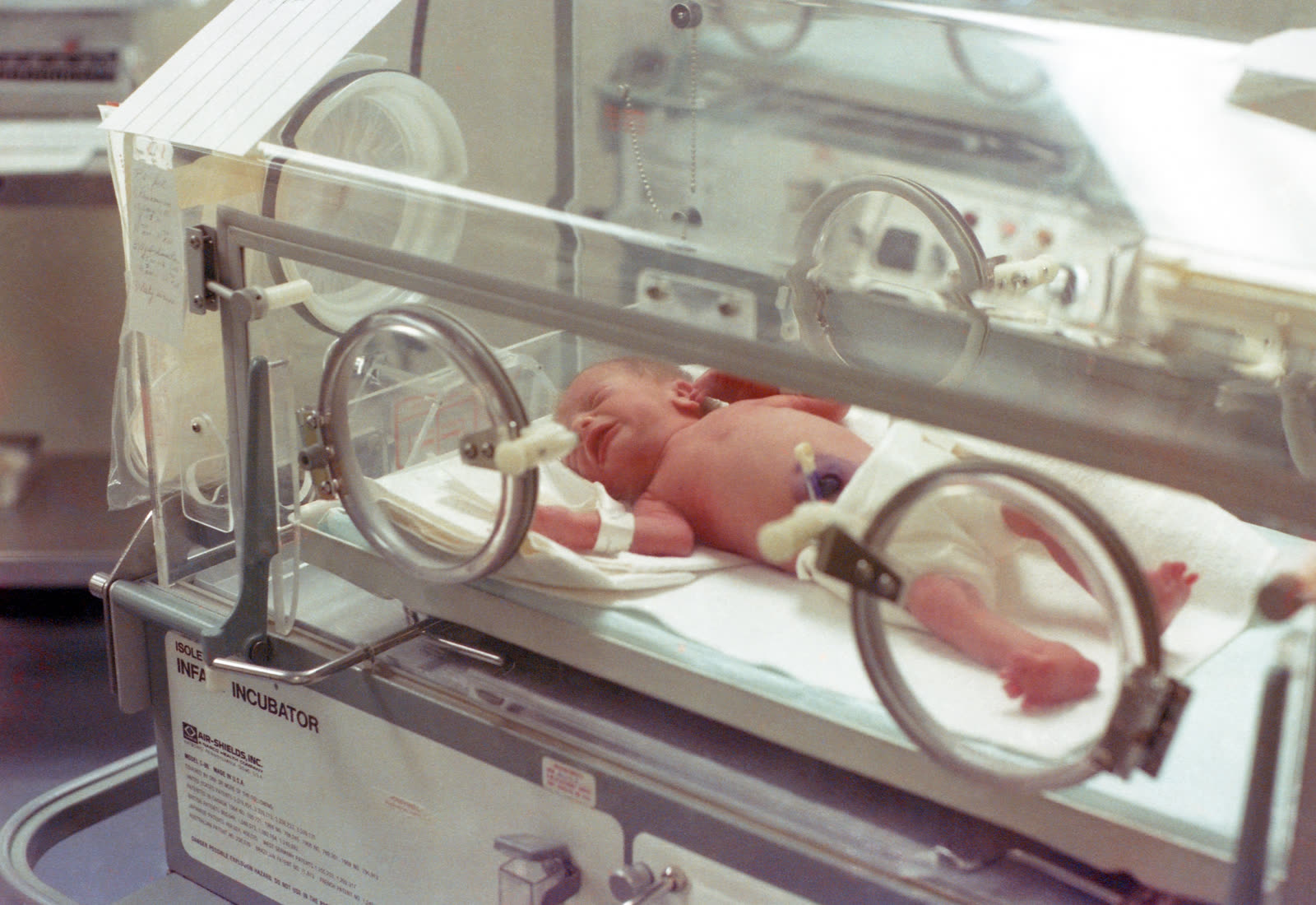
Image context: the cover uses a real 1978 hospital photograph of a premature infant in a neonatal incubator.[5] It fits the essay because the history here is not about a molecule in isolation. It is about what intensive-care rooms could finally do once premature lungs stopped collapsing so expensively between breaths.
Timeline anchors
- 1959: Avery and Mead published the paper that linked hyaline membrane disease to deficient surface properties in premature lungs.[1]
- 1980: Fujiwara and colleagues reported endotracheal artificial surfactant treatment in 10 preterm infants with severe hyaline membrane disease, turning physiology into bedside rescue.[2]
- 2013 onward: guidelines moved away from routine prophylactic dosing for the smallest babies once early CPAP became a stronger alternative to automatic intubation.[4]
- 2022: European consensus guidance recommended early rescue surfactant for worsening RDS, generally when FiO2 exceeds 0.30 on CPAP at 6 cm H2O or more, and favored less invasive delivery when possible.[4]
1. Why premature lungs fail as a mechanics problem first
NHLBI's current RDS page states the developmental baseline plainly. Surfactant production begins during the third trimester, after the 26th week of pregnancy, and RDS occurs most often in babies born before 28 weeks.[3] That timing matters because the transition at birth is abrupt. A fetus can rely on the placenta for gas exchange. A newborn has to inflate the lungs immediately.
Surfactant is the substance that makes that transition energetically manageable. NHLBI describes it as a foamy material that keeps the lungs fully expanded once the baby starts breathing air.[3] Without enough of it, the alveoli tend to collapse, the infant must generate more pressure to reinflate them, and oxygen delivery falls because ventilation never becomes stable.[3] In practice, the lung behaves like a structure that keeps losing its shape.
Avery and Mead's 1959 paper mattered because it gave that bedside pattern a physical explanation.[1] The historical diagnosis of “hyaline membrane disease” had described what clinicians and pathologists saw. Their intervention was to say that the disorder could also be understood as failed surface stability inside the immature lung.[1] That moved the problem away from vague weakness and toward a specific interface.
2. Why surfactant replacement works by changing the cost of each breath
Once the disease is understood that way, the logic of treatment becomes much clearer. Surfactant replacement is not a substitute for oxygen delivery alone, and it is not mainly an anti-inflammatory drug. It acts where the instability lives: at the alveolar lining. The point is to reduce the force needed to open and keep open the air sacs so that breathing support is not wasted on repeated collapse.[3][4]
This is also why surfactant pairs so naturally with CPAP rather than replacing respiratory support altogether. CPAP provides a distending pressure. Surfactant changes how effectively that pressure can stabilize the lung. When the lining behaves better, the same external support can accomplish more with less trauma.[3][4]
The mechanism is therefore cumulative. A premature infant with surfactant deficiency does not lose only one breath. The infant loses efficiency on breath after breath. Replacement therapy helps by interrupting that sequence before exhaustion, barotrauma, and escalating oxygen needs push the team toward harsher ventilation.[4]
3. Why the 1980 bedside report mattered so much
Fujiwara's 1980 report remains the hinge because it showed that the physiological insight could survive contact with intensive care.[2] According to the abstract, 10 severely ill preterm infants with hyaline membrane disease received artificial surfactant endotracheally.[2] Oxygenation improved, alveolar-arterial oxygen gradients improved, inspired oxygen and peak respirator pressure could be reduced, and many radiographic abnormalities resolved.[2]
The survival figures are modest by modern standards and powerful in historical context. Eight infants survived, including five of six whose birthweight was below 1500 g; the two deaths were reported as unrelated causes.[2] The significance was not that the problem had been solved forever. It was that a premature lung in acute distress could be made more recruitable quickly enough to alter the trajectory of care in real time.
That changed neonatal reasoning. Before surfactant therapy, clinicians could provide oxygen, pressure, and ventilation, but the underlying interface problem remained. After surfactant, they had a way to alter the lung's behavior directly, which meant that ventilator settings and oxygen fractions no longer had to carry the whole burden alone.[2][4]
4. Why timing still matters in 2026
Modern guidance shows how much the field learned after the original breakthrough. The 2022 European consensus states that surfactant therapy improves survival and reduces pneumothorax, and reports that about 50% of babies born between 22+0 and 32+6 weeks still receive surfactant.[4] So the therapy remains common, but the strategy around it is no longer “intubate everyone early and dose by default.”
The current aim is narrower and smarter. Start with non-invasive support when possible, watch the infant's work of breathing and oxygen requirement, and give rescue surfactant early enough that the lung does not spiral into a more damaging ventilation course.[4] The guideline's suggested threshold, FiO2 above 0.30 on CPAP of at least 6 cm H2O, captures that balance.[4] It is late enough to identify genuine worsening and early enough to avoid writing off a recruitable lung.
Dose now matters more explicitly as well. The same guideline notes that if poractant alfa is used, an initial dose of 200 mg/kg can reduce the need for re-dosing.[4] This is still the same mechanical story. Better early restoration of surface activity can spare the infant repeated deterioration and repeated instrumentation.
That is the larger lesson. Surfactant did not abolish prematurity, and it did not eliminate the risks of lung injury, chronic disease, or prolonged intensive care. What it did was shift RDS from a condition dominated by repeated alveolar failure toward one that can often be stabilized before the support itself becomes the next source of damage.[3][4]
Why the mechanism still matters
The history of surfactant is often told as a miracle-drug story. The more precise version is better. Premature respiratory distress became treatable when clinicians stopped thinking only in terms of oxygen delivery and started thinking about the physics of the first breath. The infant needed more than air. The infant needed alveoli that could stay open long enough for breathing to become sustainable.[1][2][3]
That remains true in 2026. Surfactant matters because it changes the lung's economics. It lowers the reopening bill on each breath. Everything else in modern neonatal respiratory care, CPAP, less invasive administration, early rescue thresholds, gentler ventilation, works better once that bill comes down.
Sources
- Mary Ellen Avery and Jere Mead, "Surface properties in relation to atelectasis and hyaline membrane disease" (AMA Journal of Diseases of Children, 1959) - the classic paper that tied neonatal hyaline membrane disease to deficient lung surface properties.
- Tetsuro Fujiwara, Haruo Maeta, Shoichi Chida, Tomoaki Morita, Yoshitane Watabe, and Tooru Abe, "Artificial surfactant therapy in hyaline-membrane disease" (Lancet, 1980) - the first bedside report of endotracheal surfactant rescue in ten severely ill preterm infants.
- National Heart, Lung, and Blood Institute, "Newborn Breathing Conditions Respiratory Distress Syndrome (RDS)" - current NIH explanation of developmental timing, mechanism, and treatment basics for neonatal surfactant deficiency.
- David G. Sweet et al., "European Consensus Guidelines on the Management of Respiratory Distress Syndrome: 2022 Update" (Neonatology, 2023; PMC) - current evidence-based guidance on selective rescue surfactant, timing, CPAP thresholds, and dosing.
- Wikimedia Commons, "File:Infant-Incubator-wBaby-1978-USA.jpg" - source page for the 1978 hospital photograph used as the article image.