The usual origin story of the stethoscope is brief and clean. In 1816, Rene Laennec felt it would be improper and diagnostically awkward to place his ear directly on the chest of a young woman with symptoms of heart disease, rolled paper into a tube, heard better than before, and eventually turned the tube into wood.[1][2][3] That story is true as far as it goes. Read Laennec's 1819 De l'auscultation mediate closely, however, and the real achievement looks larger and narrower at the same time.[1] The treatise is not mainly about modesty, elegance, or gadget invention. It is about building a new diagnostic discipline in which listening becomes repeatable, comparable, and accountable to lesions later found at autopsy.[1][2]
That distinction matters because the wooden cylinder itself can distract from what the book is actually doing. Laennec is not merely saying that a tube makes sounds louder. He is saying that the tube regularizes the encounter between physician and chest. It creates a fixed acoustic distance, allows one small region to be compared against another, and helps transform scattered impressions into named signs.[1][2] The instrument mattered because it carried with it a method.
The strongest way to read the 1819 treatise in 2026 is therefore not as the birth of a timeless doctorly emblem. It is as a threshold text in health diagnostics. Laennec's book makes three moves that remain foundational: it replaces improvised listening with mediate auscultation as an explicit technique, it builds a vocabulary for what the ear is hearing, and it insists that these sounds have to answer to pathological anatomy rather than bedside intuition alone.[1][2]
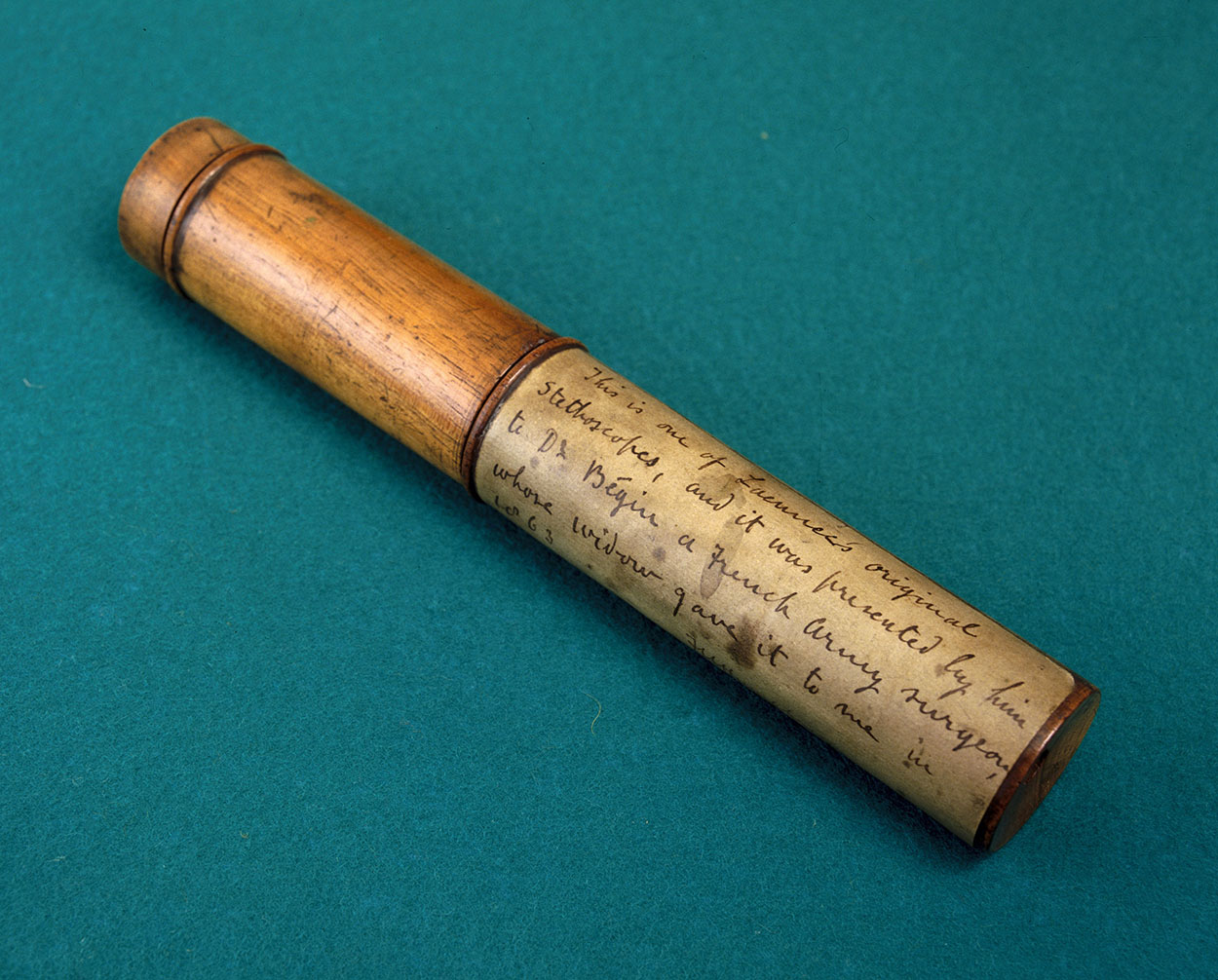
Image context: the cover uses a museum photograph of one of Laennec's early stethoscopes, a wooden monaural instrument from the first generation of mediate-auscultation tools.[4][5] It is the right image for this essay because the object mattered less as a badge of profession than as a way of making chest listening stable enough to teach, repeat, and check.
Timeline anchors before the symbol hardens
- 1816: Laennec developed the first form of mediate auscultation at the Necker Hospital in Paris after the paper-tube experiment described in the treatise's introduction.[1][2][3]
- 1819: he published De l'auscultation mediate, the two-volume work that named the stethoscope and organized a new chest-diagnostic method.[1][2]
- 1850s: the familiar binaural stethoscope with rubber tubing had emerged, showing that the method had outgrown the first exact instrument shape.[3][5]
Those dates help separate three different things that public memory often fuses into one: the first acoustic improvisation in 1816, the formal diagnostic treatise in 1819, and the later evolution of the stethoscope into other physical forms.[1][3][5]
1. The treatise begins with inconvenience, but it is aiming at method
Laennec's opening anecdote is famous because it is vivid.[1][2] He describes being consulted by a young patient whose age and sex made direct application of the ear to the precordium difficult, then recalling the acoustic principle that sound can travel clearly through solid bodies.[1] The story explains why a paper roll appears. It does not explain why the book matters.
The real work starts after the anecdote. Laennec does not present the tube as a one-off trick that happened to help in an embarrassing consultation.[1] He turns it into a generalizable procedure. The physician can now listen to the chest through an intermediary body, place the instrument with more precision than a whole ear and cheek allow, and compare one region with another under more stable conditions.[1][2] The new method is "mediate" not merely because something lies between doctor and patient, but because that intermediary object standardizes the act of listening.
That is why the NCBI Clinical Methods history chapter treats Laennec's book as more than an instrument manual.[2] It emphasizes that the treatise tied the bedside exam to a much broader program of local diagnosis: not simply whether a patient seemed ill, but what physical change inside the chest could be recognized during life.[2] Put that way, the paper tube and wooden cylinder belong to diagnostic epistemology, not just bedside etiquette.
2. The deeper innovation is comparison
Modern shorthand often says the stethoscope amplified sound.[3] That is only part of the story. The more consequential innovation in the 1819 treatise is comparative listening.[1][2] Once the examiner can move a small instrument across the chest, one spot can be judged against another, the right can be compared against the left, and one type of sound can be sorted from another instead of collapsing into a vague impression of "abnormal chest noise."[1]
This comparative structure is what turns auscultation into a teachable craft. Laennec's book does not leave the ear alone with sensation. It creates categories: rales, pectoriloquy, egophony, bronchophony, and other named relations between sound and structure.[2] The ear is no longer just intimate; it becomes classificatory. A wooden cylinder becomes valuable because it helps the clinician hear differences sharply enough to stabilize words around them.[1][2]
That point can be easy to miss because later medicine kept the instrument while naturalizing the vocabulary.[3] Once the stethoscope became ordinary, it was easy to imagine that the harder work had always been detecting sounds. Laennec's treatise shows that the harder work was organizing those sounds into repeatable signs that others could learn.[1][2] In that sense, the stethoscope's real invention was inseparable from a lexicon.
3. The book insists that bedside sound answer to the autopsy table
The third reason the treatise still reads alive is that it refuses to let auscultation remain a free-floating sensory art.[1][2] The Clinical Methods chapter makes this explicit: Laennec joined pathological anatomy and clinical medicine by an "inseparable bond," asking by what signs internal lesions could be recognized during life.[2] That summary captures the real force of the project. A sound heard through the stethoscope matters only if it corresponds to a lesion, fluid collection, cavity, consolidation, or structural change that can later be verified.[1][2]
This is why the 1819 publication mattered more than a clever tool by itself. Plenty of medical devices become curiosities because they offer sensation without a durable interpretive system. Laennec's treatise was different. It attached listening to proof. The bedside finding had to survive comparison with pathology.[1][2] That demand is also why later builders could revise the instrument's physical shape without abandoning the underlying method.[3][4]
4. Why the first stethoscope does not look like the modern emblem
Britannica's device history and preserved museum examples help clarify another misconception.[3][4] Laennec's early stethoscope is a rigid monaural cylinder of wood, not the flexible twin-eared device that later became iconic.[3][4][5] That physical difference is useful because it reminds us not to project modern symbolism backward. In 1819, the stethoscope had not yet become shorthand for medicine itself. It was a specialized chest instrument tied to a specific diagnostic campaign.
The object also shows how little the original breakthrough depended on the final mature form.[3][4] Later binaural designs were more convenient and eventually more universal, but the crucial step had already happened once Laennec made chest sounds transportable through a fixed intermediary and interpretable within a named system.[1][2][3][4] In other words, medicine could replace the exact shape and keep the logic.
That is why the best historical reading of the stethoscope is less "one famous device that endured unchanged" than "one method that quickly escaped its first housing."[1][3][4] The wooden cylinder mattered, but it mattered as scaffolding for disciplined listening.
What the 1819 text still clarifies
The easiest way to overstate the stethoscope is to treat it as a miraculous instant upgrade in diagnostic power. The easiest way to understate it is to treat it as a polite workaround for direct contact. Laennec's 1819 treatise sits between those simplifications.[1] Its real achievement was to make listening comparative, nameable, and anatomically answerable. It did not abolish uncertainty. It gave physicians a more rigorous way to organize uncertainty at the bedside.[1][2]
That is why the treatise still matters as a health document. Its instrument is simple enough to look almost premodern. Its method is not. By fixing distance, narrowing the listening field, building a vocabulary, and demanding later pathological confirmation, Laennec turned chest examination into something closer to a reproducible diagnostic science.[1][2][3] The stethoscope became iconic later. In 1819, it first became useful because it made proof easier to hear.
Sources
- R. T. H. Laennec, De l'auscultation mediate (1819 edition record with Internet Archive scan via Open Library).
- Harold C. Sox Jr. and colleagues, "The Origins of the History and Physical Examination," Clinical Methods (NCBI Bookshelf) - historical synthesis on Laennec's method, terminology, and link between bedside diagnosis and pathology.
- Encyclopaedia Britannica, "Stethoscope" - device history covering Laennec's perforated wooden cylinder and the later shift to binaural forms.
- Wood Library-Museum of Anesthesiology, "Laennec Stethoscope" - museum page on preserved early wooden stethoscope forms associated with Laennec's 1819 text.
- Wikimedia Commons, "File: Laennecs stethoscope, c 1820. (9660576833).jpg" - source page for the museum photograph used as the article image.