The 1948 streptomycin trial is often remembered as a monument with one label attached to it: the randomized controlled trial that changed medicine. Read the paper and its immediate afterlife more closely, and the picture gets sharper. What made the study durable was not one magic word. It was a package of decisions made under scarcity: who qualified, what counted as standard care, how treatment was allocated, who got priority for a bed, and how outcomes were read without letting wishful thinking flood the X-rays.[1][2][3]
That package matters because pulmonary tuberculosis was exactly the sort of disease in which enthusiasm could outrun proof. Streptomycin had already shown dramatic value in forms of tuberculosis that were otherwise close to uniformly fatal. Pulmonary disease was harder. Some patients improved with rest alone, supplies of the new drug were limited, and clinicians had every reason to want the antibiotic to work.[2][3] The paper's achievement was to build a study sturdy enough to hold that desire at arm's length.
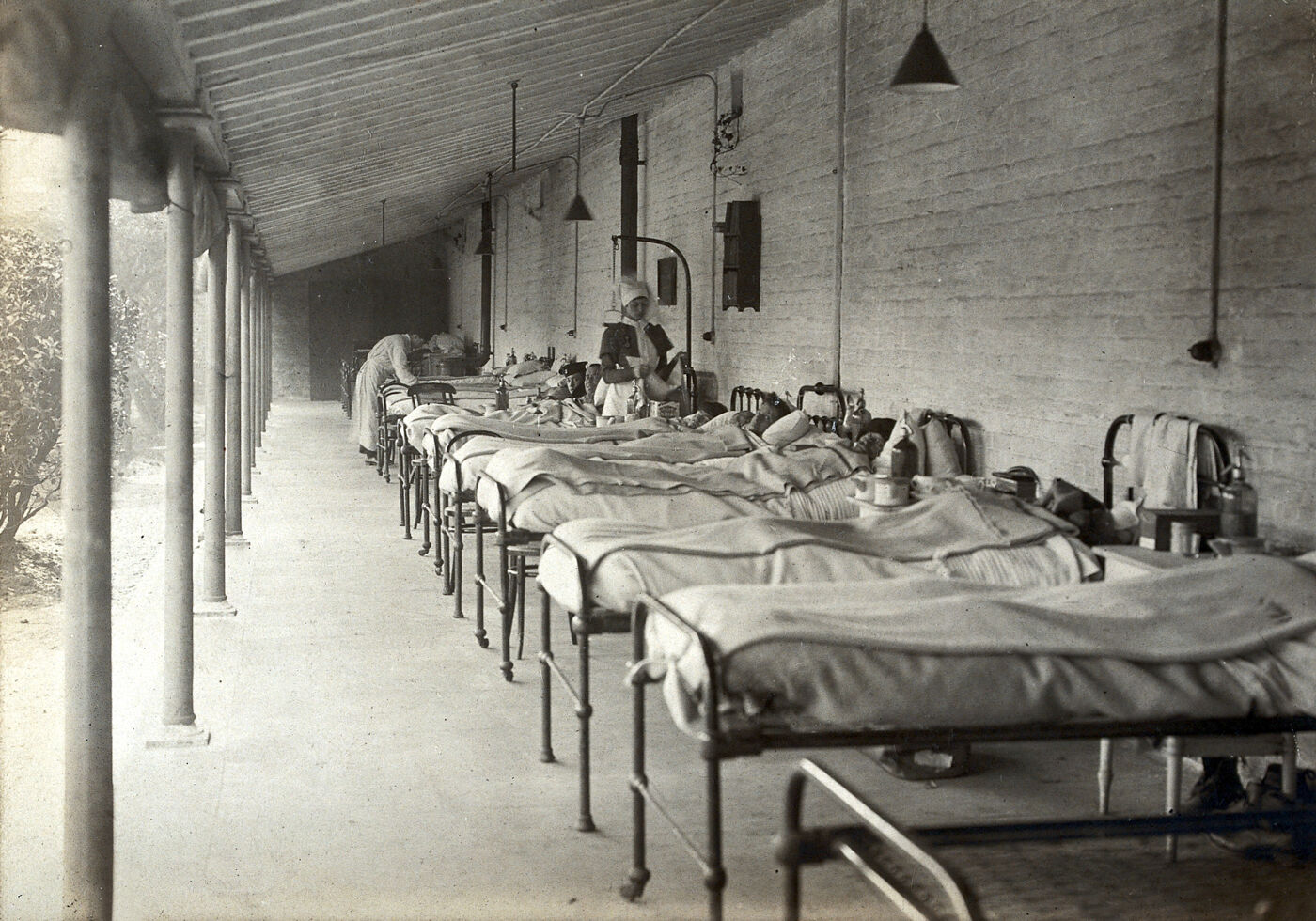
Image context: the cover image shows an open-air tuberculosis ward at the Royal Hospital, Haslar, photographed between 1914 and 1918. It is used here because the 1948 trial's control arm was not "nothing" but the sanatorium-era standard of bed rest, the older therapeutic world that streptomycin had to beat in public view.[5]
Timeline anchors before interpretation
- 1943: streptomycin was isolated at Rutgers, opening the possibility of a new anti-tuberculosis drug.[2]
- 1946: the UK's Medical Research Council began planning clinical trials while British supplies of streptomycin remained tightly limited.[2]
- 1947: the first pulmonary tuberculosis patients entered the MRC study.[2]
- 30 October 1948: the BMJ published the landmark report, Streptomycin Treatment of Pulmonary Tuberculosis: A Medical Research Council Investigation.[1][2]
- At 6 months: deaths were 4 of 55 in the streptomycin group and 15 of 52 in the bed-rest control group, but sputum cultures remained positive in 47 of 55 treated patients and 50 of 52 controls.[3]
- 1949 and after: resistance became the central warning, and combination chemotherapy with para-aminosalicylic acid (PAS) soon took on greater importance.[3][4]
1) The control arm tells you what problem the paper thought it was solving
The trial is easiest to misunderstand if it is read as a simple contest between miracle drug and therapeutic emptiness. That was not the design. Both groups received the accepted standard care for severe pulmonary tuberculosis at the time: prolonged bed rest in hospital or sanatorium conditions.[3] The real difference was whether streptomycin was layered onto that regime.
That detail matters because it restores the study's ethical logic. As John Crofton later recalled, Bradford Hill argued that, given pulmonary tuberculosis's uncertain natural course and the limited supply of the drug, it would be unethical not to find out what additional advantage streptomycin offered over bed rest alone.[3] In the paper's world, the control arm was a serious therapy, not a theatrical placebo.
The same scarcity shaped patient flow. There were more eligible patients than there were beds, and the control patients received priority for admission; if streptomycin later proved valuable, they could receive it when supplies improved.[3] That is a striking design choice. The study was not built on the premise that controls should wait outside the hospital. It was built on the premise that fairness and knowledge had to coexist inside a rationed system.
2) The paper's method bundle is more important than the mythology around "firsts"
Alan Yoshioka's history of the trial is useful here because it trims away later legend.[2] By the late twentieth century, the streptomycin paper had become shorthand for randomization itself, yet Yoshioka shows that the famous procedure was only one part of a broader method bundle: random sampling numbers, sealed envelopes, centralized coordination, and an editorial insistence that this was better than the older habit of taking alternate admissions as controls.[2]
Crofton's recollection adds the operational detail that made the design persuasive in practice. Progress was assessed with monthly chest X-rays read by three specialists who were blind to treatment allocation, while sputum smears and cultures were also reported by bacteriologists who remained blind to group assignment.[3] In other words, the paper did not rely on heroic clinician honesty alone. It built skepticism into the reading process.
This is one reason the trial still matters. The important move was not merely "patients were randomized." The important move was that allocation, observation, and interpretation were all organized so that a celebrated new drug had to survive contact with procedure.
3) What the six-month result really established
The strongest finding in the trial was not subtle. During the first six months after entry, 4 of 55 patients allocated to streptomycin died, compared with 15 of 52 allocated to bed rest alone.[3] Radiographic and clinical improvement also favored the streptomycin group.[1][3]
For a 1948 reader, that was more than enough to justify excitement. Pulmonary tuberculosis had finally met a drug that changed short-run outcomes in a controlled public comparison. The paper therefore deserves its canonical place.
But close reading requires staying with the paper after the dramatic number lands. The trial did not claim that streptomycin had solved pulmonary tuberculosis in one step. The short-run advantage sat inside a more complicated bacteriological picture, and the paper's long afterlife came from the fact that the authors refused to hide that complication.[1][3]
4) The paper's second message was harder and more important: survival benefit was not the same as cure
Crofton later described the discouraging part with unusual clarity. At six months, tubercle bacilli could still be cultured from the sputum of 47 of 55 streptomycin patients and 50 of 52 controls.[3] That gap was real, but it was not the kind of clean eradication story that the word "antibiotic" might tempt readers to imagine.
Worse, the treated patients' later deterioration tracked the emergence of streptomycin resistance, especially after the fourth month of treatment.[3] The MRC had initially intended to continue daily streptomycin for the full six months, then cut treatment short after four months because resistance and renewed decline were becoming too obvious to ignore.[3] The trial's public lesson was therefore double-edged: streptomycin worked, and streptomycin alone was not enough.
That second lesson is why the 1948 paper still reads like science rather than triumphalism. It did not turn a promising drug into a cure by rhetorical force. It forced clinicians to absorb an uncomfortable boundary. The control arm was weaker, but the treatment arm was still incomplete.
The 1949 resistance paper and the rapid turn toward combination therapy made that boundary even clearer.[4] Streptomycin opened the era of effective chemotherapy for tuberculosis, but the disease would not stay still long enough for monotherapy to remain credible.
5) Why this close reading still matters
The easiest way to flatten the streptomycin trial is to call it the first important randomized trial and stop there. That misses the part of the paper that still feels alive in modern evidence culture. The study did three demanding things at once.[1][2][3]
First, it treated standard care seriously enough to make the comparison meaningful. Second, it handled allocation and outcome reading with enough procedural discipline to slow bias down. Third, it reported a favorable treatment result without concealing the resistance problem that would soon force combination therapy.[2][3][4]
That is why the paper remains larger than a methods badge. It is a record of medicine learning that the right question was not "does the new drug look impressive?" The harder question was: under conditions of scarcity, uncertainty, and institutional pressure, what design can separate genuine advantage from professional hope, and what result is strong enough to change practice while still leaving room for a second correction? The 1948 streptomycin trial mattered because it answered both halves.
Sources
- Medical Research Council, Streptomycin Treatment of Pulmonary Tuberculosis: A Medical Research Council Investigation (British Medical Journal, 1948) — the original report published on 30 October 1948.
- Alan Yoshioka, "Use of randomisation in the Medical Research Council's clinical trial of streptomycin in pulmonary tuberculosis in the 1940s" (BMJ, 1998) — how random numbers, sealed envelopes, and later trial mythology fit together.
- John Crofton, "The MRC randomized trial of streptomycin and its legacy: a view from the clinical front line" (Journal of the Royal Society of Medicine, 2006) — design details, outcome numbers, and the early resistance problem from a participant's perspective.
- Medical Research Council, Streptomycin Resistance in Pulmonary Tuberculosis (British Medical Journal, 1949) — the follow-on resistance problem that quickly limited monotherapy.
- Wellcome Collection, "The Royal Hospital, Haslar, England: an open-air tuberculosis ward. Photograph, 1914/1918." — archival image used for the article cover.