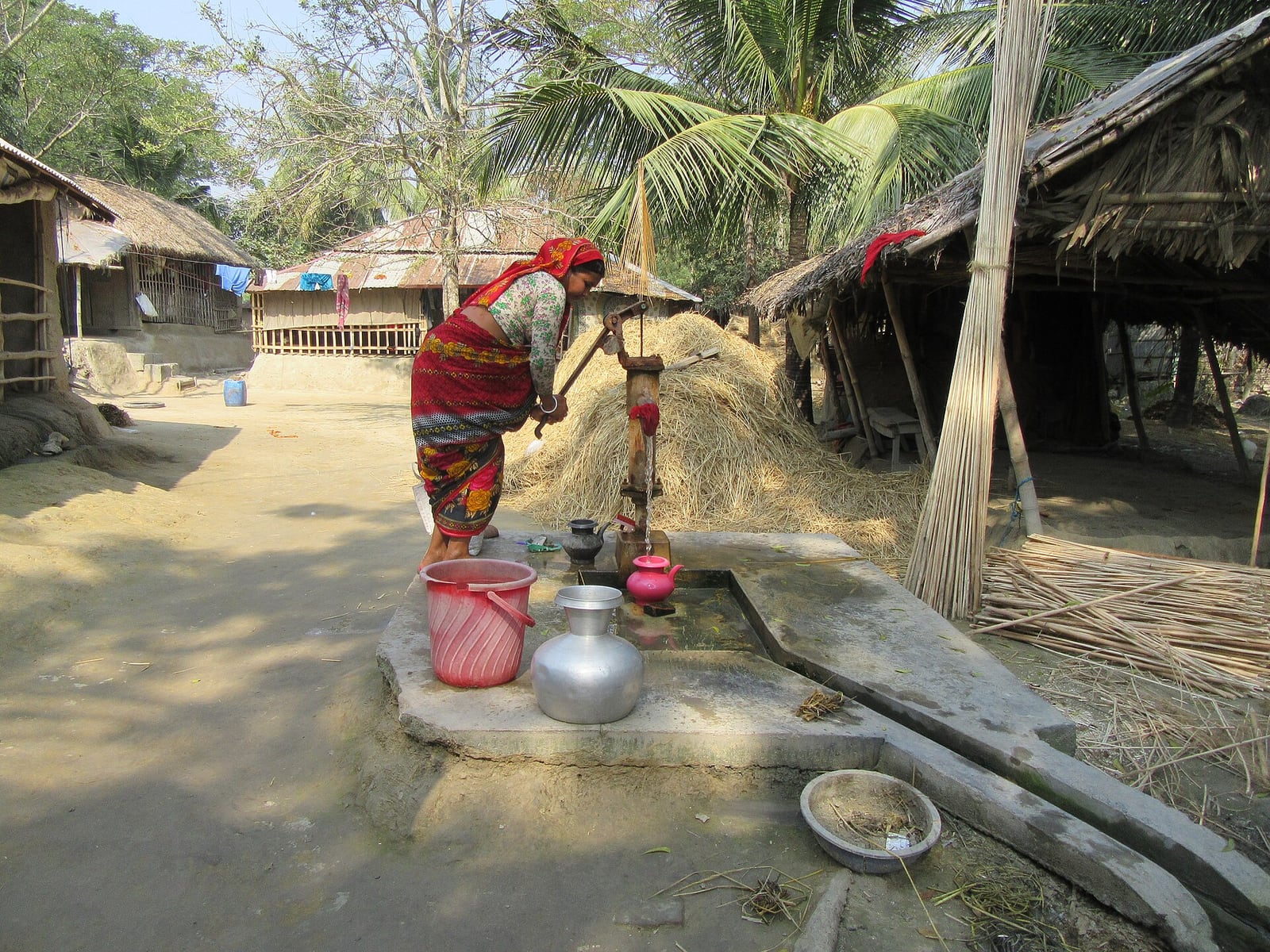
The pump in the photograph stands a few steps from a home. One person can work its iron handle and fill the metal vessels arranged beneath the spout. It is intimate infrastructure: a water source close enough to belong to a household routine rather than a distant utility.[9]
Nothing in the image reveals whether the water contains arsenic. The photograph's record makes no such claim.[9] Appearance could not settle the question anyway. Dissolved arsenic is invisible and tasteless; its injuries may take years to emerge. A source has to be tested before a red, green, or blue mark can turn chemistry into an instruction.[2]
That small distance—from pump to kitchen—is the beginning of a large historical contrast. In Antofagasta, Chile, a period of extreme arsenic exposure ran through a centralized municipal supply. In Bangladesh, the crisis appeared across millions of tubewells whose concentrations could differ sharply from one another. The contaminant was the same element. The unit of public-health control was not.
The comparison is therefore not a morality play in which Chile succeeded and Bangladesh failed. Antofagasta could intervene at a small number of shared points in one urban network. Rural Bangladesh had to discover, label, revisit, and replace a dispersed population of sources—while preserving the protection from microbial disease that groundwater had originally promised. Arsenic control depended on chemistry and measurement in both places. Only in one could the peak exposure be intercepted through a centralized utility intervention.
The same element entered two unlike landscapes
Both crises began in geology, not with a factory spill. Northern Chile's volcanic and geothermal setting can release arsenic into Andean waters. In the young floodplain sediments of the Ganges–Brahmaputra–Meghna basin, reducing groundwater conditions can free naturally occurring arsenic from sediment into shallow aquifers. Drilling a well did not manufacture the element; it connected daily water use to a hazard already held underground.[2]
The health clock is slow enough to disguise that connection. Long-term exposure to inorganic arsenic is associated with skin lesions and cancers of the skin, lung, and bladder, as well as cardiovascular and developmental harms. WHO's provisional drinking-water guideline is 10 micrograms per litre, while Bangladesh has long used a national standard of 50 micrograms per litre. The difference matters whenever a source is called “safe”: the word can mean below a national intervention threshold, not the absence of risk.[1][2]
The two landscapes then converted geology into exposure in opposite ways. Antofagasta's desert geography concentrated residents onto a few public supplies. Bangladesh's watery delta encouraged a distributed solution: relatively cheap tubewells placed close to homes. One network made a population's exposure unusually uniform and historically legible. The other made exposure intensely local.
Antofagasta: one supply drew a sharp exposure curve
In 1958, Antofagasta began receiving Andean river water with high natural arsenic. The average concentration in the city's supply rose from about 90 micrograms per litre before that change to roughly 860 micrograms per litre during 1958–1970. More than 250,000 people were eventually exposed to the high-concentration supply. Few alternative sources existed in the Atacama Desert, so residence in the city became a strong proxy for what water a person drank.[3]
That was a public-health disaster, but it also defined the intervention point. The city did not need every family to identify an unsafe backyard source and negotiate access to a safer neighbor's. It needed to change the water before the municipal network divided it among households.
The first Salar del Carmen arsenic-removal plant began operating in 1970. Its treatment train made dissolved arsenic removable in stages: adjust the water's pH, oxidize arsenite into a form that binds more readily, add ferric chloride so arsenic adsorbs onto iron-rich flocs, allow those particles to settle, and filter what remains. Later plants and upgrades continued the reduction. Historical supply records used by epidemiologists show Antofagasta's average falling to about 110 micrograms per litre in the 1970s, then 70, then 40, and eventually about 10.[3][4]
The important word is operating. A plant does not erase arsenic merely by existing. Chemicals must be dosed, flocs kept intact, filters run within limits, residuals managed, and finished water measured. Centralization made those obligations easier to locate; it did not make them disappear.[4]
Nor did the falling concentration close the health story. A population-based study conducted in northern Chile from 2007 to 2010 included 232 lung-cancer cases, 306 bladder-cancer cases, and 640 matched controls. Among people highly exposed in Antofagasta during 1958–1970 but not highly exposed afterward, the reported odds ratio was 4.35 for lung cancer (95% confidence interval, 2.57–7.36) and 6.88 for bladder cancer (3.84–12.32), compared with the study's reference group.[3]
Those are observational estimates, not a prediction for an individual, and they do not turn every later cancer into an arsenic case. They do establish the central temporal lesson: ending peak exposure and ending harm are different dates. Antofagasta's network produced a comparatively abrupt exposure curve; biology carried part of that curve forward for decades.
Bangladesh: a safe-water revolution found a hidden hazard
Bangladesh's tubewells entered public-health history for a different reason. Surface water could carry the organisms responsible for diarrhoeal disease. From the 1970s onward, government agencies, international organizations, and households expanded access to groundwater through hand-pumped wells. The water looked clear, the pump reduced the distance to a source, and the protected bore appeared to separate drinking water from contaminated ponds and rivers.[5]
Routine testing had not been designed around arsenic. Widespread contamination became clear only in the 1990s, after millions of people had already reorganized daily life around groundwater. The apparent solution to one exposure pathway had uncovered another: a slow chemical hazard inside infrastructure built to avoid fast microbial hazards.[2][5]
Scale alone does not explain the difficulty. Spatial variation does. A high-arsenic shallow well can stand near a lower-arsenic one because subsurface age, depth, sediment, and water chemistry change across short distances. A district map can identify a risk zone, but it cannot certify the pump beside a particular courtyard. Every working source is a measurement problem.[2][8]
Bangladesh's response converted those measurements into a public language. A national campaign tested about five million tubewells from 1999 through 2003 with field kits, at no charge to households. Pumps above the national 50-microgram threshold were commonly marked red; those at or below it were marked green. The mark compressed an invisible laboratory problem into a visible choice: do not drink here; collect drinking water there.[6]
That was not merely awareness work. It changed the effective network. A household with an unsafe well could switch to a nearby lower-arsenic source, turning privately installed pumps into a shared, improvised supply system. Where a suitable shallow source was unavailable, deep community wells, treated surface water, rainwater, piped systems, or arsenic-removal devices could provide alternatives. In practice, the UNICEF–WHO review found that well switching and deep boreholes—not household filters alone—had delivered much of Bangladesh's successful mitigation.[2]
A painted pump is a control point with a memory
Well switching can produce a large exposure reduction quickly because it works with infrastructure already in the ground. It also reveals why Bangladesh's control problem does not end after one national sweep.
First, a field test is a classification under uncertainty. A 2021 analysis combined laboratory measurements from 6,595 wells across 25 square kilometres in Araihazar with 943 paired field-kit and laboratory results. In modeled switching scenarios, kit-based information still reduced average exposure substantially, even though laboratory results were far more precise. The practical comparison was not “perfect measurement or careless measurement.” It was how much additional exposure reduction that precision produced when weighed against the cost and delay of generating millions of laboratory results. In the model, the incremental exposure-reduction benefit was modest, which is why the authors treated workable field kits as a population-scale tool rather than a substitute for laboratory measurement.[8]
Second, the source population changes. New private wells are installed after survey teams leave. Paint weathers away. A family may move, a safe-well owner may restrict access, or the walk may become too burdensome. The infrastructure has no central control room that automatically notices those changes.
A 2005 survey of 4,109 households in 76 Araihazar villages shows the leak in the information chain. Two years after blanket testing, 27% of households using unsafe wells had switched; 21% of all surveyed households did not know their well's status, and 21% of households that left an unsafe well had moved to an untested one. Most unknown-status wells had been installed after the earlier campaign.[7]
Another longitudinal study found that warnings could remain influential: by 2008, additional switching had doubled the share of initially exposed households who had moved away from unsafe wells. Yet 22% no longer recalled the test result. Information did not simply vanish on the day paint faded, but neither did it become permanent infrastructure.[6]
The most durable lesson is not that field kits failed. It is that testing is a service, not a ceremony. The relevant loop is install → test → communicate → provide a usable alternative → retest or replace. Break the loop at any point and “safe water” can become an old label attached to a new reality.
Central treatment and well switching solve different parts of the same problem
Antofagasta and Bangladesh are sometimes tempting endpoints for a simple verdict: build a plant, not a patchwork. That conclusion ignores why the patchwork existed. A centralized plant needs an intake, a distribution network, continuous operation, skilled staff, finance, and surveillance. Those assets were already unusually concentrated in Antofagasta. They could not be summoned instantly across rural Bangladesh by proving that ferric coagulation works.
The reverse simplification is just as weak. Well switching is not automatically inferior because it relies on behavior. When safe wells are nearby, clearly marked, socially shareable, and regularly tested, switching can reduce exposure faster than waiting for universal pipes. The better intervention is the one that matches local hydrogeology and can keep delivering microbiologically safe, low-arsenic water after the project team leaves.[1][2]
That microbial qualification is essential. Sending a household away from an arsenic-contaminated well toward an unprotected surface source can exchange a delayed chemical risk for an acute infectious one. The UNICEF–WHO primer calls this risk substitution. A source is not made safe merely by solving the contaminant currently receiving attention.[2]
The two histories therefore converge on operations, even though their hardware differs. Antofagasta needed treatment performance at a utility scale and health follow-up long after peak exposure stopped. Bangladesh needed measurement, memory, access, and new safe supplies at the scale of individual pumps. Both needed surveillance that could detect when the engineered promise and the delivered water separated.
The contrast changes what it means to “remove arsenic.” In a centralized city, it can mean intercepting water once before distribution and maintaining that barrier. In a dispersed well landscape, it can mean removing unsafe sources from the drinking network—socially as much as physically—then rebuilding the decision every time a well, label, or household changes.
Antofagasta could bend its exposure curve at one treatment works. Bangladesh had to bend millions of small routes between a handle and a cup. The chemistry explains how arsenic leaves water. The shape of the water system explains why one success could happen at a plant, while the other has to keep happening at the pump.
Sources
- World Health Organization, “Arsenic” (fact sheet, 7 December 2022) — health effects, the 10-microgram provisional guideline, and the range of source-substitution, testing, and treatment controls.
- UNICEF and World Health Organization, Arsenic Primer: Guidance on the Investigation and Mitigation of Arsenic Contamination (2018) — geology, thresholds, testing and marking, well switching, deep boreholes, operational monitoring, and microbial-risk substitution.
- Craig M. Steinmaus et al., “Drinking Water Arsenic in Northern Chile: High Cancer Risks 40 Years after Exposure Cessation,” Cancer Epidemiology, Biomarkers & Prevention 22 (2013) — Antofagasta's exposure record, centralized-supply contrast, study design, and long-latency lung- and bladder-cancer estimates.
- Barbara Ruffino et al., “Drinking Water Supply in the Region of Antofagasta (Chile): A Challenge between Past, Present and Future,” International Journal of Environmental Research and Public Health 19 (2022) — regional water history and the operating sequence of the arsenic-removal plants.
- Allan H. Smith, Elena O. Lingas, and Mahfuzar Rahman, “Contamination of Drinking-Water by Arsenic in Bangladesh: A Public Health Emergency,” Bulletin of the World Health Organization 78 (2000) — tubewell expansion, recognition of widespread contamination, exposure scale, and early response context.
- Soumya Balasubramanya et al., “Evolution of Households' Responses to the Groundwater Arsenic Crisis in Bangladesh,” Environment and Development Economics 19 (2014) — the 1999–2003 national testing campaign and the persistence and loss of well-status knowledge.
- Alexander Pfaff et al., “Reduction in Exposure to Arsenic from Drinking Well-Water in Bangladesh Limited by Insufficient Testing and Awareness,” Journal of Water, Sanitation and Hygiene for Development 7 (2017) — household switching, unknown-status wells, and the need for repeated testing.
- Yusuf Jameel et al., “Well-Switching to Reduce Arsenic Exposure in Bangladesh: Making the Most of Inaccurate Field Kit Measurements,” GeoHealth 5 (2021) — well-level variation, field-kit performance, and modeled exposure reductions.
- Sonia Hoque/REACH, “Woman Pumps Water from a Shallow Tubewell” (Sahas Union, Khulna District, Bangladesh, 25 January 2017; Wikimedia Commons) — source record for the article's documentary photograph.