Two people were meant to share a bedroom barely four square metres in size. At St. Jørgen's Hospital in Bergen, the sleeping chambers opened onto communal halls; the little space inside had to accommodate two beds. Later, as the number of residents fell, a room of one's own became possible.[1]
Preservation keeps the walls in view while occupancy and expectations of privacy change. The museum's own documentation makes that difference visible.
The hospital's last two residents died in 1946. The museum opened in 1970. Today's buildings largely belong to the eighteenth century, rebuilt after the fire of 1702; they preserve a much longer institutional history without being medieval survivals.[2] What should a visitor remember here: the disease, the institution or the people who made a life within it?
The rooms contain more than one period
The furnished bedrooms are especially persuasive because beds, cloth and a small table make an unfamiliar institution look domestic. But the museum explains that two rooms have been arranged to suggest how they might once have looked. Textiles and other objects were borrowed from Old Bergen Museum; personal belongings from the last residents had not remained.[1]
The display conveys domestic life without identifying any final resident's possessions. Its value depends on keeping that distinction visible.
Even the shared hall has changed. Before a separate workroom was established in the 1870s, residents able to work made goods in the main ward, which also served for meals. Fishing nets, clogs, buckets, spinning and sewing belonged to this space. A large roof window arrived only in the 1880s. The room seen by visitors therefore has a history of alterations, as well as a history of care.[3]
The museum's account makes it possible to read the hall as a place of activity: people eating near work in progress, handling materials and sharing limited space. Its present quiet cannot supply the sounds of those tasks. Preserving the building gives them a location; written evidence gives the location something to do.
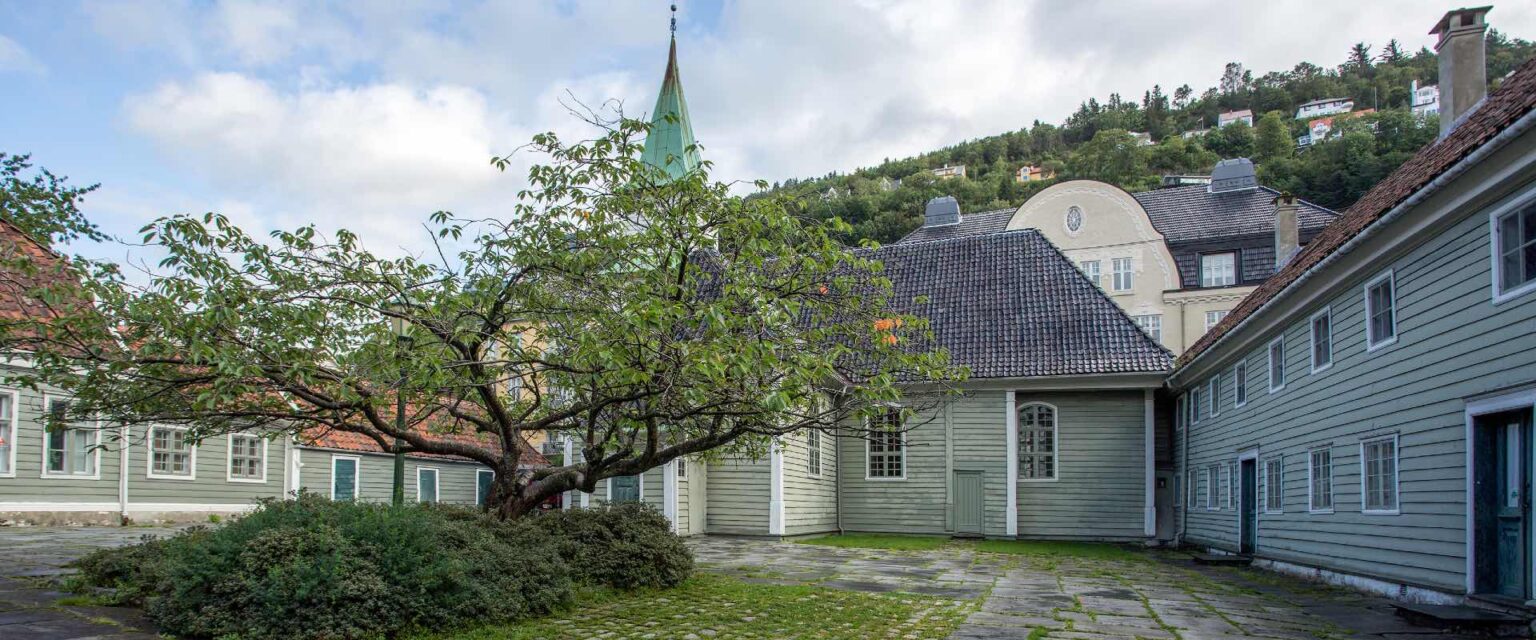
The courtyard opened onto a city
A former leprosy hospital can invite an immediate assumption of complete exclusion. St. Jørgen's had a more changeable relationship with Bergen. Seventeenth-century statutes restricted residents from leaving, but in the eighteenth and nineteenth centuries they could go into town, subject to rules about the hour and the weather. They sold things they had made, including small household utensils. In 1891, residents were forbidden to sell goods in the marketplace.[4]
These details make the courtyard a threshold with a history. It connected residents to customers, purchases and city streets, even as permission could narrow. The market ban also warns against treating any one period's freedom as a permanent feature of the institution.
Remembering that traffic gives residents occupations beyond being patients. Someone making a ladle had a skill, materials to work with and a buyer to find. Those relationships belong in the hospital's history alongside diagnosis and admission.
A resident supplied his own account
Peder Olsen Feidie entered St. Jørgen's in 1832 and died there in 1849. During those seventeen years he wrote four laments that were printed in Bergen. The first, from 1835, survives as a rare resident's account of the hospital.[5]
In the museum's presentation, the song moves from youth and family separation to suffering inside the institution. Feidie describes his failing sight and the distress he hears as he walks through the building. He also acknowledges gifts from strangers and thanks the authorities for providing care. Christian belief gives the poem its language of endurance and hoped-for release.[5]
His lament holds gratitude and anguish together. Reading it beside the rooms prevents a tidy interpretation in which shelter cancels suffering, or suffering erases every experience of help. It is one person's shaped, religious account, valuable precisely because it has an author and a perspective.
Remembering beyond the building
St. Jørgen's records are dispersed among archives and library collections. Admissions, correspondence and accounts preserve different traces of residents and the institution. Much older material was lost, probably in fires; most surviving documents date from 1702 onward, and gaps remain within the later records too.[6]
An admission entry can establish arrival. An account can reveal what the institution paid for. Neither automatically supplies a person's feelings about living there. Read beside Feidie's lament and the physical rooms, these records allow several kinds of evidence to correct and enlarge one another. The gaps matter because they set limits on the lives a museum can reconstruct.
The wider Leprosy Archives of Bergen entered UNESCO's Memory of the World register in 2001. They include records from several hospitals and the chief medical officer, extending remembrance beyond famous discoveries to administration, finances and daily life.[7] A museum visitor sees only part of this surviving record.
Present-day medicine belongs beside that history. WHO describes leprosy as curable with multidrug therapy and says it is not transmitted through ordinary casual contact such as shaking hands or sharing meals.[8] An evocative old hospital should leave visitors better informed about the disease, rather than carrying its historical fear into the present.
St. Jørgen's offers rooms, records and a resident's voice. Keeping the differences between them visible makes remembrance more precise: a reconstructed interior can suggest a household, an archive can document its arrangements, and a poem can tell us what one person wanted others to hear.
Sources
- Leprosy Museum, Bergen City Museum, “Bedchambers at St. Jørgen's Hospital” — room size, changing occupancy and reconstructed furnishings.
- Bymuseet i Bergen, “Guide til Lepramuseet St. Jørgens Hospital” — building history, final residents, museum opening and source of the courtyard photograph; in Norwegian.
- Leprosy Museum, “The main ward at St. Jørgen's Hospital” — communal work, lighting and alterations to the hall.
- Leprosy Museum, “The residents of St. Jørgen's and the city of Bergen” — movement, trade, restrictions and the 1891 marketplace ban.
- Leprosy Museum, “Peder Olsen Feidie's lament from 1835” — biographical context, interpretation and translated selections from a resident's published song.
- Leprosy Museum, “Archive material for St. Jørgen's Hospital” — surviving records, institutional custody and gaps.
- Leprosy Museum, “The archives” — the Bergen collections, their scope and 2001 UNESCO inscription.
- World Health Organization, “Leprosy” — current overview of treatment and transmission.