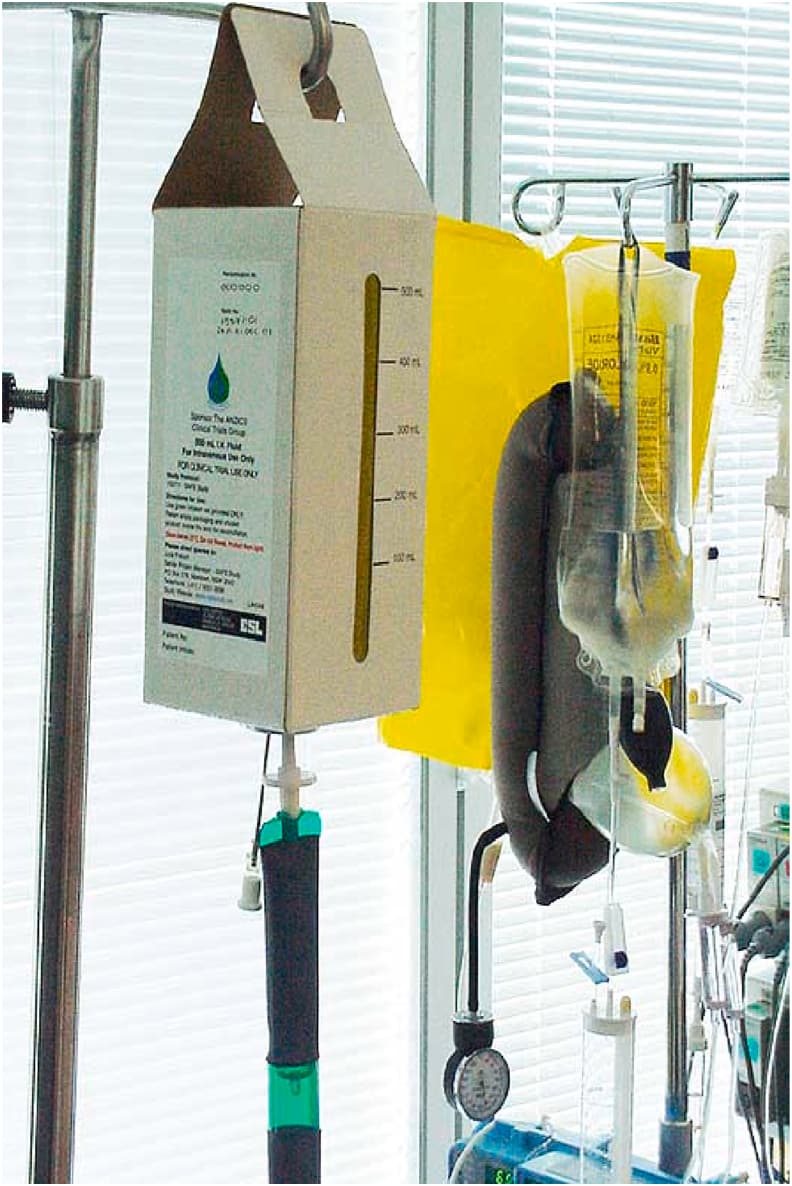
The cardboard carton hanging from the infusion pole has a narrow yellow window. Staff can see how much fluid remains, but the packaging conceals which fluid it is. Below it, sleeves cover parts of a green infusion set. These are the practical details that made the Saline versus Albumin Fluid Evaluation study, or SAFE, possible: albumin's colour and tendency to froth could otherwise have revealed the treatment assignment.[1]
The result published on May 27, 2004 looked reassuringly uneventful. Among almost 7,000 critically ill adults, deaths were nearly equal in the two treatment groups. Yet the subsequent investigation of patients with traumatic brain injury would make the same experiment a warning about the limits of an average.[2][5]
The question behind the carton
In July 1998, the Cochrane Injuries Group Albumin Reviewers had reported a disturbing synthesis of small trials. Across studies involving patients with reduced circulating blood volume, burns or low blood albumin, the pooled absolute difference suggested six additional deaths per 100 patients given albumin, with a 95% confidence interval of three to nine. The review included 30 randomized trials and 1,419 participants.[3]
That was a safety signal requiring an answer. It was also a pooled estimate from several clinical settings, rather than a direct observation that every use of albumin carried the same penalty. The review's authors called for rigorous randomized trials.[3]
SAFE's investigators built a large comparison around an everyday ICU decision: a clinician judged that a patient needed fluid to restore circulating volume. Participants would receive albumin or saline for resuscitation. The study deliberately used broad eligibility criteria, though it excluded patients admitted after cardiac surgery or liver transplantation, and those admitted for burns.[4]
The masking equipment mattered because treatment expectations can affect care. The investigators' later account describes a manufacturing problem as well as a clinical one: ordinary saline and albumin came in different containers. CSL had to manufacture saline for the study so the packaging could match. Concealment extended all the way down to the infusion chambers.[1]
What the main result actually measured
SAFE compared 4% albumin with 0.9% saline, using death from any cause within 28 days as its primary outcome. There were 726 deaths with albumin and 729 with saline. The relative risk was 0.99, with a 95% confidence interval of 0.91–1.09.[2]
The estimate sat close to no difference. Its uncertainty still allowed a modest relative benefit or harm; it did not establish that the fluids had identical effects. The reassuring finding concerned these treatments, this population and this follow-up period. SAFE also found no significant differences in several secondary outcomes, including time receiving mechanical ventilation or kidney replacement therapy.[2]
In their September 2004 account, investigators emphasized both the trial's broad usefulness and the need for caution about subgroup results. Trauma was a predefined grouping. Within it, the suggestion of harm with albumin appeared concentrated among people with brain injury. The authors explicitly acknowledged that subgroup differences can arise by chance.[4]
Two readings therefore had to remain in view: the overall comparison was reassuring, while a smaller group raised a serious question. Selecting whichever result fitted an existing preference would have discarded part of the evidence.
Following the patients behind the signal
The follow-up published on August 30, 2007 examined 460 SAFE participants with traumatic brain injury. Researchers reviewed clinical records and brain scans and assessed survival and neurological outcomes two years after randomization.[5]
Among patients with available mortality outcomes, 71 of 214 albumin recipients had died, compared with 42 of 206 saline recipients: 33.2% versus 20.4%. The relative risk was 1.63, with a 95% confidence interval of 1.17–2.26. Baseline characteristics and measures of injury severity were similar.[5]
This was a post hoc follow-up of a subgroup from the original randomized trial. It did not constitute a second, independently randomized experiment, and two-year outcomes were unavailable for some participants. Those limitations matter. So does the size and direction of the observed difference.[5]
The follow-up strengthened the reason to take the brain-injury signal seriously. It left the overall SAFE calculation intact while showing why that calculation was insufficient for this narrower clinical question. An average across many diagnoses cannot guarantee the same treatment effect within each one.
A plausible mechanism, with unfinished edges
In 2013, investigators returned to the records of 321 SAFE patients with brain injury who had intracranial-pressure monitoring. They found evidence linking albumin to rising pressure during the first week, particularly among patients whose monitoring ended during that week.[6]
Interpreting those records required care. Monitoring could stop because someone improved, because equipment failed, or because the patient died. Comparing only the readings still available later could therefore mislead. The investigators modelled patterns according to when monitoring ceased.[6]
Higher pressure offered a plausible explanation for worse outcomes, but it did not settle why pressure rose. The authors discussed albumin escaping across an injured blood–brain barrier and the relatively hypotonic formulation used in SAFE. They cautioned that the analysis could not establish the full causal pathway.[6]
That distinction is the lasting value of reading the papers together. The original trial estimated an overall treatment effect. The follow-up examined a clinically important exception. The pressure analysis investigated an explanation. Each answered a different question, and confidence in one answer did not require pretending the others were complete.
Sources
- Simon R. Finfer, Naomi E. Hammond and John A. Myburgh, “Science-based fluid therapy in the intensive care unit: Professor Rinaldo Bellomo's legacy,” Critical Care and Resuscitation (2025) — investigators' account of fluid blinding and Figure 1, the SAFE equipment photograph.
- The SAFE Study Investigators, “A Comparison of Albumin and Saline for Fluid Resuscitation in the Intensive Care Unit,” NEJM (May 27, 2004) — original trial report, hosted by Queen's University.
- Cochrane Injuries Group Albumin Reviewers, “Human albumin administration in critically ill patients: systematic review of randomised controlled trials,” BMJ (July 25, 1998) — pooled mortality findings and call for further trials.
- Simon R. Finfer, Neil W. Boyce and Robyn N. Norton, “The SAFE Study: a landmark trial of the safety of albumin in intensive care,” Medical Journal of Australia (September 6, 2004) — eligibility, predefined subgroups and caution about subgroup interpretation.
- The SAFE Study Investigators and colleagues, “Saline or albumin for fluid resuscitation in patients with traumatic brain injury,” NEJM (August 30, 2007) — post hoc follow-up, available outcome denominators and two-year mortality.
- D. James Cooper and colleagues, “Albumin Resuscitation for Traumatic Brain Injury: Is Intracranial Hypertension the Cause of Increased Mortality?” Journal of Neurotrauma (April 1, 2013) — pressure-monitoring analysis, missing-data problem and mechanistic limitations.