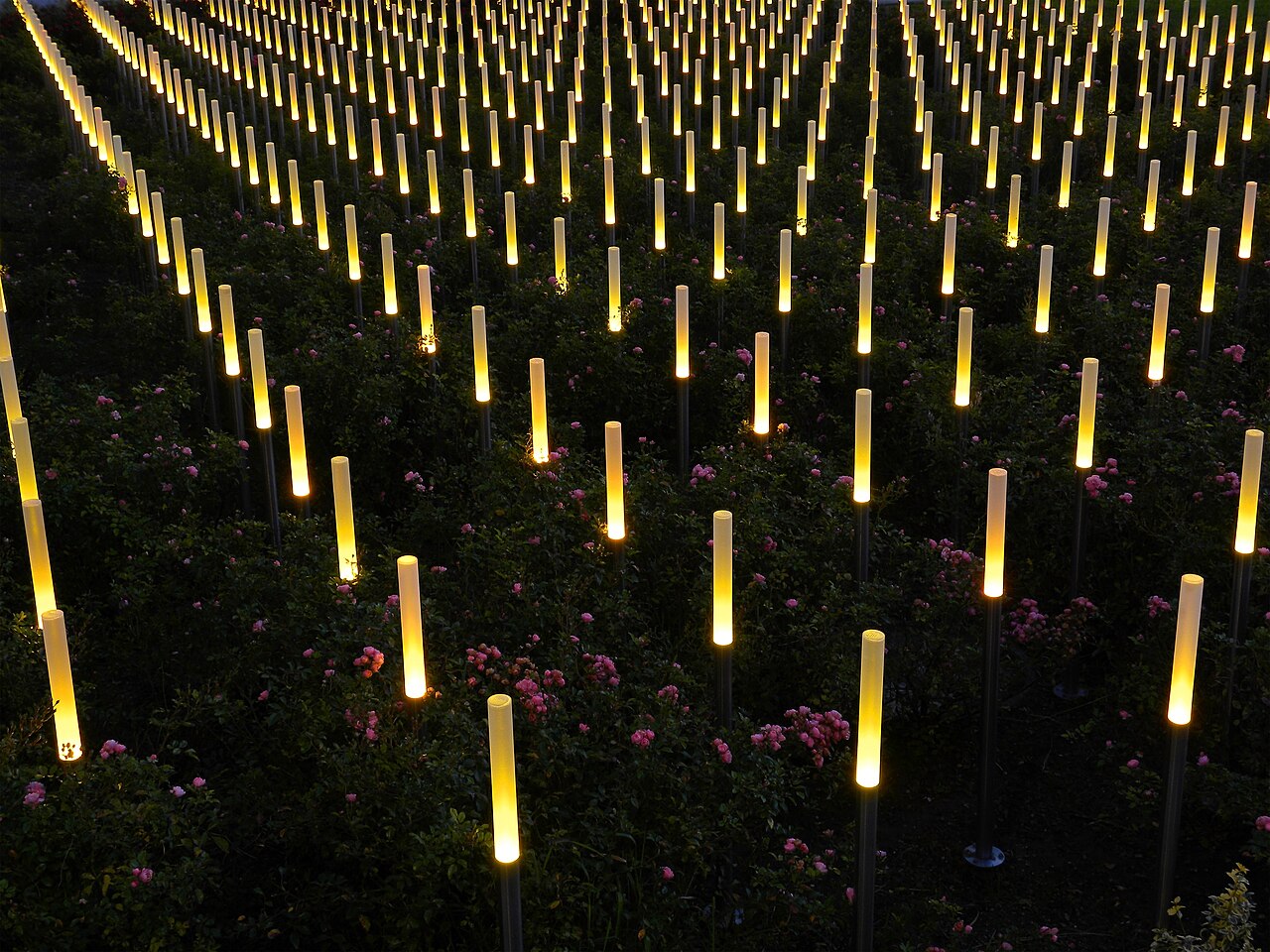
At dusk, hundreds of narrow lights switch on among the roses outside an Art Nouveau theater on the grounds of Vienna's former Otto Wagner Hospital. They do not form a heroic statue. They stand in a rigid grid, close enough to read as a system and separate enough to remain individual. The Austrian National Fund describes 772 light stelae, each assigned to a child or adolescent murdered at the Nazi institution called Am Spiegelgrund between 1940 and 1945.[4]
The beauty of the lights is almost a trap. They can make remembrance look complete: one light, one life, one finished memorial. The record says otherwise. The Steinhof memorial site's Book of the Dead reconstructs 789 names from the clinic's death register.[2] Human remains were ceremonially buried in 2002, further material was buried in 2012, and newly identified tissue samples led to another burial in 2025.[3][7][8] The physical memorial has stayed in place while the evidentiary work has kept moving.
That is why Spiegelgrund belongs in health memory, not only in the history of Nazism. The central question is not whether medicine should condemn murder committed under medical authority; that answer is obvious. The harder question is what a hospital, university, archive, and profession owe after patients have been converted into records, slides, specimens, and publications. Spiegelgrund's memorial offers a severe answer: stop the research, but do not stop there. Recover names. Audit collections. Return remains. Preserve survivor testimony. State what is still uncertain.
The clinic made killing look like a medical process
Am Spiegelgrund opened on the Steinhof hospital grounds in July 1940. It belonged to a wider Nazi system in which physicians and midwives were ordered to report children labeled with intellectual disabilities, congenital conditions, or other traits that racial-hygiene policy marked as undesirable. Children were sent to so-called special wards, examined, and reported onward for killing decisions.[1]
At Spiegelgrund, that bureaucracy ended in a clinic room. The memorial exhibition documents physicians administering high doses of sedatives until selected children died from pneumonia or other infections; it also records lethal tuberculosis-vaccine experiments. Between August 25, 1940, and June 3, 1945, at least 789 children and young people died there.[1] The death register recorded them while incomplete entries and false clinical explanations obscured how they died.[2][3]
Medicine was not merely decorative language placed over an independently operating killing machine. Medical categories selected the children. Medical examinations produced files. Medical authority made confinement appear therapeutic. After death, dissection and preservation turned bodies into material for future investigation.[1][3] The same system could therefore erase a child twice: first by treating disability or social difference as a reason to kill, then by treating the remains as useful evidence detached from the person.
The Book of the Dead exposes that contradiction. A register built inside the institution that concealed killing later made it possible to reconstruct names, dates of birth, admission, and death. Since 2002, the book itself has been held by the Vienna City and State Archive.[2] The document is not innocent, but neither is it useless. Read against the purpose for which it was made, an administrative instrument becomes a route back toward identity.
The specimens survived the regime
The children's clinic was dissolved in May 1945, but the medical afterlife of the victims did not end with the war. The Steinhof chronology records that physician Heinrich Gross began examining preserved brain specimens in 1953 and used them as the basis for publications over roughly 25 years.[10] Paul Weindling's study of the collection places this practice inside a larger postwar pattern: institutes could disavow Nazi ideology while continuing to hold and study body parts obtained through Nazi persecution.[3]
That continuity matters more than a simple story about one compromised doctor. A specimen can look politically neutral once its provenance is pushed out of view. The label names a tissue type or pathology; the paper discusses a neurological finding; the storage cabinet makes continued possession feel routine. Each step increases the distance between scientific use and the violence that made the material available.
Weindling argues that anonymization deepened the problem. When victims of medical murder remained unnamed, researchers could discuss responsible science in general while avoiding individual biographies, institutional connections, and possible evidence about selection for death.[3] At Spiegelgrund, recovering a name did not merely add sentiment to an ethical debate. It reopened factual questions: who the child was, why the child entered the institution, what was done before death, who retained the tissue, and what research followed.
This is the sharp boundary the memorial asks medicine to keep. A tissue section may carry information, but it never ceases to be part of a person merely because a catalog describes it efficiently. Provenance is not an optional historical note attached after the science. In a collection formed through coercion and murder, provenance determines whether possession and use can be ethically understood at all.
Burial changed the grammar of the collection
On April 28, 2002, preserved remains from Spiegelgrund were interred in an honorary grave at Vienna Central Cemetery.[10] The Steinhof memorial site opened that May alongside the burial; its exhibition was redesigned as a permanent installation in 2008.[5] These acts changed the public grammar of the material. What had sat in scientific custody as preparations or specimens was received at a cemetery as human remains belonging to victims.
The light memorial followed in 2003. Its concept came from a school ideas competition in Vienna's 14th district. Student Tanja Walter proposed a separate sign for every murdered child; after discussion with victims' representatives, relatives, and elected officials, architect Peter Schwager designed and implemented the field of 772 stelae.[4] The installation's power comes from repetition without merger. The lights form a collective field, but no single beam can stand in for all the others.
There is an unresolved numerical boundary here. The official description of the light memorial gives 772 stelae, while the Book of the Dead says 789 victims' names were reconstructed.[2][4] The cited institutional sources do not explain the difference. It would be tempting to turn the gap into a neat metaphor about missing children or changing research, but that would manufacture certainty where the record supplied here does not. The responsible move is to retain both attributed counts and keep the reason open.
That restraint is part of commemoration too. A memorial should make lives visible without pretending that every archival problem has been solved. It should be stable enough to hold public attention and porous enough to admit corrections.
Survivor testimony prevents the dead from becoming the whole story
Spiegelgrund was a killing center, but not every child sent through its wards was killed there. Treating the site only as a cemetery can eclipse the people who survived its violence and then lived through the institutional continuities that followed 1945.
In 2012, the Steinhof exhibition added interviews with survivors of Spiegelgrund and other Viennese welfare institutions.[5] The project preserves accounts from 12 people, drawn from 45 hours of recording, and places excerpts and transcripts in the exhibition and online.[6] Their histories describe hunger, punishment, confinement, experimentation, and the persistence of staff and institutional attitudes after the regime collapsed.[6]
These voices do something the light field cannot. The memorial represents extinguished lives; testimony records people who remained capable of describing what the institution did and how its categories followed them. It also corrects a passive picture of later remembrance. Survivors such as Friedrich Zawrel and Alois Kaufmann worked publicly to expose the crimes and the postwar careers built around them.[6] Commemoration was not simply granted by an enlightened institution. It was pressed into being by evidence, testimony, scholarship, and demands for recognition.
That distinction changes who is allowed to narrate medical wrongdoing. If only hospitals and universities explain their own past, repair can become another institutional performance. Survivor testimony makes the archive answerable to lived experience, including facts that a diagnosis, death certificate, or specimen label was designed not to preserve.
A memorial must also be an inventory
The most unsettling measure of Spiegelgrund's unfinished work arrived after the memorial and the first burial. In May 2025, the Medical University of Vienna announced that complete digital indexing of a historical neuropathology collection had identified microscopic sections and paraffin-embedded tissue from nine children. Six had died at Spiegelgrund; three had been murdered at the Görden institution in Brandenburg, and their material had reached Vienna through a postwar scientific collaboration.[7]
The university did not present the discovery as new victims found outside the historical record. Austria's culture ministry later said the remains could be assigned to already known and previously buried victims. After a small private burial, a public commemoration was held at Vienna Central Cemetery on December 1, 2025.[8] The ministry also recorded that material found at both the Medical University and the Natural History Museum had required coordinated provenance work.[8]
That sequence changes the meaning of a memorial from noun to method. A monument says: remember what happened here. An inventory asks: what from that violence is still here, in which box, under whose authority, connected to which name? One cannot substitute for the other. The lights provide a public place for memory; the catalog audit tests whether the institutions around that place have finished relinquishing possession.
Nor does burial erase the research history. A dignified interment can return remains to a human and social order, but the papers, collection transfers, funding paths, and professional careers still require study. Otherwise, the specimen leaves the cabinet while the system that normalized its use remains undescribed.
What medicine owes the people inside its evidence
Spiegelgrund's memorial does not offer a universal checklist for every historical collection. It does establish a demanding sequence.
First, institutions must identify provenance rather than wait for scandal to expose it. Digital indexing in 2025 found material more than eight decades after the killings; that is evidence that collection review must be active and repeatable, not assumed complete after one ceremony.[7][8]
Second, identification should move toward people, not only cleaner catalog entries. The Book of the Dead, burial records, survivor interviews, and light stelae perform different tasks, but all resist the reduction of a life to diagnosis or tissue.[2][4][6][8] Privacy and family wishes still matter. So does stating a boundary when records do not support a confident answer.
Third, commemoration must leave institutions open to correction. The unexplained difference between the memorial's count and the reconstructed death register should remain visible. The later discoveries of retained tissue should remain inside the story of the 2002 burial, not be treated as an embarrassing appendix. A truthful memorial is not weakened when new evidence changes its account. It proves its purpose by making revision possible.
At dusk, the lights at Spiegelgrund are visually complete. Historically, they are not—and should not be. They mark lives that medicine tried to turn into categories, then specimens, then anonymous scientific value. Their strongest demand is not that viewers feel grief for a moment. It is that every institution holding human evidence keep asking the question the old labels avoided: whose life is inside this record?
Sources
- Gedenkstätte Steinhof, “Diagnosis: ‘Useless’” — official memorial exhibition account of the Spiegelgrund killing system, medical selection, sedative overdoses, experiments, and the 1940–1945 death chronology.
- Gedenkstätte Steinhof, “Book of the Dead” — official source on the death register, reconstruction of 789 victims' names, and the register's archival custody since 2002.
- Paul Weindling, “From Scientific Object to Commemorated Victim: the Children of the Spiegelgrund,” History and Philosophy of the Life Sciences, 2013 — open-access study of postwar specimen use, identification, burial, and individual commemoration.
- National Fund of the Republic of Austria for Victims of National Socialism, “Memorial for the victims of Spiegelgrund” — official project record for the 772 light stelae, Tanja Walter's concept, consultation process, and Peter Schwager's design.
- Gedenkstätte Steinhof, “Background” — institutional history of the memorial site, the 2002 opening, 2008 permanent redesign, and 2012 integration of survivor interviews.
- Gedenkstätte Steinhof, “Spiegelgrund Survivors Speak Out” — curated testimony project with survivor biographies, interview excerpts, transcripts, and the scope of the recorded archive.
- Medical University of Vienna, “Remains of tissue samples from Nazi victims found in the collection of the former Neurological Institute in Vienna,” May 30, 2025 — official account of the digitally indexed collection and tissue identified from nine children.
- Austrian Federal Ministry for Housing, Arts, Culture, Media and Sport, “Remains of Spiegelgrund victims buried,” December 1, 2025 — official record of the latest burial, identification work, institutional holdings, and public commemoration.
- Wikimedia Commons, “File:Mahnmal für die Kinder vom Spiegelgrund.jpg” — metadata and original-file page for Haeferl's 2010 photograph of the illuminated memorial used as the article image.
- Gedenkstätte Steinhof, “Chronology” — official timeline for the clinic's creation and dissolution, the postwar use of preserved specimens, the failed prosecution of Heinrich Gross, and the April 28, 2002 burial.